House committee advances draft requiring notices, reporting as phone networks shift from copper to fiber
February 07, 2026 | Environment & Energy, HOUSE OF REPRESENTATIVES, Committees, Legislative , Vermont
This article was created by AI summarizing key points discussed. AI makes mistakes, so for full details and context, please refer to the video of the full meeting. Please report any errors so we can fix them. Report an error »
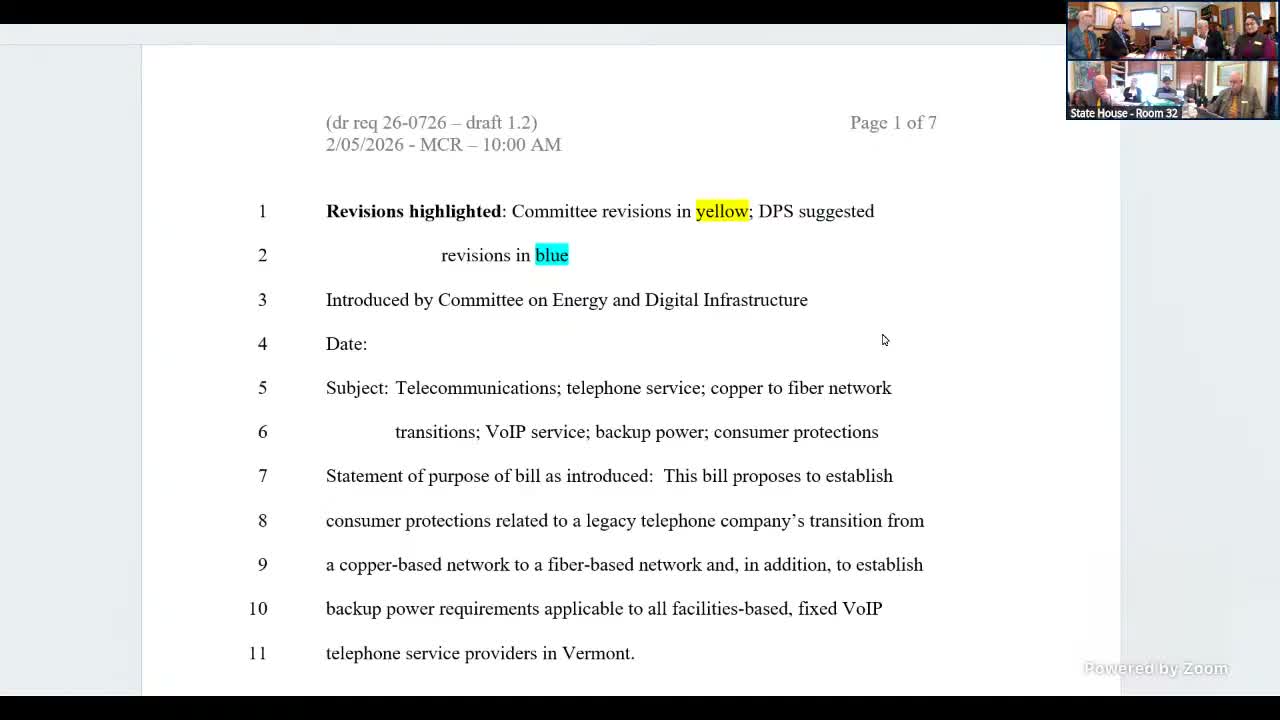
The House Energy and Digital Infrastructure committee on Feb. 5 reviewed draft 1.2 of committee bill DR260726, a measure aimed at steering how telecommunications providers notify customers and regulators when network infrastructure moves from copper-based to fiber-based systems.
The draft would require carriers to send a written notice by first-class mail and by electronic mail, and to notify both the Commissioner of Public Service and the 911 board before a transition, Maria Royal, legislative counsel, told the committee. "This is concerning the transition from a copper based network to a fiber based network," Royal said, describing the bill's revisions and the color-coded draft that incorporates committee and Department of Public Service (DPS) suggestions.
Why it matters: Committee members said the changes may affect consumer access to voice service, emergency-911 reliability, and the state’s ability to monitor vulnerabilities as providers move customers to fixed VoIP or other replacement voice services. Jim Porter, director for public advocacy at the Department of Public Service, said Vermont "sort of has gone all in on fiber to the home," while Daniel Burke, staff attorney and hearing officer at the Public Utility Commission (PUC), warned the legal overlap of federal and state authority is complex. "It is my interpretation of the relevant law that regardless of what has been filed and approved by the FCC, Consolidated must provide voice service in those exchanges on a stand alone basis to its customers," Burke said.
What the bill would require: The draft clarifies notice contents (expected transition date; the impact on the customer’s service; whether a reasonably comparable replacement service will be offered and the general terms), recommends that carriers inform customers to test auxiliary telephony-dependent devices (for example, medical-alert systems) for compatibility with replacement VoIP service, and would make certain reporting available to the DPS for monitoring. Royal said the draft replaces some prescriptive technical-support requirements with informational disclosures.
Timing and notice windows were a central debate. DPS staff suggested changing the current 90/60/30-day notice sequence to a 120-and-30-day model; some members preferred 120/60/30 or keeping the original staggered notices so customers have adequate lead time before a final 30-day notice.
Backup power and data collection: The draft would ask carriers to report annually if they sell battery-backup systems to customers and to disclose any known incidents where 911 access was impaired due to lack of backup power. Several legislators cautioned that such carrier-supplied sales data would be incomplete — customers can buy batteries elsewhere — but others argued the information could help DPS identify areas prone to extended outages. One committee member who disclosed a board role with the Vermont Community Broadband Board said the data can reveal vulnerability trends even if incomplete.
Enforcement and monitoring: DPS recommended striking a proposed monitoring subsection, but the draft includes language directing the Commissioner to review outage reports submitted to 911 and DPS telecom-availability data to identify locations especially prone to carrier or power outages and potential extended loss of 911 access. Committee members discussed how prescriptive the statute should be versus allowing DPS flexibility in what it reviews.
State vs. federal filings and Consolidated: Committee members pressed PUC and DPS staff about recent filings by Consolidated seeking relief from legacy/TDM obligations in specific exchanges. PUC staff said some Consolidated filings have been made to the FCC and that, to date, Consolidated remains subject to its federal ETC designation and its state incentive regulation plan (IRP). Staff also noted filing irregularities (one filing was routed incorrectly and not received by the PUC clerks). The committee discussed whether an FCC approval could preempt state authority and whether the PUC should open an investigation to seek sworn answers from Consolidated about intentions and obligations.
Scope and affected customers: PUC staff reported an estimate — relayed to the committee by DPS/PUC speakers — that roughly 3,000 customers statewide may remain copper customers with no other options after the current buildout. Legislators flagged that number as a reason to maintain monitoring and consumer-protection tools for vulnerable areas.
Next steps: Maria Royal will prepare and post a new draft for the committee; members were told the committee expects to vote on DR260726 next week. The committee also plans additional hearings on related issues (net metering, disconnections, and data centers).
The committee did not take any formal vote during this session; several issues remained "to be determined" in the draft, including exact notice windows, any mandatory backup-power obligations, and the final scope of DPS monitoring.
The draft would require carriers to send a written notice by first-class mail and by electronic mail, and to notify both the Commissioner of Public Service and the 911 board before a transition, Maria Royal, legislative counsel, told the committee. "This is concerning the transition from a copper based network to a fiber based network," Royal said, describing the bill's revisions and the color-coded draft that incorporates committee and Department of Public Service (DPS) suggestions.
Why it matters: Committee members said the changes may affect consumer access to voice service, emergency-911 reliability, and the state’s ability to monitor vulnerabilities as providers move customers to fixed VoIP or other replacement voice services. Jim Porter, director for public advocacy at the Department of Public Service, said Vermont "sort of has gone all in on fiber to the home," while Daniel Burke, staff attorney and hearing officer at the Public Utility Commission (PUC), warned the legal overlap of federal and state authority is complex. "It is my interpretation of the relevant law that regardless of what has been filed and approved by the FCC, Consolidated must provide voice service in those exchanges on a stand alone basis to its customers," Burke said.
What the bill would require: The draft clarifies notice contents (expected transition date; the impact on the customer’s service; whether a reasonably comparable replacement service will be offered and the general terms), recommends that carriers inform customers to test auxiliary telephony-dependent devices (for example, medical-alert systems) for compatibility with replacement VoIP service, and would make certain reporting available to the DPS for monitoring. Royal said the draft replaces some prescriptive technical-support requirements with informational disclosures.
Timing and notice windows were a central debate. DPS staff suggested changing the current 90/60/30-day notice sequence to a 120-and-30-day model; some members preferred 120/60/30 or keeping the original staggered notices so customers have adequate lead time before a final 30-day notice.
Backup power and data collection: The draft would ask carriers to report annually if they sell battery-backup systems to customers and to disclose any known incidents where 911 access was impaired due to lack of backup power. Several legislators cautioned that such carrier-supplied sales data would be incomplete — customers can buy batteries elsewhere — but others argued the information could help DPS identify areas prone to extended outages. One committee member who disclosed a board role with the Vermont Community Broadband Board said the data can reveal vulnerability trends even if incomplete.
Enforcement and monitoring: DPS recommended striking a proposed monitoring subsection, but the draft includes language directing the Commissioner to review outage reports submitted to 911 and DPS telecom-availability data to identify locations especially prone to carrier or power outages and potential extended loss of 911 access. Committee members discussed how prescriptive the statute should be versus allowing DPS flexibility in what it reviews.
State vs. federal filings and Consolidated: Committee members pressed PUC and DPS staff about recent filings by Consolidated seeking relief from legacy/TDM obligations in specific exchanges. PUC staff said some Consolidated filings have been made to the FCC and that, to date, Consolidated remains subject to its federal ETC designation and its state incentive regulation plan (IRP). Staff also noted filing irregularities (one filing was routed incorrectly and not received by the PUC clerks). The committee discussed whether an FCC approval could preempt state authority and whether the PUC should open an investigation to seek sworn answers from Consolidated about intentions and obligations.
Scope and affected customers: PUC staff reported an estimate — relayed to the committee by DPS/PUC speakers — that roughly 3,000 customers statewide may remain copper customers with no other options after the current buildout. Legislators flagged that number as a reason to maintain monitoring and consumer-protection tools for vulnerable areas.
Next steps: Maria Royal will prepare and post a new draft for the committee; members were told the committee expects to vote on DR260726 next week. The committee also plans additional hearings on related issues (net metering, disconnections, and data centers).
The committee did not take any formal vote during this session; several issues remained "to be determined" in the draft, including exact notice windows, any mandatory backup-power obligations, and the final scope of DPS monitoring.
View the Full Meeting & All Its Details
This article offers just a summary. Unlock complete video, transcripts, and insights as a Founder Member.
✓
Watch full, unedited meeting videos
✓
Search every word spoken in unlimited transcripts
✓
AI summaries & real-time alerts (all government levels)
✓
Permanent access to expanding government content
30-day money-back guarantee
