CTC approves freight‑charging site move to Tracy; pavement design dispute raised for SR‑99 Tulare baseline
February 01, 2026 | Transportation Commission, Agencies under Office of the Governor, Executive, California
This article was created by AI summarizing key points discussed. AI makes mistakes, so for full details and context, please refer to the video of the full meeting. Please report any errors so we can fix them. Report an error »
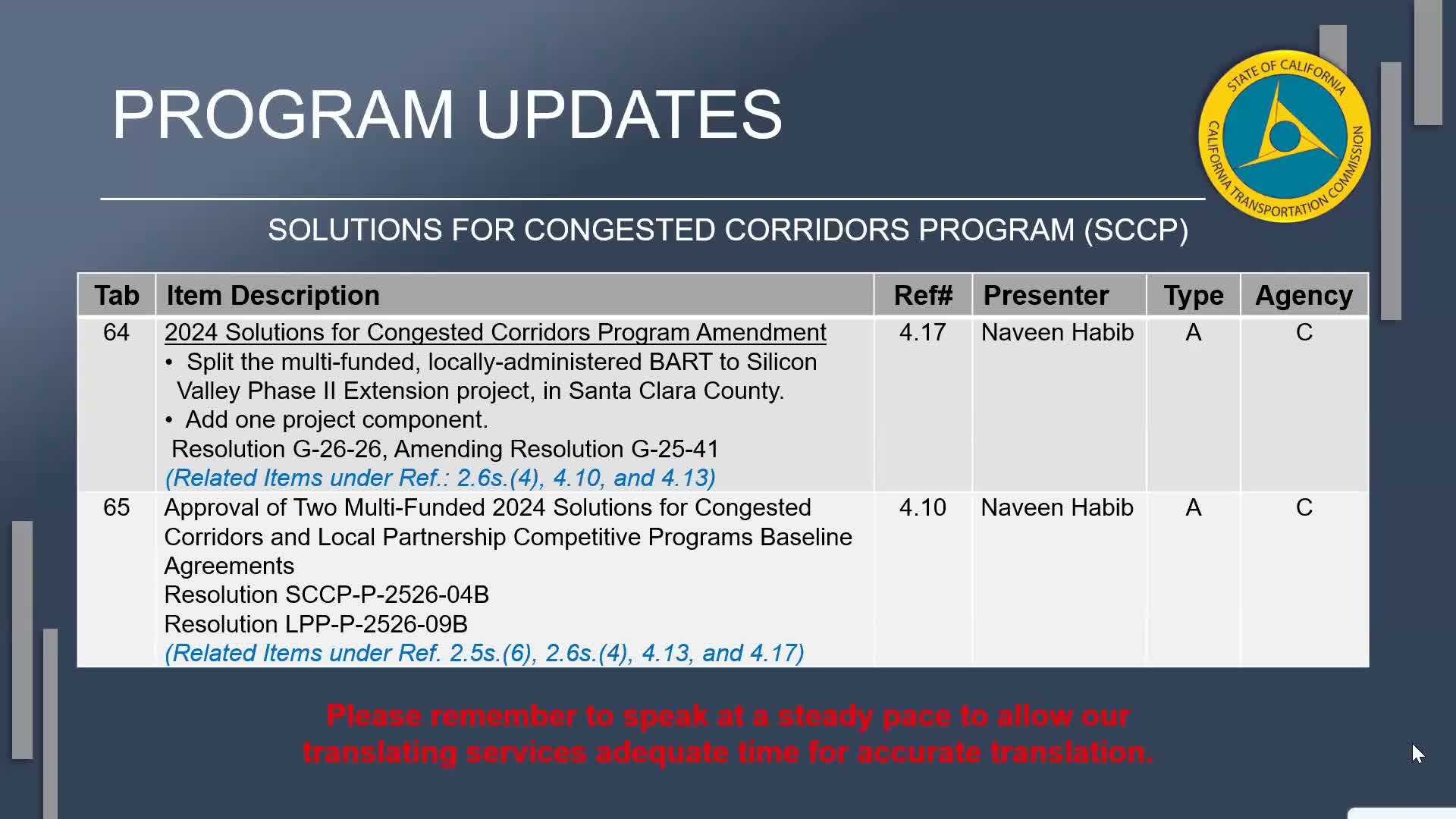
The Transportation Commission approved Tab 66 and Tab 67, which include a scope amendment to relocate a freight logistics megawatt charging station and a set of baseline agreements for Trade Corridor Enhancement Program projects. At the same time, a public commenter raised technical objections about pavement‑type selection on the SR‑99 Tulare improvement baseline agreement.
Beverly, presenting Tabs 66–67, said Caltrans and Prologis Mobility proposed relocating a medium and heavy‑duty zero‑emission charging station from an infeasible site in Hayward (Alameda County) to a cleared site in Tracy (San Joaquin County) near the junction of Interstates 205, 580 and 5. The change, she said, would increase project throughput and use megawatt charging and combined charging system standards to speed truck charging. The new Tracy location lies in an industrial area about 1 mile from the nearest neighborhood; staff said there would be no negative impacts on historically impacted communities.
During online public comment, Charles Stewart of the Southwest Concrete Pavement Association asked the commission to hold the baseline agreement for the SR‑99 Tulare 6‑lane and Page Avenue interchange project, citing ambiguous life‑cycle cost analysis and a potential $40 million‑plus inefficiency resulting from a decision to use a 20‑year asphalt design rather than longer‑life concrete alternatives. "It appears the team is going with some variety of alternative 3 ... and we see a huge inefficiency here," Stewart said.
Michael Navarro, Caltrans District 6 director, responded that the project adds a median lane built in asphalt to match existing recently rehabilitated asphalt lanes and to avoid profile and long‑term pavement compatibility issues. Navarro said trucks would be prohibited from the new number‑one median lane and that matching the existing pavement life‑design was a strategic choice tied to system uniformity and federal grant match considerations.
Staff recommended approval of Tabs 66 and 67 (with a yellow replacement attachment correcting minor technical items). Commissioners approved the items after the exchange. The transcript records the public comment and staff reply on the record; the commission did not change the baseline agreement during the meeting.
Beverly, presenting Tabs 66–67, said Caltrans and Prologis Mobility proposed relocating a medium and heavy‑duty zero‑emission charging station from an infeasible site in Hayward (Alameda County) to a cleared site in Tracy (San Joaquin County) near the junction of Interstates 205, 580 and 5. The change, she said, would increase project throughput and use megawatt charging and combined charging system standards to speed truck charging. The new Tracy location lies in an industrial area about 1 mile from the nearest neighborhood; staff said there would be no negative impacts on historically impacted communities.
During online public comment, Charles Stewart of the Southwest Concrete Pavement Association asked the commission to hold the baseline agreement for the SR‑99 Tulare 6‑lane and Page Avenue interchange project, citing ambiguous life‑cycle cost analysis and a potential $40 million‑plus inefficiency resulting from a decision to use a 20‑year asphalt design rather than longer‑life concrete alternatives. "It appears the team is going with some variety of alternative 3 ... and we see a huge inefficiency here," Stewart said.
Michael Navarro, Caltrans District 6 director, responded that the project adds a median lane built in asphalt to match existing recently rehabilitated asphalt lanes and to avoid profile and long‑term pavement compatibility issues. Navarro said trucks would be prohibited from the new number‑one median lane and that matching the existing pavement life‑design was a strategic choice tied to system uniformity and federal grant match considerations.
Staff recommended approval of Tabs 66 and 67 (with a yellow replacement attachment correcting minor technical items). Commissioners approved the items after the exchange. The transcript records the public comment and staff reply on the record; the commission did not change the baseline agreement during the meeting.
Don't Miss a Word: See the Full Meeting!
Go beyond summaries. Unlock every video, transcript, and key insight with a Founder Membership.
✓
Get instant access to full meeting videos
✓
Search and clip any phrase from complete transcripts
✓
Receive AI-powered summaries & custom alerts
✓
Enjoy lifetime, unrestricted access to government data
30-day money-back guarantee
