CTC northern STIP hearing: staff says proposals exceed early‑year capacity; March adoption targeted
February 01, 2026 | Transportation Commission, Agencies under Office of the Governor, Executive, California
This article was created by AI summarizing key points discussed. AI makes mistakes, so for full details and context, please refer to the video of the full meeting. Please report any errors so we can fix them. Report an error »
The Transportation Commission held a northern informational hearing on the proposed 2026 State Transportation Improvement Program (STIP), where staff and regional agencies briefed commissioners and the public on project proposals and funding limits.
Sheila Ennis, acting program manager for STIP staff, summarized the schedule and constraints for the 2026 STIP, which covers five fiscal years. Ennis said the 2025 fund estimate identified roughly $952,000,000 in new programming capacity for the STIP; the combined RTIP and ITIP proposals in the hearing book total about $966,000,000, a gap of roughly $15,000,000. More materially for early years, Ennis said total proposals for the first three years exceed available capacity by approximately $333,000,000, meaning many projects proposed for the early years will likely shift into later years of the STIP cycle. Staff said the hearing book is a draft and that staff recommendations will be published no later than Feb. 27, 2026, ahead of a final adoption vote at the commission's March meeting in Los Angeles (virtual access available).
Caltrans presented the 2026 Interregional Transportation Improvement Program (ITIP). James Anderson, division chief for financial programming at Caltrans, said the ITIP supports the California Transportation Plan 2050 and the Interregional Transportation Strategic Plan (ITSP). Anderson reported about $169,000,000 in new ITIP capacity, noted Caltrans had requested roughly an additional $7.6 million (bringing the total ITIP capacity to about $176.7 million), and said about $61.2 million is available for programming new interregional projects; the remainder is reserved for cost updates and carryover work on existing ITIP projects. Caltrans also noted five new ITIP projects in 2026—including two passenger rail projects, one mass transit project, one active‑transportation project and one highway project—and encouraged proposers to request debriefs for projects not selected.
Regional agencies presented their RTIP packages and priorities. The Metropolitan Transportation Commission (MTC) said its nine‑county Bay Area region received about $141,000,000 in new capacity and proposed approximately $142,000,000 in programming, using reserve balances and prior unprogrammed funds to cover the difference; MTC highlighted $31,000,000 for BART Silicon Valley extension phase 2, a $4,000,000 procurement for zero‑emission buses for AC Transit, and multiple bicycle and pedestrian projects and corridor upgrades. The Sacramento Area Council of Governments (SACOG) tied its RTIP to a newly adopted long‑range plan and listed investments focused on pavement rehabilitation, safety and transit vehicle purchases. Smaller and rural agencies, including the Shasta Regional Transportation Agency and Lake Area Planning Council, emphasized safety, complete‑streets and freight resiliency projects.
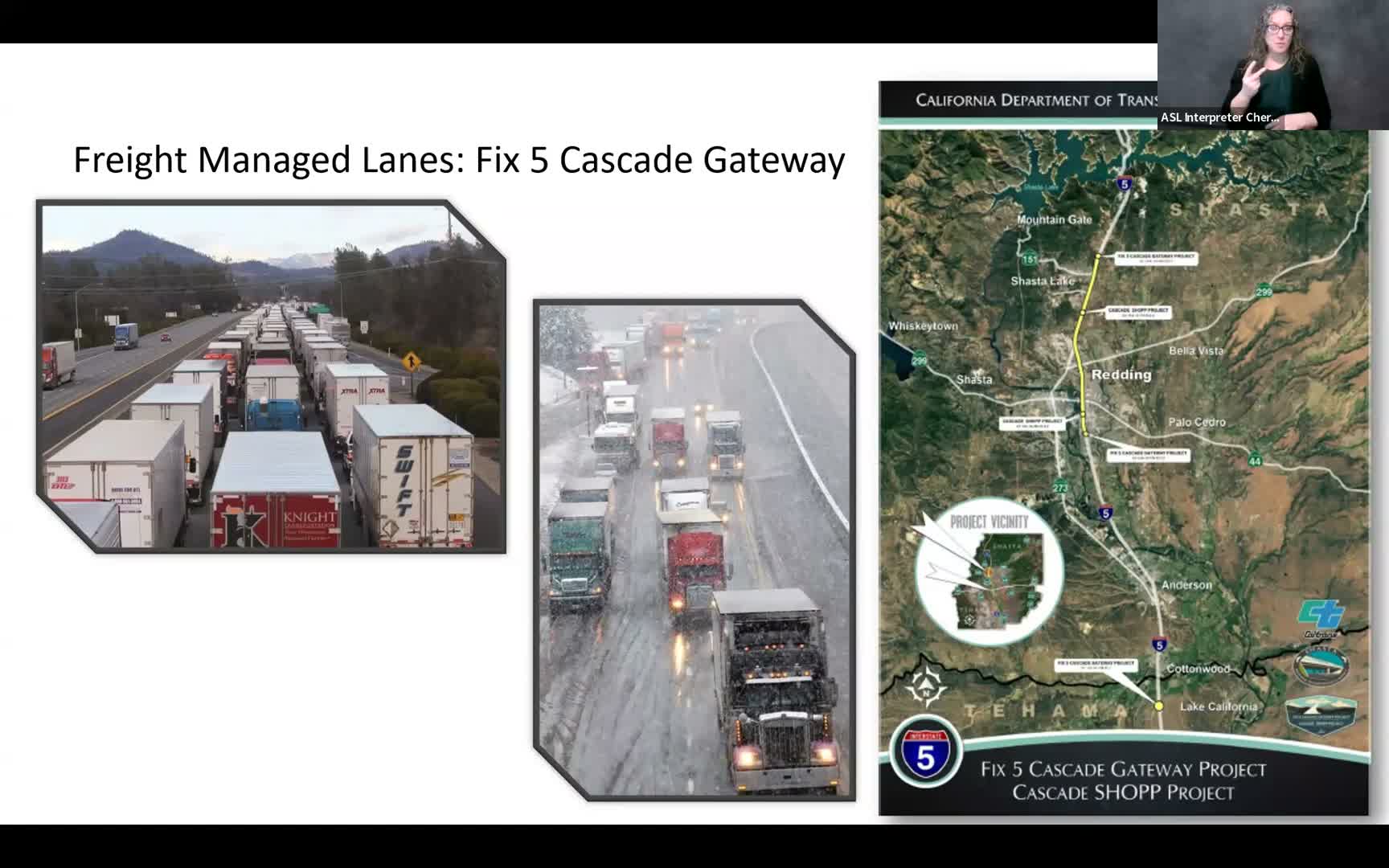
Shasta's executive director, Sean Tejian, described a freight managed‑lane concept for Interstate 5—roughly seven miles each direction of freight‑managed lanes with EV chargers and some lane conversions—framing it as a response to frequent storm‑related freight backups and local safety risks; Tejian said large assets such as the Pit River Bridge require federal and state partnership and cost estimates in the billions.
Public comment included Jeanne Wardwaller of Climate Plan, who commended the mix of active‑transportation and transit investments in the draft documents while warning that legacy highway projects remain and that Climate Plan will submit detailed written comments urging continued movement toward climate and equity objectives.
The commission did not take formal action at the hearing (the meeting was informational). Staff said they will incorporate hearing input, correct any errors in the compiled hearing book and publish formal staff recommendations on Feb. 27, 2026, before the March adoption meeting.
Sheila Ennis, acting program manager for STIP staff, summarized the schedule and constraints for the 2026 STIP, which covers five fiscal years. Ennis said the 2025 fund estimate identified roughly $952,000,000 in new programming capacity for the STIP; the combined RTIP and ITIP proposals in the hearing book total about $966,000,000, a gap of roughly $15,000,000. More materially for early years, Ennis said total proposals for the first three years exceed available capacity by approximately $333,000,000, meaning many projects proposed for the early years will likely shift into later years of the STIP cycle. Staff said the hearing book is a draft and that staff recommendations will be published no later than Feb. 27, 2026, ahead of a final adoption vote at the commission's March meeting in Los Angeles (virtual access available).
Caltrans presented the 2026 Interregional Transportation Improvement Program (ITIP). James Anderson, division chief for financial programming at Caltrans, said the ITIP supports the California Transportation Plan 2050 and the Interregional Transportation Strategic Plan (ITSP). Anderson reported about $169,000,000 in new ITIP capacity, noted Caltrans had requested roughly an additional $7.6 million (bringing the total ITIP capacity to about $176.7 million), and said about $61.2 million is available for programming new interregional projects; the remainder is reserved for cost updates and carryover work on existing ITIP projects. Caltrans also noted five new ITIP projects in 2026—including two passenger rail projects, one mass transit project, one active‑transportation project and one highway project—and encouraged proposers to request debriefs for projects not selected.
Regional agencies presented their RTIP packages and priorities. The Metropolitan Transportation Commission (MTC) said its nine‑county Bay Area region received about $141,000,000 in new capacity and proposed approximately $142,000,000 in programming, using reserve balances and prior unprogrammed funds to cover the difference; MTC highlighted $31,000,000 for BART Silicon Valley extension phase 2, a $4,000,000 procurement for zero‑emission buses for AC Transit, and multiple bicycle and pedestrian projects and corridor upgrades. The Sacramento Area Council of Governments (SACOG) tied its RTIP to a newly adopted long‑range plan and listed investments focused on pavement rehabilitation, safety and transit vehicle purchases. Smaller and rural agencies, including the Shasta Regional Transportation Agency and Lake Area Planning Council, emphasized safety, complete‑streets and freight resiliency projects.
Shasta's executive director, Sean Tejian, described a freight managed‑lane concept for Interstate 5—roughly seven miles each direction of freight‑managed lanes with EV chargers and some lane conversions—framing it as a response to frequent storm‑related freight backups and local safety risks; Tejian said large assets such as the Pit River Bridge require federal and state partnership and cost estimates in the billions.
Public comment included Jeanne Wardwaller of Climate Plan, who commended the mix of active‑transportation and transit investments in the draft documents while warning that legacy highway projects remain and that Climate Plan will submit detailed written comments urging continued movement toward climate and equity objectives.
The commission did not take formal action at the hearing (the meeting was informational). Staff said they will incorporate hearing input, correct any errors in the compiled hearing book and publish formal staff recommendations on Feb. 27, 2026, before the March adoption meeting.
View the Full Meeting & All Its Details
This article offers just a summary. Unlock complete video, transcripts, and insights as a Founder Member.
✓
Watch full, unedited meeting videos
✓
Search every word spoken in unlimited transcripts
✓
AI summaries & real-time alerts (all government levels)
✓
Permanent access to expanding government content
30-day money-back guarantee
