Shasta RTA outlines freight managed‑lane pilot concept to reduce storm backups and improve safety
February 01, 2026 | Transportation Commission, Agencies under Office of the Governor, Executive, California
This article was created by AI summarizing key points discussed. AI makes mistakes, so for full details and context, please refer to the video of the full meeting. Please report any errors so we can fix them. Report an error »
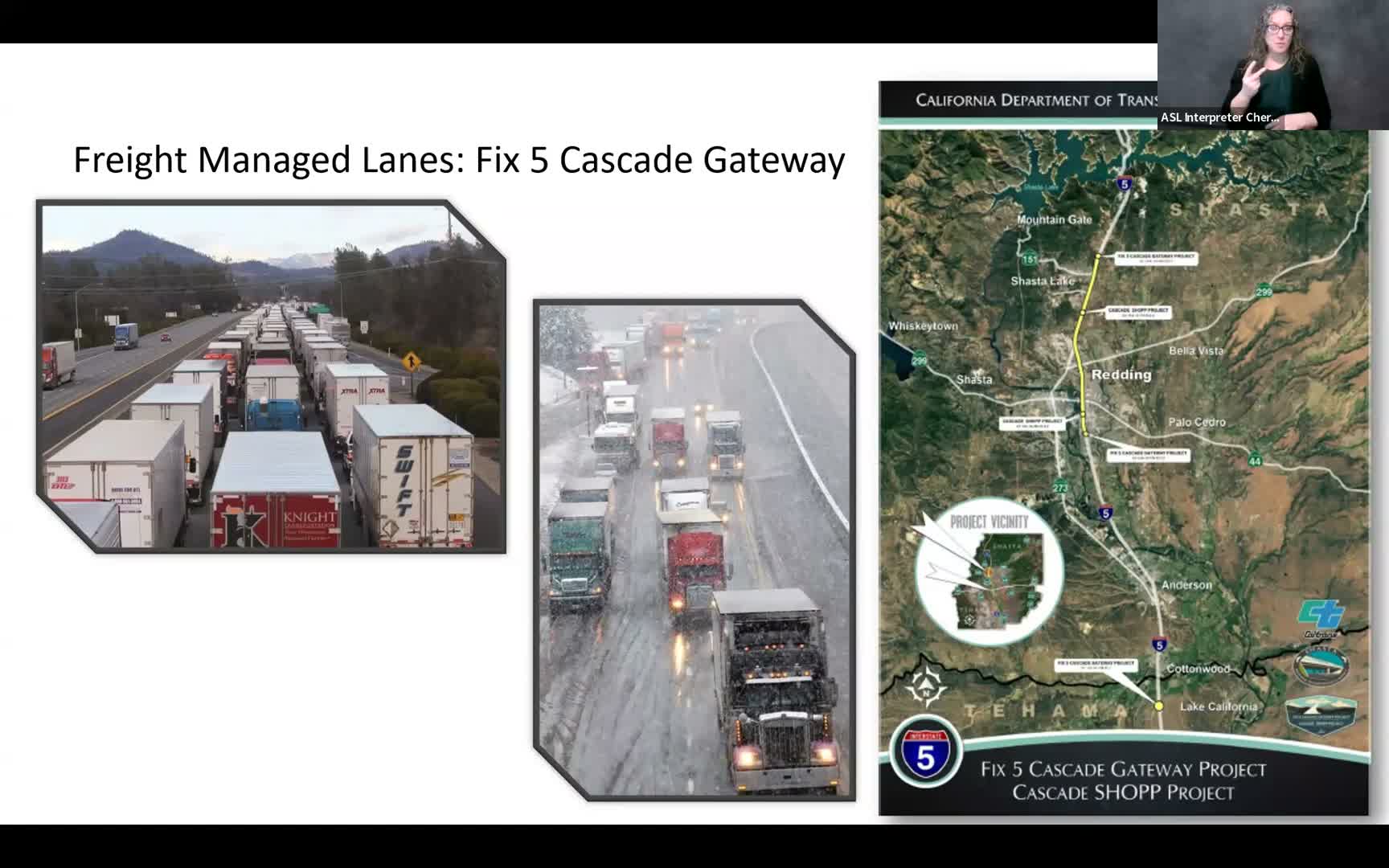
Sean Tejian, executive director of the Shasta Regional Transportation Agency, used the Northern STIP hearing to highlight the agency’s rural context and a freight‑focused suite of projects.
Tejian said Shasta County receives relatively small annual STIP allocations and must leverage partner funds. He presented local active‑transportation projects (Victor improvement, Butte Street Boogie) but focused on freight resiliency: recurring storm events cause freight backups of “as much as 15 to 18 miles,” Tejian said, and SRTA is proposing freight managed lanes on Interstate 5—about seven miles in each direction with some lane conversions, and two freight EV charging stations—to improve freight flow and safety. Tejian framed the proposal as innovative for Northern California, noted that some general‑purpose lanes would be converted and that the project would include both managed and newly created lane segments.
On large, multi‑jurisdictional work, Tejian highlighted the Pit River Bridge replacement as a federally owned, costly project (he estimated replacement in the billions) that will require federal, state and elected‑official partnerships. For the region’s STIP slate, Tejian described how limited STIP dollars are being used toward safety, accessibility and freight improvements, and said SRTA will coordinate with Caltrans district staff and others on implementation and potential multi‑state coordination.
Commissioners asked about timing, funding and whether coordination exists with Oregon and other partners; Tejian said he would consult district staff on interstate coordination and that the project would rely on a mix of STIP, SHOP, local, federal and congressional directed funds for implementation planning and initial phases.
Tejian said Shasta County receives relatively small annual STIP allocations and must leverage partner funds. He presented local active‑transportation projects (Victor improvement, Butte Street Boogie) but focused on freight resiliency: recurring storm events cause freight backups of “as much as 15 to 18 miles,” Tejian said, and SRTA is proposing freight managed lanes on Interstate 5—about seven miles in each direction with some lane conversions, and two freight EV charging stations—to improve freight flow and safety. Tejian framed the proposal as innovative for Northern California, noted that some general‑purpose lanes would be converted and that the project would include both managed and newly created lane segments.
On large, multi‑jurisdictional work, Tejian highlighted the Pit River Bridge replacement as a federally owned, costly project (he estimated replacement in the billions) that will require federal, state and elected‑official partnerships. For the region’s STIP slate, Tejian described how limited STIP dollars are being used toward safety, accessibility and freight improvements, and said SRTA will coordinate with Caltrans district staff and others on implementation and potential multi‑state coordination.
Commissioners asked about timing, funding and whether coordination exists with Oregon and other partners; Tejian said he would consult district staff on interstate coordination and that the project would rely on a mix of STIP, SHOP, local, federal and congressional directed funds for implementation planning and initial phases.
Don't Miss a Word: See the Full Meeting!
Go beyond summaries. Unlock every video, transcript, and key insight with a Founder Membership.
✓
Get instant access to full meeting videos
✓
Search and clip any phrase from complete transcripts
✓
Receive AI-powered summaries & custom alerts
✓
Enjoy lifetime, unrestricted access to government data
30-day money-back guarantee
