Planning commission forwards Coral Street overlay to council, urges lower height cap
February 07, 2026 | Santa Cruz City, Santa Cruz County, California
This article was created by AI summarizing key points discussed. AI makes mistakes, so for full details and context, please refer to the video of the full meeting. Please report any errors so we can fix them. Report an error »
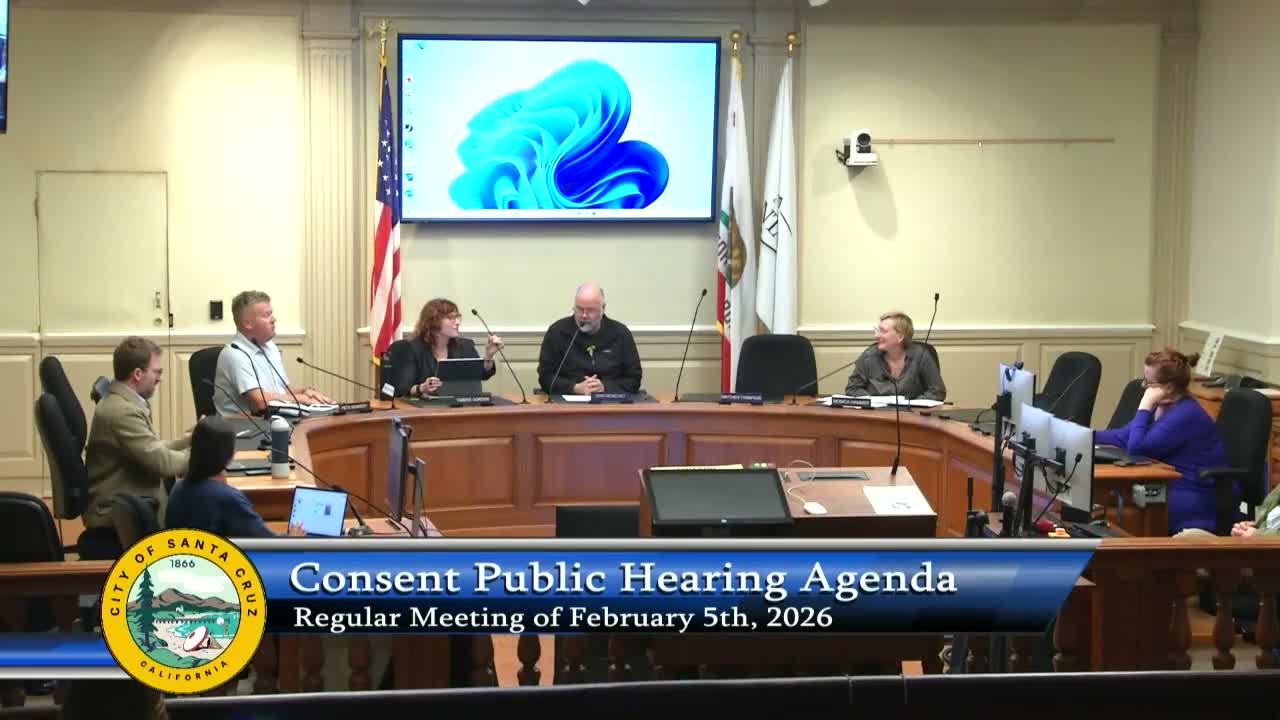
The City of Santa Cruz Planning Commission voted Feb. 5 to forward the Coral Street overlay rezoning to City Council with a recommendation that council consider lowering the maximum building height from eight stories to five.
Commissioners and staff framed the overlay as a planning tool to demonstrate capacity required by state law, not as a directive to immediately build shelter beds. Clara Stanger, senior planner, told the commission the staff estimate for the overlay area is 424 shelter beds — a capacity figure used to meet the state’s point‑in‑time unsheltered housing planning requirement. Staff said the state requires qualifying sites be zoned to allow that capacity as a principally permitted use but does not require immediate construction of those beds.
Debate at the dais focused on whether concentrating large numbers of shelter beds in the Coral Street area would worsen safety and segregation concerns. Commissioner Hammer cited experience with large public housing projects and referenced the Olmstead decision in arguing that concentrating vulnerable people in a single area can be legally and practically problematic. Hammer said she would only feel comfortable approving the recommendation if the height limit were reduced to five stories; commissioners discussed 55–60 feet as a typical five‑story height and noted that five‑ to six‑story mid‑rise buildings are more common for affordable projects.
Staff told the commission the eight‑story maximum reflects the Coral Street visioning report and provides flexibility should a developer propose a larger mid‑rise project, but added that typical affordable housing projects in the area have been five to six stories. Commissioners pressed staff on whether lower heights could still satisfy the state’s capacity demonstration; staff said the city must show sufficient qualifying sites and that future point‑in‑time counts could change the requirement.
After an initial 3–1 vote on the staff recommendation, the commission reconsidered and approved an amendment asking council to consider reducing the maximum from eight to five stories. Staff will note the 3–1 vote and the dissenting concerns in the report to council when the item goes for first reading on March 10.
The commission’s action is a recommendation to City Council; final zoning decisions and any ordinance text changes would be made by council at subsequent readings.
Commissioners and staff framed the overlay as a planning tool to demonstrate capacity required by state law, not as a directive to immediately build shelter beds. Clara Stanger, senior planner, told the commission the staff estimate for the overlay area is 424 shelter beds — a capacity figure used to meet the state’s point‑in‑time unsheltered housing planning requirement. Staff said the state requires qualifying sites be zoned to allow that capacity as a principally permitted use but does not require immediate construction of those beds.
Debate at the dais focused on whether concentrating large numbers of shelter beds in the Coral Street area would worsen safety and segregation concerns. Commissioner Hammer cited experience with large public housing projects and referenced the Olmstead decision in arguing that concentrating vulnerable people in a single area can be legally and practically problematic. Hammer said she would only feel comfortable approving the recommendation if the height limit were reduced to five stories; commissioners discussed 55–60 feet as a typical five‑story height and noted that five‑ to six‑story mid‑rise buildings are more common for affordable projects.
Staff told the commission the eight‑story maximum reflects the Coral Street visioning report and provides flexibility should a developer propose a larger mid‑rise project, but added that typical affordable housing projects in the area have been five to six stories. Commissioners pressed staff on whether lower heights could still satisfy the state’s capacity demonstration; staff said the city must show sufficient qualifying sites and that future point‑in‑time counts could change the requirement.
After an initial 3–1 vote on the staff recommendation, the commission reconsidered and approved an amendment asking council to consider reducing the maximum from eight to five stories. Staff will note the 3–1 vote and the dissenting concerns in the report to council when the item goes for first reading on March 10.
The commission’s action is a recommendation to City Council; final zoning decisions and any ordinance text changes would be made by council at subsequent readings.
View the Full Meeting & All Its Details
This article offers just a summary. Unlock complete video, transcripts, and insights as a Founder Member.
✓
Watch full, unedited meeting videos
✓
Search every word spoken in unlimited transcripts
✓
AI summaries & real-time alerts (all government levels)
✓
Permanent access to expanding government content
30-day money-back guarantee
