Agency of Agriculture lays out $61.19 million FY2027 request and proposes dropping dairy water‑quality fees
February 07, 2026 | Appropriations, HOUSE OF REPRESENTATIVES, Committees, Legislative , Vermont
This article was created by AI summarizing key points discussed. AI makes mistakes, so for full details and context, please refer to the video of the full meeting. Please report any errors so we can fix them. Report an error »
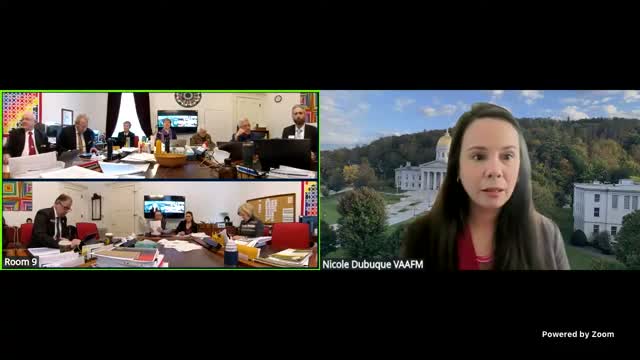
Anson Tebets, secretary of agriculture, food and markets, told the House Appropriations Committee on Feb. 6 that the governor's recommended FY2027 budget for the Agency of Agriculture, Food and Markets is $61,190,000. "Our recommended budget from the governor, for FY 2027, it's 61,190,000.00," Tebets said, summarizing the agency's request and funding mix of federal, transfer, general and special funds.
Tebets said the overall package is largely level‑funded but contains targeted changes to address current pressures on producers. The agency is proposing to eliminate annual water‑quality fees for dairy farms — fees that historically have been charged at $2,500 for large farms and $1,500 for medium farms — and to replace those fees with general fund dollars. "What the governor and we're all proposing is that we drop the fees. This will benefit about a 131 farmers, and we replace these fees, with general fund dollars," Tebets said, estimating the state cost at $231,500 per year while stressing that agency programming and staffing levels for water quality work would remain unchanged.
The committee pressed agency staff on recent federal funding changes. Tebets said two federal awards ended in the previous year: the Local Food Systems and Schools grant (about $300,000) and the Local Food Purchase Assistance grant (about $500,000). He added that the department had not heard of additional federal discontinuations since those awards were removed.
Nicole Dubuque, operations director for the agency, described a shift in how the agency administers the Dairy Business Innovation Center (DBIC), a USDA multi‑state program managed from Vermont. "We have to already, by USDA standards, put 50% of our funding out in grants direct to dairy businesses," Dubuque said, explaining that the program has moved from contracting assessments to allocating more dollars directly to processors and farms. The agency said average DBIC grants have been roughly $85,000 and that award decisions are competitive across the Northeast.
Committee members asked whether moving away from contracts would reduce opportunities for firms that previously carried out assessments. Tebets and Dubuque said many earlier contracts were one‑time assessments whose findings now guide grant priorities; some recurring technical assistance agreements (for example, earlier grazing cohorts run with University of Vermont Extension) have ended as projects reached their conclusions.
On staffing, Tebets said the governor's recommendation includes one new business‑office position to ensure timely processing and management of increased federal and grant funds. Separately, Dubuque told members Vermont is one of eight states lined up for a USDA block grant to manage severe‑weather losses from 2023–24; the state share is about $31,750,000 and the agency anticipates five limited‑service positions to process and oversee that program if it is finalized.
Agency staff also reviewed performance measures across divisions, noting produce safety, working lands and DBIC outcomes, and flagged a roughly $30,000 reduction in a produce safety technical assistance grant related to FDA funding that will reduce certain extension payments while inspections and in‑state technical assistance continue.
Committee members asked clarifying questions about special funds, lab capacity in Randolph, and how clean water grants are administered; staff said most special funds ("at least a dozen, maybe 15," by one estimate) have positive balances and that the Clean Water Board allocates surcharge dollars from the property transfer tax through a public process.
The committee recessed briefly after the presentation and questions. The Appropriations Committee will continue its review of FY2027 requests in the coming weeks as it considers funding priorities across state government.
Tebets said the overall package is largely level‑funded but contains targeted changes to address current pressures on producers. The agency is proposing to eliminate annual water‑quality fees for dairy farms — fees that historically have been charged at $2,500 for large farms and $1,500 for medium farms — and to replace those fees with general fund dollars. "What the governor and we're all proposing is that we drop the fees. This will benefit about a 131 farmers, and we replace these fees, with general fund dollars," Tebets said, estimating the state cost at $231,500 per year while stressing that agency programming and staffing levels for water quality work would remain unchanged.
The committee pressed agency staff on recent federal funding changes. Tebets said two federal awards ended in the previous year: the Local Food Systems and Schools grant (about $300,000) and the Local Food Purchase Assistance grant (about $500,000). He added that the department had not heard of additional federal discontinuations since those awards were removed.
Nicole Dubuque, operations director for the agency, described a shift in how the agency administers the Dairy Business Innovation Center (DBIC), a USDA multi‑state program managed from Vermont. "We have to already, by USDA standards, put 50% of our funding out in grants direct to dairy businesses," Dubuque said, explaining that the program has moved from contracting assessments to allocating more dollars directly to processors and farms. The agency said average DBIC grants have been roughly $85,000 and that award decisions are competitive across the Northeast.
Committee members asked whether moving away from contracts would reduce opportunities for firms that previously carried out assessments. Tebets and Dubuque said many earlier contracts were one‑time assessments whose findings now guide grant priorities; some recurring technical assistance agreements (for example, earlier grazing cohorts run with University of Vermont Extension) have ended as projects reached their conclusions.
On staffing, Tebets said the governor's recommendation includes one new business‑office position to ensure timely processing and management of increased federal and grant funds. Separately, Dubuque told members Vermont is one of eight states lined up for a USDA block grant to manage severe‑weather losses from 2023–24; the state share is about $31,750,000 and the agency anticipates five limited‑service positions to process and oversee that program if it is finalized.
Agency staff also reviewed performance measures across divisions, noting produce safety, working lands and DBIC outcomes, and flagged a roughly $30,000 reduction in a produce safety technical assistance grant related to FDA funding that will reduce certain extension payments while inspections and in‑state technical assistance continue.
Committee members asked clarifying questions about special funds, lab capacity in Randolph, and how clean water grants are administered; staff said most special funds ("at least a dozen, maybe 15," by one estimate) have positive balances and that the Clean Water Board allocates surcharge dollars from the property transfer tax through a public process.
The committee recessed briefly after the presentation and questions. The Appropriations Committee will continue its review of FY2027 requests in the coming weeks as it considers funding priorities across state government.
View the Full Meeting & All Its Details
This article offers just a summary. Unlock complete video, transcripts, and insights as a Founder Member.
✓
Watch full, unedited meeting videos
✓
Search every word spoken in unlimited transcripts
✓
AI summaries & real-time alerts (all government levels)
✓
Permanent access to expanding government content
30-day money-back guarantee
