Committee considers H628 to let judges order continued household payments and to include defendants under DOC supervision in RFAs
February 07, 2026 | Judiciary, HOUSE OF REPRESENTATIVES, Committees, Legislative , Vermont
This article was created by AI summarizing key points discussed. AI makes mistakes, so for full details and context, please refer to the video of the full meeting. Please report any errors so we can fix them. Report an error »
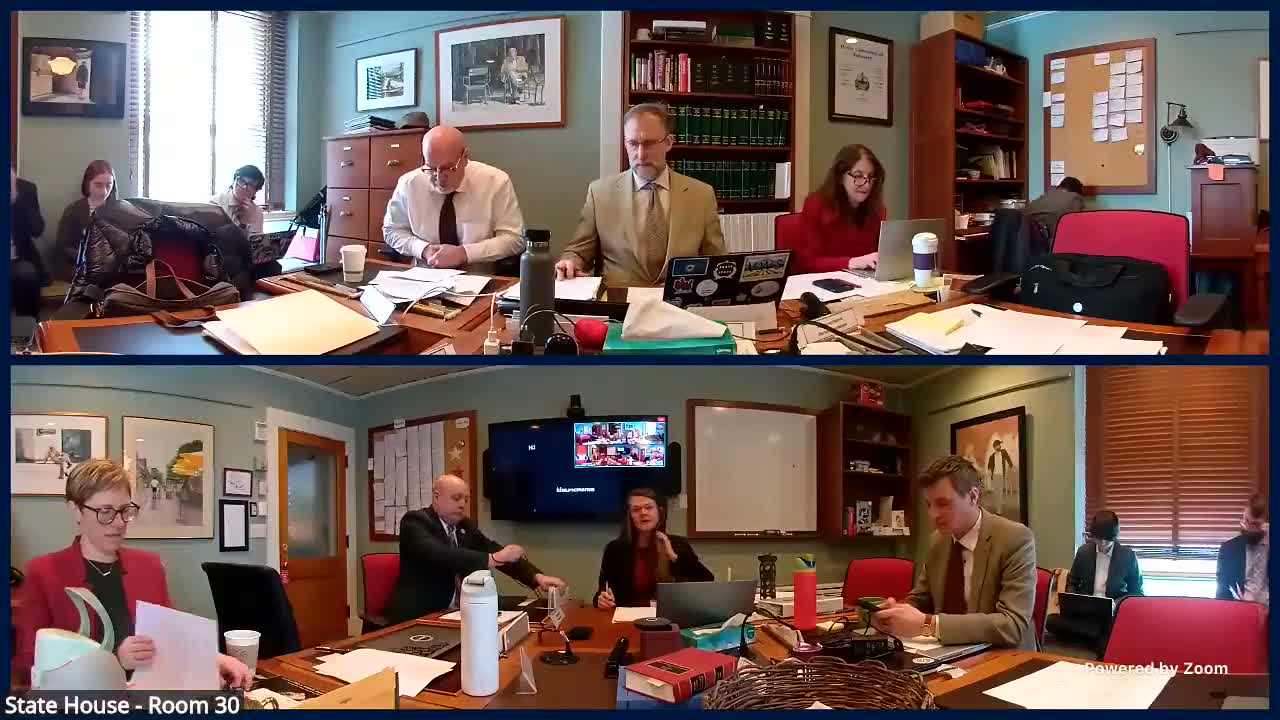
Michelle Childs of the Office of Legislative Council told the committee H628 would amend Title 15 (abuse prevention, civil protection orders) by changing part of section 11o3 and adding a new subdivision. Under current law, one path to a final relief‑from‑abuse (RFA) order applies when a defendant is "currently incarcerated" for certain offenses; H628 would replace that phrase with "currently under the supervision of the Department of Corrections," which would include people on parole or probation. Childs said the bill does not change temporary emergency orders.
Charley Lisserman, policy director for the Vermont Network Against Domestic and [censored] Violence, testified the revision closes a practical gap: plea agreements and short sentences can leave survivors at risk even when a defendant is not jailed but is supervised in the community. Lisserman said the proposal would ensure survivors can access civil protections when the underlying conduct was severe or recent.
The bill also adds a new discretionary condition of relief (subdivision f) that would allow a judge to order a defendant to continue paying household bills for which the defendant was responsible at the time the plaintiff requested the order, for a fixed period. Witnesses and staff contrasted subdivision f with existing subdivision e: e requires the court to find a legal "duty to support" the plaintiff and caps payments at three months, while f targets previously agreed financial arrangements (for example, an ongoing mortgage split) and does not include the same three‑month cap or duty‑to‑support requirement.
Edward Paul, director of the Vermont Network’s legal clinic, said in practice subdivision e is rarely used and that practitioners encounter many cases where shared household payments stop when a plaintiff files an RFA. Paul and Lisserman described how abrupt loss of bill payments can leave survivors unable to pay rent or utilities, damaging credit or housing stability precisely when they need safety and stability.
Kim McDonough of the Department of State’s Attorneys and Sheriffs told the committee economic abuse is a common control tactic. McDonough emphasized that "duty to support" is a legal standard, not a moral one, and that subdivision f would better capture situations where victims lack access to billing and need continued payments to remain housed and safe.
Committee members asked about whether the proposed "under supervision" language should be explicitly tied to a relevant conviction (so the supervision is for one of the listed violent offenses). Staff and witnesses said that in practice the supervision is typically linked to the underlying conviction, and members discussed clarifying the draft language to reflect that. No vote on H628 occurred in this session; staff said they would consider suggested clarifications and potential additional witnesses (including a zone judge) for follow-up.
The committee moved on after hearing testimony, leaving the bill open for further drafting and potential amendment.
Charley Lisserman, policy director for the Vermont Network Against Domestic and [censored] Violence, testified the revision closes a practical gap: plea agreements and short sentences can leave survivors at risk even when a defendant is not jailed but is supervised in the community. Lisserman said the proposal would ensure survivors can access civil protections when the underlying conduct was severe or recent.
The bill also adds a new discretionary condition of relief (subdivision f) that would allow a judge to order a defendant to continue paying household bills for which the defendant was responsible at the time the plaintiff requested the order, for a fixed period. Witnesses and staff contrasted subdivision f with existing subdivision e: e requires the court to find a legal "duty to support" the plaintiff and caps payments at three months, while f targets previously agreed financial arrangements (for example, an ongoing mortgage split) and does not include the same three‑month cap or duty‑to‑support requirement.
Edward Paul, director of the Vermont Network’s legal clinic, said in practice subdivision e is rarely used and that practitioners encounter many cases where shared household payments stop when a plaintiff files an RFA. Paul and Lisserman described how abrupt loss of bill payments can leave survivors unable to pay rent or utilities, damaging credit or housing stability precisely when they need safety and stability.
Kim McDonough of the Department of State’s Attorneys and Sheriffs told the committee economic abuse is a common control tactic. McDonough emphasized that "duty to support" is a legal standard, not a moral one, and that subdivision f would better capture situations where victims lack access to billing and need continued payments to remain housed and safe.
Committee members asked about whether the proposed "under supervision" language should be explicitly tied to a relevant conviction (so the supervision is for one of the listed violent offenses). Staff and witnesses said that in practice the supervision is typically linked to the underlying conviction, and members discussed clarifying the draft language to reflect that. No vote on H628 occurred in this session; staff said they would consider suggested clarifications and potential additional witnesses (including a zone judge) for follow-up.
The committee moved on after hearing testimony, leaving the bill open for further drafting and potential amendment.
View the Full Meeting & All Its Details
This article offers just a summary. Unlock complete video, transcripts, and insights as a Founder Member.
✓
Watch full, unedited meeting videos
✓
Search every word spoken in unlimited transcripts
✓
AI summaries & real-time alerts (all government levels)
✓
Permanent access to expanding government content
30-day money-back guarantee
