Fairfax planning commissioners review draft Urban Forest Master Plan, counsel staff on priorities
December 08, 2025 | Fairfax City, Fairfax County, Virginia
This article was created by AI summarizing key points discussed. AI makes mistakes, so for full details and context, please refer to the video of the full meeting. Please report any errors so we can fix them. Report an error »
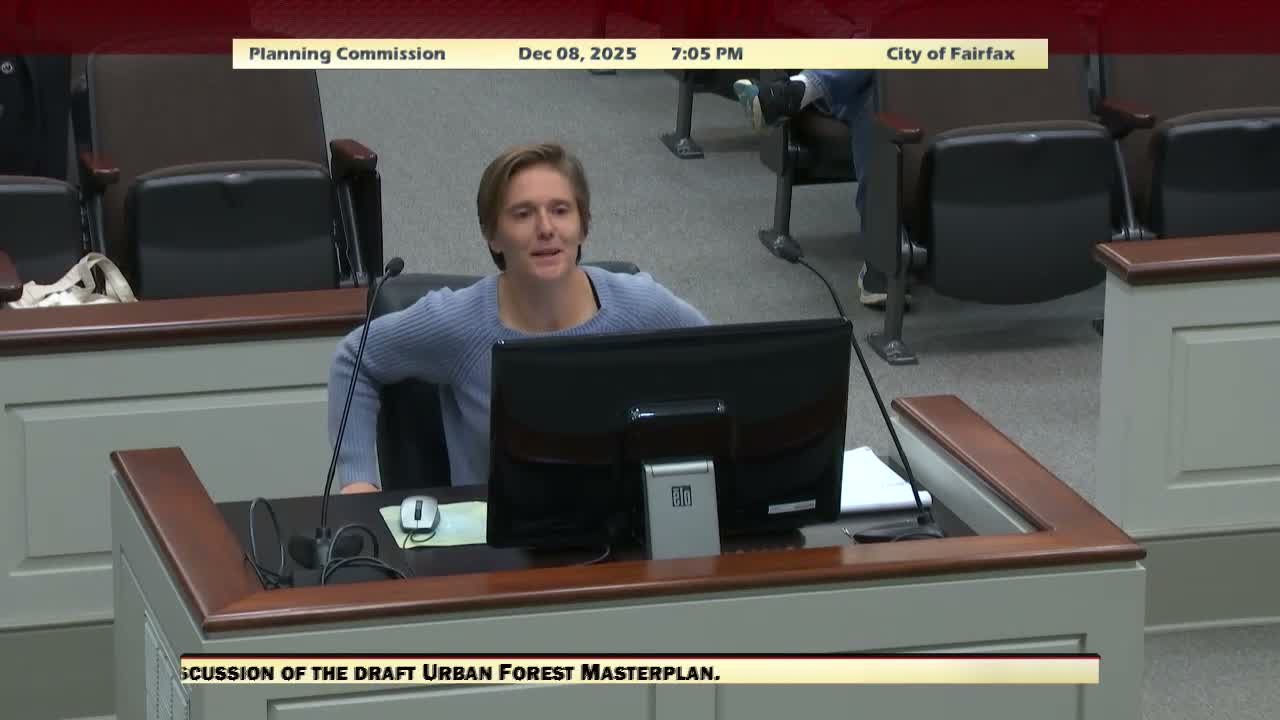
Miss Safford, the city’s urban forester, presented the draft Urban Forest Master Plan to the Fairfax City Planning Commission on Dec. 8, outlining project status, benchmarks and next steps and asking for commission feedback before a planned City Council public hearing in late January.
The plan, Safford said, is built on a 2021 tree canopy assessment and i-Tree analysis and frames work around five objectives — protect, regulate, grow, manage and engage — with short-, medium- and long-term actions. "Fairfax's Urban Forest removes 31 tons of air pollutants, sequesters 66,000 tons of carbon, and prevents 20,000,000 gallons of stormwater from entering our stormwater system each year," Safford said, noting the dollar value of those benefits is an approximate figure derived from the i-Tree tool and the city’s 2021 canopy data.
Commissioners welcomed the plan’s engagement-centered approach but repeatedly flagged capacity and funding constraints. Safford told the commission that Fairfax employs three certified arborists and operates with substantially lower staff capacity and budget compared with peer cities, and that the plan therefore recommends creating an urban forestry division in roughly a 1–5 year timeframe to coordinate work and pursue sustainable funding.
Several commissioners pressed staff on how to increase canopy on private property. Safford pointed to existing tools — a stormwater utility credit for private tree planting and periodic tree giveaways — and described recommended positions (an urban forester role and a stewardship coordinator) to expand education, permit review and volunteer programming. She also urged regional coordination on imagery and monitoring, noting high costs for frequent high-resolution imagery and recommending partnership with neighboring jurisdictions.
The draft links 12 KPIs to three overarching goals: build a resilient and equitable urban forest, increase capacity to care for trees, and strengthen community involvement. Safford proposed annual "state of the urban forest" reports and formal five-year plan reviews to track progress and recalibrate actions.
Next steps: Safford said staff will incorporate the Planning Commission’s feedback and council comments into a final draft, with an anticipated City Council public hearing tentatively scheduled for Jan. 27 and a finalization goal in early 2026.
Why it matters: The plan bundles technical metrics, community priorities and operational recommendations into a roadmap the city can use to guide planting, maintenance and policy decisions; commissioners emphasized that limited staff and budget will require prioritizing low‑cost, high‑impact actions first.
The plan, Safford said, is built on a 2021 tree canopy assessment and i-Tree analysis and frames work around five objectives — protect, regulate, grow, manage and engage — with short-, medium- and long-term actions. "Fairfax's Urban Forest removes 31 tons of air pollutants, sequesters 66,000 tons of carbon, and prevents 20,000,000 gallons of stormwater from entering our stormwater system each year," Safford said, noting the dollar value of those benefits is an approximate figure derived from the i-Tree tool and the city’s 2021 canopy data.
Commissioners welcomed the plan’s engagement-centered approach but repeatedly flagged capacity and funding constraints. Safford told the commission that Fairfax employs three certified arborists and operates with substantially lower staff capacity and budget compared with peer cities, and that the plan therefore recommends creating an urban forestry division in roughly a 1–5 year timeframe to coordinate work and pursue sustainable funding.
Several commissioners pressed staff on how to increase canopy on private property. Safford pointed to existing tools — a stormwater utility credit for private tree planting and periodic tree giveaways — and described recommended positions (an urban forester role and a stewardship coordinator) to expand education, permit review and volunteer programming. She also urged regional coordination on imagery and monitoring, noting high costs for frequent high-resolution imagery and recommending partnership with neighboring jurisdictions.
The draft links 12 KPIs to three overarching goals: build a resilient and equitable urban forest, increase capacity to care for trees, and strengthen community involvement. Safford proposed annual "state of the urban forest" reports and formal five-year plan reviews to track progress and recalibrate actions.
Next steps: Safford said staff will incorporate the Planning Commission’s feedback and council comments into a final draft, with an anticipated City Council public hearing tentatively scheduled for Jan. 27 and a finalization goal in early 2026.
Why it matters: The plan bundles technical metrics, community priorities and operational recommendations into a roadmap the city can use to guide planting, maintenance and policy decisions; commissioners emphasized that limited staff and budget will require prioritizing low‑cost, high‑impact actions first.
Don't Miss a Word: See the Full Meeting!
Go beyond summaries. Unlock every video, transcript, and key insight with a Founder Membership.
✓
Get instant access to full meeting videos
✓
Search and clip any phrase from complete transcripts
✓
Receive AI-powered summaries & custom alerts
✓
Enjoy lifetime, unrestricted access to government data
30-day money-back guarantee
