House committee debates sublease limits, tax changes in manufactured-housing bill
February 07, 2026 | General & Housing, HOUSE OF REPRESENTATIVES, Committees, Legislative , Vermont
This article was created by AI summarizing key points discussed. AI makes mistakes, so for full details and context, please refer to the video of the full meeting. Please report any errors so we can fix them. Report an error »
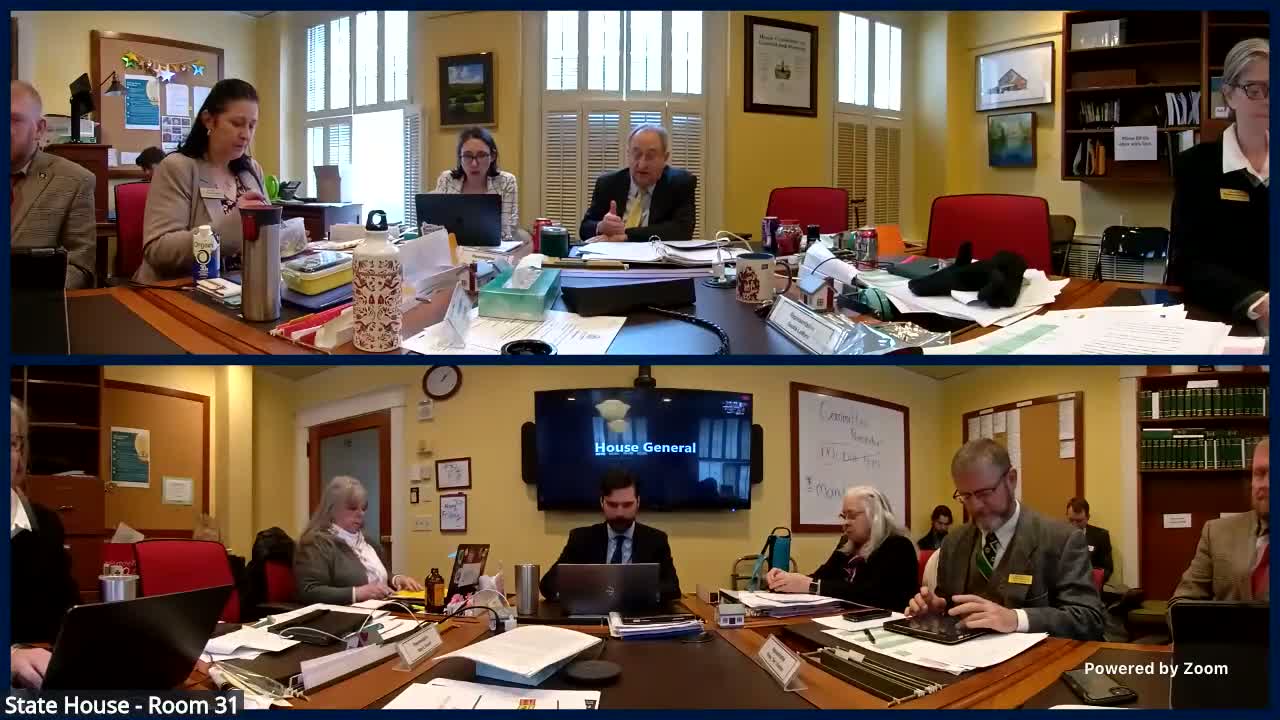
The Vermont House General & Housing Committee on Feb. 6 continued a detailed walkthrough of Act 857, a bill that would change how manufactured-home parks organized as limited-equity cooperatives (LECs) can handle subleases and tax treatment.
At issue was existing language in Subdivision 7 that caps a sublease payment at 110% of the proprietary-lease payment. Cameron Wood of the Office of Legislative Council told the committee the statutory text is ambiguous about whether that 110% limit applies only to the proprietary-lease component or to the total amount a sublessor may charge. "You can only pass that on to someone else at a 110%," Wood said when explaining the current statutory phrasing. The chair summarized the practical problem: if a resident owns a home and pays a mortgage while the cooperative owns the land, capping allowable sublease payments at 110% of lot rent can leave the homeowner unable to cover mortgage costs.
To address that, draft amendments under discussion would: 1) allow mobile-home parks organized as LECs to require subleases priced at applicable fair-market rent rather than a strict 110% ceiling; 2) add a narrowly tailored rule treating a mobile-home LEC as if it were incorporated as a state nonprofit for the limited purpose of applying for state funding and grants; and 3) convert some sales-and-use-tax treatment for manufactured housing into a property-transfer tax for all manufactured housing while retaining a narrow property-tax exemption for land owned by mobile-home LECs.
Counsel cautioned that LECs were created to serve low- and moderate-income residents and are not intended principally for subleasing. Members raised multiple drafting questions, including whether an alternative phrasing — "HUD fair-market rent or lot rent, whichever is greater" — might better allow owners to break even during temporary hardships. One member noted the hardship provision (allowing subleasing in limited circumstances) should not allow systematic conversion of the unit into market-rate housing that would undermine the cooperative's affordability purpose.
The committee also removed a previously proposed section addressing stormwater impact fees from the draft. Counsel said that provision overlapped the jurisdiction of the Environment Committee and risked bogging the bill down in cross-committee review.
On tax treatment, counsel explained the bill would change how manufactured homes are taxed at transfer and would include a narrowly tailored provision to exempt cooperative-owned common land from property tax because restrictions on transferability limit its market value. Members pressed for data on how much of a typical park’s value is in individual homes versus common land and asked staff to report figures (for example, sale prices ranging widely were discussed in committee) and to consult the Department of Housing and Community Development before further action.
The committee did not take final action on the bill on Feb. 6 and agreed to continue the discussion next week after staff provide additional fiscal and valuation data.
The chair said the committee will schedule follow-up and seeks information on: (1) the relative share of market value in houses versus common land in typical parks, and (2) how many parks would be affected by the nonprofit-equivalency language. Members emphasized balancing owner protections with preserving the affordability purpose of LECs.
At issue was existing language in Subdivision 7 that caps a sublease payment at 110% of the proprietary-lease payment. Cameron Wood of the Office of Legislative Council told the committee the statutory text is ambiguous about whether that 110% limit applies only to the proprietary-lease component or to the total amount a sublessor may charge. "You can only pass that on to someone else at a 110%," Wood said when explaining the current statutory phrasing. The chair summarized the practical problem: if a resident owns a home and pays a mortgage while the cooperative owns the land, capping allowable sublease payments at 110% of lot rent can leave the homeowner unable to cover mortgage costs.
To address that, draft amendments under discussion would: 1) allow mobile-home parks organized as LECs to require subleases priced at applicable fair-market rent rather than a strict 110% ceiling; 2) add a narrowly tailored rule treating a mobile-home LEC as if it were incorporated as a state nonprofit for the limited purpose of applying for state funding and grants; and 3) convert some sales-and-use-tax treatment for manufactured housing into a property-transfer tax for all manufactured housing while retaining a narrow property-tax exemption for land owned by mobile-home LECs.
Counsel cautioned that LECs were created to serve low- and moderate-income residents and are not intended principally for subleasing. Members raised multiple drafting questions, including whether an alternative phrasing — "HUD fair-market rent or lot rent, whichever is greater" — might better allow owners to break even during temporary hardships. One member noted the hardship provision (allowing subleasing in limited circumstances) should not allow systematic conversion of the unit into market-rate housing that would undermine the cooperative's affordability purpose.
The committee also removed a previously proposed section addressing stormwater impact fees from the draft. Counsel said that provision overlapped the jurisdiction of the Environment Committee and risked bogging the bill down in cross-committee review.
On tax treatment, counsel explained the bill would change how manufactured homes are taxed at transfer and would include a narrowly tailored provision to exempt cooperative-owned common land from property tax because restrictions on transferability limit its market value. Members pressed for data on how much of a typical park’s value is in individual homes versus common land and asked staff to report figures (for example, sale prices ranging widely were discussed in committee) and to consult the Department of Housing and Community Development before further action.
The committee did not take final action on the bill on Feb. 6 and agreed to continue the discussion next week after staff provide additional fiscal and valuation data.
The chair said the committee will schedule follow-up and seeks information on: (1) the relative share of market value in houses versus common land in typical parks, and (2) how many parks would be affected by the nonprofit-equivalency language. Members emphasized balancing owner protections with preserving the affordability purpose of LECs.
View the Full Meeting & All Its Details
This article offers just a summary. Unlock complete video, transcripts, and insights as a Founder Member.
✓
Watch full, unedited meeting videos
✓
Search every word spoken in unlimited transcripts
✓
AI summaries & real-time alerts (all government levels)
✓
Permanent access to expanding government content
30-day money-back guarantee
