Committee weighs H.757 changes to manufactured‑home transfers and subleasing rules for limited‑equity co‑ops
February 07, 2026 | General & Housing, HOUSE OF REPRESENTATIVES, Committees, Legislative , Vermont
This article was created by AI summarizing key points discussed. AI makes mistakes, so for full details and context, please refer to the video of the full meeting. Please report any errors so we can fix them. Report an error »
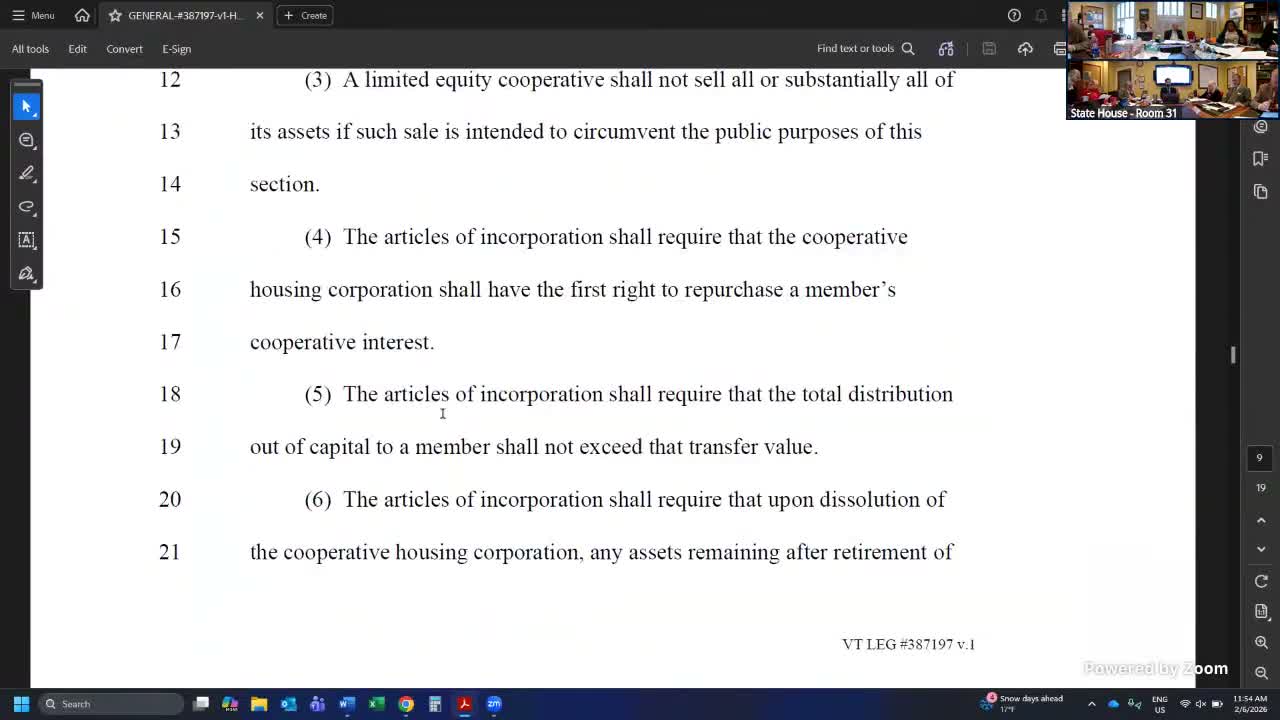
Members of the General & Housing committee on Feb. 6 spent several hours reviewing a revised strike‑all draft of H.757, a bill that would change how manufactured homes are defined, transferred and financed and would add new limits on subleasing in limited‑equity cooperatives (LECs) organized around mobile‑home parks. Counsel Cameron Wood, Office of Legislative Counsel, walked the committee through draft 1.1 and flagged several choices members must resolve before taking a vote.
The most immediate change in the draft would alter how permanently sited manufactured homes are handled when they are financed or sold. Current statute requires ("shall") that a manufactured home financed as real estate be transferred by deed; the draft would make that a permissive standard ("may") for some owner‑to‑owner transfers and add a new subsection preserving a homeowner’s ability to convey by bill of sale under section 2602. "If you change the law and allow us to do a bill of sale," counsel said, it would let dealers and lenders continue a common practice of converting a bill of sale into a warranty deed only when necessary, potentially reducing transaction costs for some buyers.
At the same time, counsel and several members warned that removing the statutory deed template could reduce a modest but real consumer‑protection benefit. "A warranty deed shall, when duly executed and delivered, have the enforcement effect of a deed in fee simple to the grantee," Cameron Wood said while explaining the protections embedded in the current statutory form; other members said the written example helps non‑attorneys complete a transfer without legal counsel. Proponents of striking or revising the template said the form is rarely used by dealers or banks and proposed keeping it as an exemplar rather than mandatory text so the statute does not require an outdated form.
The committee then shifted to changes in Title 11 that affect limited‑equity cooperatives. The draft narrows some provisions so they apply only to mobile‑home parks organized as LECs (and, in one clause, only to those organized before July 1, 2026) and would prohibit subleasing unless the member demonstrates a hardship, require an affirmative board vote to allow subleasing, and direct that sublease rent be limited to a reasonable or fair‑market amount rather than the current statute’s 110% cap on proprietary lease payments.
Members raised two core concerns. First, several said "fair market rent" is not the same as the LEC concept of preserving low‑ and moderate‑income ownership, and allowing a higher sublease rent could undermine affordability. Second, they pressed how "hardship" would be defined and how boards could detect and prevent opportunistic overcharging: committee members said the current 110% language has been widely misunderstood or ignored in practice, and that clearer statutory language or practical enforcement tools may be needed to prevent abuse.
Committee members repeatedly emphasized that the draft is intended as a first round of changes to simplify transfers and reduce friction in sales and financing, while protecting consumers. One member summarized the approach as building a foundation and returning with additional fixes after the law is in place. No formal motion or vote on H.757 was taken; the committee agreed to reconvene after lunch for counsel to finish the walk‑through and to hear tenant testimony at 1:30 p.m. The committee did not set a final vote date and said it would not vote until members had a final, fully fleshed‑out draft.
The most immediate change in the draft would alter how permanently sited manufactured homes are handled when they are financed or sold. Current statute requires ("shall") that a manufactured home financed as real estate be transferred by deed; the draft would make that a permissive standard ("may") for some owner‑to‑owner transfers and add a new subsection preserving a homeowner’s ability to convey by bill of sale under section 2602. "If you change the law and allow us to do a bill of sale," counsel said, it would let dealers and lenders continue a common practice of converting a bill of sale into a warranty deed only when necessary, potentially reducing transaction costs for some buyers.
At the same time, counsel and several members warned that removing the statutory deed template could reduce a modest but real consumer‑protection benefit. "A warranty deed shall, when duly executed and delivered, have the enforcement effect of a deed in fee simple to the grantee," Cameron Wood said while explaining the protections embedded in the current statutory form; other members said the written example helps non‑attorneys complete a transfer without legal counsel. Proponents of striking or revising the template said the form is rarely used by dealers or banks and proposed keeping it as an exemplar rather than mandatory text so the statute does not require an outdated form.
The committee then shifted to changes in Title 11 that affect limited‑equity cooperatives. The draft narrows some provisions so they apply only to mobile‑home parks organized as LECs (and, in one clause, only to those organized before July 1, 2026) and would prohibit subleasing unless the member demonstrates a hardship, require an affirmative board vote to allow subleasing, and direct that sublease rent be limited to a reasonable or fair‑market amount rather than the current statute’s 110% cap on proprietary lease payments.
Members raised two core concerns. First, several said "fair market rent" is not the same as the LEC concept of preserving low‑ and moderate‑income ownership, and allowing a higher sublease rent could undermine affordability. Second, they pressed how "hardship" would be defined and how boards could detect and prevent opportunistic overcharging: committee members said the current 110% language has been widely misunderstood or ignored in practice, and that clearer statutory language or practical enforcement tools may be needed to prevent abuse.
Committee members repeatedly emphasized that the draft is intended as a first round of changes to simplify transfers and reduce friction in sales and financing, while protecting consumers. One member summarized the approach as building a foundation and returning with additional fixes after the law is in place. No formal motion or vote on H.757 was taken; the committee agreed to reconvene after lunch for counsel to finish the walk‑through and to hear tenant testimony at 1:30 p.m. The committee did not set a final vote date and said it would not vote until members had a final, fully fleshed‑out draft.
Don't Miss a Word: See the Full Meeting!
Go beyond summaries. Unlock every video, transcript, and key insight with a Founder Membership.
✓
Get instant access to full meeting videos
✓
Search and clip any phrase from complete transcripts
✓
Receive AI-powered summaries & custom alerts
✓
Enjoy lifetime, unrestricted access to government data
30-day money-back guarantee
