Senate Judiciary reviews DMH edits to forensic-facility bill, flags competency and diversion questions
February 07, 2026 | Judiciary, SENATE, Committees, Legislative , Vermont
This article was created by AI summarizing key points discussed. AI makes mistakes, so for full details and context, please refer to the video of the full meeting. Please report any errors so we can fix them. Report an error »
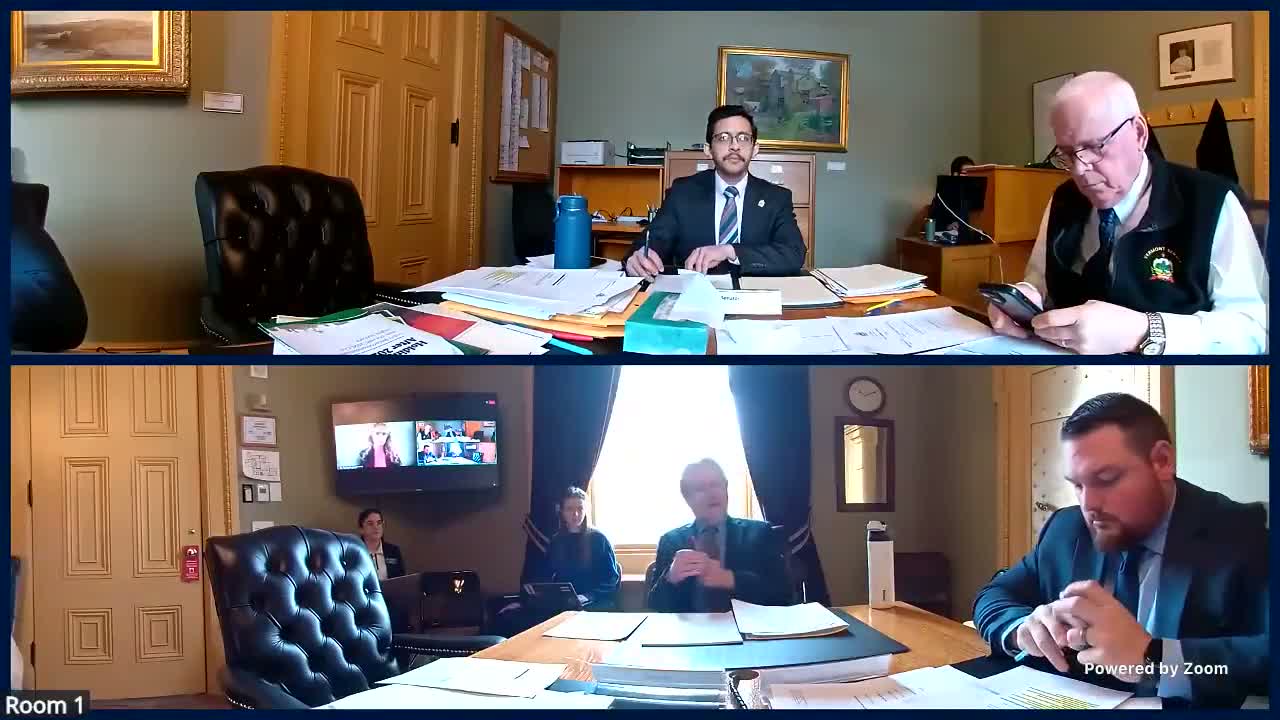
Eric Fitzpatrick of the Office of Legislative Counsel briefed the Senate Judiciary Committee on edits proposed by the Department of Mental Health to S.193, the bill establishing a state forensic facility. Fitzpatrick said the department’s draft would move responsibility for arranging court-ordered competency evaluations to the Department of Buildings and General Services (BGS), which he expects would hold statewide contracts and subcontract the clinical work rather than perform evaluations in-house.
The change is intended, Fitzpatrick said, to centralize contracting and reduce costs. "I assume they would contract for it," he said, adding the committee should ask BGS about capacity and contracting procedures. Karen Barber, general counsel for the Department of Mental Health, told the committee DMH currently only arranges evaluations and does not employ clinicians to perform them: "We just arrange for them," she said, describing DMH’s role as administrative and supportive of a statewide contract to obtain better rates.
The committee pressed several points the counsel and DMH raised. One set of edits would require that, for certain misdemeanor cases, diversion be attempted and found unsuccessful before a court may order a competency evaluation; for some felonies, parties would first be required to consider referral to an adult court conversion program. Senators asked how diversion — a voluntary, nontrial route — would work when a defendant’s competency to stand trial is already at issue and whether an incompetent person could meaningfully consent to diversion programs.
Fitzpatrick told members these provisions may limit when a competency evaluation can be ordered and could create difficult as-applied problems: "It seems to kind of limit the defendant's ability to raise competency as a defense," he said. Barber responded that competency to stand trial is a limited legal question and does not necessarily bar individuals from consenting to treatment or medication in other contexts, noting states differentiate competency to stand trial from capacity to accept treatment.
Committee members also flagged a draft provision that would allow BGS to administer the contracts for evaluations, asking whether that department has clinical capacity. Counsel reiterated that BGS likely would contract out clinical services and recommended inviting BGS to explain how it would operate such arrangements. Members also raised cost concerns — one senator noted an evaluation can cost about $4,000 — and asked who would pay.
Another significant set of edits would add a procedure for cases in which competency cannot be restored. Counsel noted the department’s language provides an avenue where the original draft did not, but also lacks a clear time frame, a decision-maker, or an established standard for declaring a person non-restorable. The committee discussed whether those procedural elements should mirror language the bill uses for individuals found not guilty by reason of insanity to avoid duplicative or inconsistent processes.
Members also objected to language in one subdivision that, as written, shifts the burden of proof to an individual seeking release. Fitzpatrick and others said the burden should rest with the state (for example, the state’s attorney or attorney general) when seeking commitment. Barber acknowledged that the burden language originated in the bill as introduced and said DMH had no formal position on revising burden-of-proof allocations.
The committee asked for additional clarification on several technical points — including whether HIPAA applies to the forensic program depending on how it is structured in the Department of Corrections — and requested testimony from BGS, DOC and additional witnesses to address capacity, contracting, and time frames before the committee drafts final language. The committee scheduled follow-up work and additional testimony in a future meeting.
Next steps: staff will arrange follow-up briefings by BGS and other agencies and return to the committee for more detailed drafting and consideration of timelines and standards for non-restorable competency.
The change is intended, Fitzpatrick said, to centralize contracting and reduce costs. "I assume they would contract for it," he said, adding the committee should ask BGS about capacity and contracting procedures. Karen Barber, general counsel for the Department of Mental Health, told the committee DMH currently only arranges evaluations and does not employ clinicians to perform them: "We just arrange for them," she said, describing DMH’s role as administrative and supportive of a statewide contract to obtain better rates.
The committee pressed several points the counsel and DMH raised. One set of edits would require that, for certain misdemeanor cases, diversion be attempted and found unsuccessful before a court may order a competency evaluation; for some felonies, parties would first be required to consider referral to an adult court conversion program. Senators asked how diversion — a voluntary, nontrial route — would work when a defendant’s competency to stand trial is already at issue and whether an incompetent person could meaningfully consent to diversion programs.
Fitzpatrick told members these provisions may limit when a competency evaluation can be ordered and could create difficult as-applied problems: "It seems to kind of limit the defendant's ability to raise competency as a defense," he said. Barber responded that competency to stand trial is a limited legal question and does not necessarily bar individuals from consenting to treatment or medication in other contexts, noting states differentiate competency to stand trial from capacity to accept treatment.
Committee members also flagged a draft provision that would allow BGS to administer the contracts for evaluations, asking whether that department has clinical capacity. Counsel reiterated that BGS likely would contract out clinical services and recommended inviting BGS to explain how it would operate such arrangements. Members also raised cost concerns — one senator noted an evaluation can cost about $4,000 — and asked who would pay.
Another significant set of edits would add a procedure for cases in which competency cannot be restored. Counsel noted the department’s language provides an avenue where the original draft did not, but also lacks a clear time frame, a decision-maker, or an established standard for declaring a person non-restorable. The committee discussed whether those procedural elements should mirror language the bill uses for individuals found not guilty by reason of insanity to avoid duplicative or inconsistent processes.
Members also objected to language in one subdivision that, as written, shifts the burden of proof to an individual seeking release. Fitzpatrick and others said the burden should rest with the state (for example, the state’s attorney or attorney general) when seeking commitment. Barber acknowledged that the burden language originated in the bill as introduced and said DMH had no formal position on revising burden-of-proof allocations.
The committee asked for additional clarification on several technical points — including whether HIPAA applies to the forensic program depending on how it is structured in the Department of Corrections — and requested testimony from BGS, DOC and additional witnesses to address capacity, contracting, and time frames before the committee drafts final language. The committee scheduled follow-up work and additional testimony in a future meeting.
Next steps: staff will arrange follow-up briefings by BGS and other agencies and return to the committee for more detailed drafting and consideration of timelines and standards for non-restorable competency.
Don't Miss a Word: See the Full Meeting!
Go beyond summaries. Unlock every video, transcript, and key insight with a Founder Membership.
✓
Get instant access to full meeting videos
✓
Search and clip any phrase from complete transcripts
✓
Receive AI-powered summaries & custom alerts
✓
Enjoy lifetime, unrestricted access to government data
30-day money-back guarantee
