Senate Judiciary advances S.208 after striking provision that would criminalize third offense for masked federal officers
February 07, 2026 | Judiciary, SENATE, Committees, Legislative , Vermont
This article was created by AI summarizing key points discussed. AI makes mistakes, so for full details and context, please refer to the video of the full meeting. Please report any errors so we can fix them. Report an error »
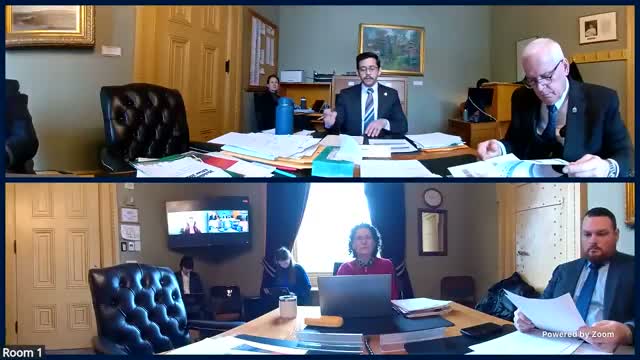
MONTPELIER, Vt. — The Senate Judiciary committee on Feb. 6 voted to advance S.208, a bill that would require law-enforcement officers to visibly display a name, unique radio or badge number and prohibit masks or disguises while interacting in person with the public, after removing a provision that would have made a third offense a criminal misdemeanor.
Legislative counsel Sophie Sedatny briefed the committee on constitutional risks tied to the bill, telling members that "the supremacy clause is really the key." Sedatny and other counsel framed two central legal tests: whether a state law directly regulates the federal government (intergovernmental immunity) and whether the state's rule is preempted because an official’s action is authorized and necessary under federal law (a supremacy-clause inquiry).
Why it matters: Committee members repeatedly pressed whether courts would treat the statute as an impermissible regulation of federal officers or as an acceptable, incidental burden on federal operations. Sedatny said courts focus on what the federal officer was doing and whether the challenged conduct was within the officer's scope of federal employment; if so, immunity or preemption is more likely to apply.
Counsel noted there is no federal statute that affirmatively requires masking for federal officers and that Department of Homeland Security guidance has generally left masking to individual officers’ discretion. Sedatny also cited post-2020 National Defense Authorization Act guidance requiring visible identification during responses to civil disturbances and said existing rules — for example, ICE regulations that require agents to identify themselves "as soon as it is safe to do so" during arrests — do not directly conflict with S.208's identification requirement.
On penalties and enforceability, the committee discussed civil versus criminal sanctions and how enforcement would operate. Counsel explained that violations would proceed through the judicial bureau, which maintains records and would allow a clerk or officer to determine whether a prior violation had occurred. Counsel also warned that if a federal officer were prosecuted in state court, the federal officer could likely remove the case to federal court.
Hillary, also with the legislative counsel office, summarized the federal government's arguments in related litigation in California, noting that the federal plaintiffs have argued masked officers "hamper federal operations" and that criminal liability could have a stronger "chilling" effect than civil fines. "A civil violation would not immediately give rise to the threat of arrest that would directly hamper operations," she said, contrasting civil sanctions with the disruption that comes from arrest or criminal prosecution.
Substantive changes under consideration included an explicit requirement that officers display identifying information on their person (to account for plainclothes officers), language clarifying that prohibitions apply when an officer is "interacting in person with the public," and narrow exceptions for tactical units, the Vermont Drug Task Force and undercover investigations into child-exploitation matters.
Amendment and votes: During the session several senators said they favored removing the bill's third-offense criminal misdemeanor. A strike-all amendment that removed the third-offense criminal penalty was offered, called and adopted by roll call (the committee recorded 4 yes, 1 no on the amendment). The committee then reported the bill out as amended; the transcript shows the committee announcing the bill as amended by a 5-0-0 tally in the record that followed the amendment vote.
What was not decided: Counsel emphasized that whether courts ultimately find S.208 preempted by federal law remains unsettled and will depend in part on how trial courts weigh factual declarations in any federal challenge. Committee members noted the California litigation may provide guidance but cautioned lower-court decisions can be appealed.
Next steps: The committee scheduled further business and said it would continue with other items on the agenda; S.208 was reported out of committee in its amended form for the next steps in the legislative process.
(Reporting by legislative counsel and committee roll-call; committee transcript used for quotes and vote tallies.)
Legislative counsel Sophie Sedatny briefed the committee on constitutional risks tied to the bill, telling members that "the supremacy clause is really the key." Sedatny and other counsel framed two central legal tests: whether a state law directly regulates the federal government (intergovernmental immunity) and whether the state's rule is preempted because an official’s action is authorized and necessary under federal law (a supremacy-clause inquiry).
Why it matters: Committee members repeatedly pressed whether courts would treat the statute as an impermissible regulation of federal officers or as an acceptable, incidental burden on federal operations. Sedatny said courts focus on what the federal officer was doing and whether the challenged conduct was within the officer's scope of federal employment; if so, immunity or preemption is more likely to apply.
Counsel noted there is no federal statute that affirmatively requires masking for federal officers and that Department of Homeland Security guidance has generally left masking to individual officers’ discretion. Sedatny also cited post-2020 National Defense Authorization Act guidance requiring visible identification during responses to civil disturbances and said existing rules — for example, ICE regulations that require agents to identify themselves "as soon as it is safe to do so" during arrests — do not directly conflict with S.208's identification requirement.
On penalties and enforceability, the committee discussed civil versus criminal sanctions and how enforcement would operate. Counsel explained that violations would proceed through the judicial bureau, which maintains records and would allow a clerk or officer to determine whether a prior violation had occurred. Counsel also warned that if a federal officer were prosecuted in state court, the federal officer could likely remove the case to federal court.
Hillary, also with the legislative counsel office, summarized the federal government's arguments in related litigation in California, noting that the federal plaintiffs have argued masked officers "hamper federal operations" and that criminal liability could have a stronger "chilling" effect than civil fines. "A civil violation would not immediately give rise to the threat of arrest that would directly hamper operations," she said, contrasting civil sanctions with the disruption that comes from arrest or criminal prosecution.
Substantive changes under consideration included an explicit requirement that officers display identifying information on their person (to account for plainclothes officers), language clarifying that prohibitions apply when an officer is "interacting in person with the public," and narrow exceptions for tactical units, the Vermont Drug Task Force and undercover investigations into child-exploitation matters.
Amendment and votes: During the session several senators said they favored removing the bill's third-offense criminal misdemeanor. A strike-all amendment that removed the third-offense criminal penalty was offered, called and adopted by roll call (the committee recorded 4 yes, 1 no on the amendment). The committee then reported the bill out as amended; the transcript shows the committee announcing the bill as amended by a 5-0-0 tally in the record that followed the amendment vote.
What was not decided: Counsel emphasized that whether courts ultimately find S.208 preempted by federal law remains unsettled and will depend in part on how trial courts weigh factual declarations in any federal challenge. Committee members noted the California litigation may provide guidance but cautioned lower-court decisions can be appealed.
Next steps: The committee scheduled further business and said it would continue with other items on the agenda; S.208 was reported out of committee in its amended form for the next steps in the legislative process.
(Reporting by legislative counsel and committee roll-call; committee transcript used for quotes and vote tallies.)
Don't Miss a Word: See the Full Meeting!
Go beyond summaries. Unlock every video, transcript, and key insight with a Founder Membership.
✓
Get instant access to full meeting videos
✓
Search and clip any phrase from complete transcripts
✓
Receive AI-powered summaries & custom alerts
✓
Enjoy lifetime, unrestricted access to government data
30-day money-back guarantee
