Subcommittee acts on a slate of criminal‑law bills; several reported, tabled, or carried over
February 07, 2026 | 2026 Legislature VA, Virginia
This article was created by AI summarizing key points discussed. AI makes mistakes, so for full details and context, please refer to the video of the full meeting. Please report any errors so we can fix them. Report an error »
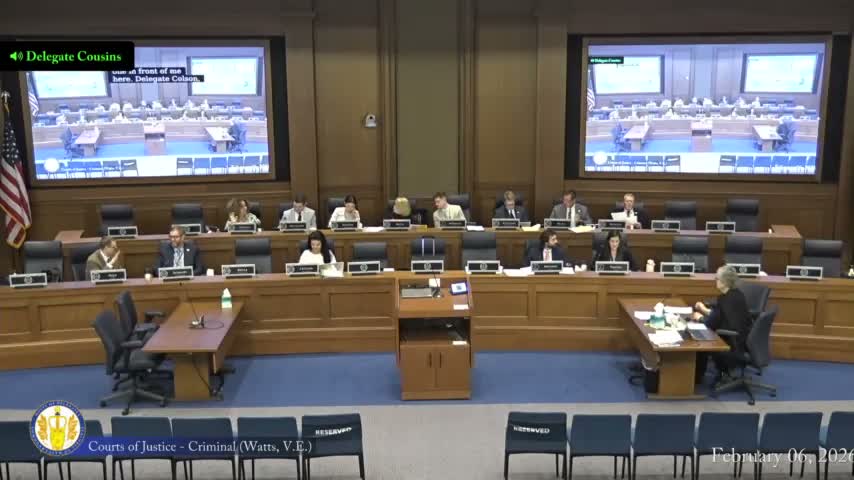
The Criminal Law Subcommittee of the House Courts Committee considered a large docket Thursday and took formal action on a string of bills covering juvenile diversion, controlled‑substance retail restrictions, victim services reimbursement, drone use in emergencies and other criminal procedure reforms.
Votes and formal actions at a glance: HB240 (Gardner) — After testimony from the patron and the victim’s mother about a missed temporary detention order in Richmond, members moved to carry over the substitute to 2027 and requested a letter to the Behavioral Health Commission for further study; the motion was carried by voice vote. HB1105 (Kilgore) — stricken at the patron’s request (recorded vote reported as 10‑0). HB1215 (Oates) — laid on the table (voice/recorded vote). HB438 (Lavere Bolling) — A substitute expanding juvenile diversion access (including post‑petition deferrals to court service units) was reported with substitute by a vote of 8–1 after supporters cited state recidivism data showing lower rearrest rates for diversion and prosecutors raised concerns about consent language. HB648 (Kent) — A substitute that would ban sale of flavored nitrous oxide marketed like food or beverage, prohibit canisters over eight grams to non‑exempt persons, and create a class‑1 misdemeanor penalty was reported with substitute and referred to General Laws (10–0). HB718 (Zier) — An amendment to make arrest the default for class‑1 and class‑2 misdemeanors drew law‑enforcement support and public testimony about problems with summonses; the committee tabled the bill by recorded vote (7–3). HB1027 (Walker) — A substitute intended to narrow online‑solicitation liability to cases involving a child, parent/guardian, or undercover law‑enforcement officer prompted extended debate about ‘‘vigilante’’ sting operations; committee members moved to carry the bill over for further work. HB1219 (Sewell) — Substitute language limited warrantless drone use to narrow emergency responses on public property and asked DCJS for a model policy; extensive Fourth Amendment concerns were aired; the subcommittee agreed to add a reenactment/report clause asking DCJS to study and produce a model policy before reenactment. HB1464 (Shinn) — A bill to reimburse anonymous trace evidence kits for strangulation victims and to require a registered‑nurse coordinator was reported and referred to Appropriations (9–1). HB1411 (Schmidt) — A substitute to clarify when mental‑condition evidence may be admitted was reported and referred to Appropriations. HB637 (Colson) — A large substitute to create a residue‑possession misdemeanor tier and cascade penalty changes was reported with substitute after debate about how to define ‘‘residue’’ and whether to tie the term to Virginia forensic laboratory practice. HB862 (Cousins) — VASAP consolidation and requirements for local fiscal agents and local funding was reported with amendments after stakeholder discussion.
What’s next: Several of the reported bills will move to the committees noted (General Laws or Appropriations) for further consideration; others were carried over to allow additional drafting, study, or a conference approach. The subcommittee’s actions reflect a mix of incremental statutory fixes (bail/magistrate information), public‑safety technology policy (drones), public‑health oriented sentencing reforms (residue possession, diversion) and victim‑service funding questions.
The committee record shows which items were carried, tabled, stricken, or reported; sponsors and witnesses signaled continued negotiation on technical definitions and enforcement mechanisms as bills move to the next stages.
Votes and formal actions at a glance: HB240 (Gardner) — After testimony from the patron and the victim’s mother about a missed temporary detention order in Richmond, members moved to carry over the substitute to 2027 and requested a letter to the Behavioral Health Commission for further study; the motion was carried by voice vote. HB1105 (Kilgore) — stricken at the patron’s request (recorded vote reported as 10‑0). HB1215 (Oates) — laid on the table (voice/recorded vote). HB438 (Lavere Bolling) — A substitute expanding juvenile diversion access (including post‑petition deferrals to court service units) was reported with substitute by a vote of 8–1 after supporters cited state recidivism data showing lower rearrest rates for diversion and prosecutors raised concerns about consent language. HB648 (Kent) — A substitute that would ban sale of flavored nitrous oxide marketed like food or beverage, prohibit canisters over eight grams to non‑exempt persons, and create a class‑1 misdemeanor penalty was reported with substitute and referred to General Laws (10–0). HB718 (Zier) — An amendment to make arrest the default for class‑1 and class‑2 misdemeanors drew law‑enforcement support and public testimony about problems with summonses; the committee tabled the bill by recorded vote (7–3). HB1027 (Walker) — A substitute intended to narrow online‑solicitation liability to cases involving a child, parent/guardian, or undercover law‑enforcement officer prompted extended debate about ‘‘vigilante’’ sting operations; committee members moved to carry the bill over for further work. HB1219 (Sewell) — Substitute language limited warrantless drone use to narrow emergency responses on public property and asked DCJS for a model policy; extensive Fourth Amendment concerns were aired; the subcommittee agreed to add a reenactment/report clause asking DCJS to study and produce a model policy before reenactment. HB1464 (Shinn) — A bill to reimburse anonymous trace evidence kits for strangulation victims and to require a registered‑nurse coordinator was reported and referred to Appropriations (9–1). HB1411 (Schmidt) — A substitute to clarify when mental‑condition evidence may be admitted was reported and referred to Appropriations. HB637 (Colson) — A large substitute to create a residue‑possession misdemeanor tier and cascade penalty changes was reported with substitute after debate about how to define ‘‘residue’’ and whether to tie the term to Virginia forensic laboratory practice. HB862 (Cousins) — VASAP consolidation and requirements for local fiscal agents and local funding was reported with amendments after stakeholder discussion.
What’s next: Several of the reported bills will move to the committees noted (General Laws or Appropriations) for further consideration; others were carried over to allow additional drafting, study, or a conference approach. The subcommittee’s actions reflect a mix of incremental statutory fixes (bail/magistrate information), public‑safety technology policy (drones), public‑health oriented sentencing reforms (residue possession, diversion) and victim‑service funding questions.
The committee record shows which items were carried, tabled, stricken, or reported; sponsors and witnesses signaled continued negotiation on technical definitions and enforcement mechanisms as bills move to the next stages.
View the Full Meeting & All Its Details
This article offers just a summary. Unlock complete video, transcripts, and insights as a Founder Member.
✓
Watch full, unedited meeting videos
✓
Search every word spoken in unlimited transcripts
✓
AI summaries & real-time alerts (all government levels)
✓
Permanent access to expanding government content
30-day money-back guarantee
