Committee passes National Popular Vote bill after extended testimony
February 07, 2026 | 2026 Legislature VA, Virginia
This article was created by AI summarizing key points discussed. AI makes mistakes, so for full details and context, please refer to the video of the full meeting. Please report any errors so we can fix them. Report an error »
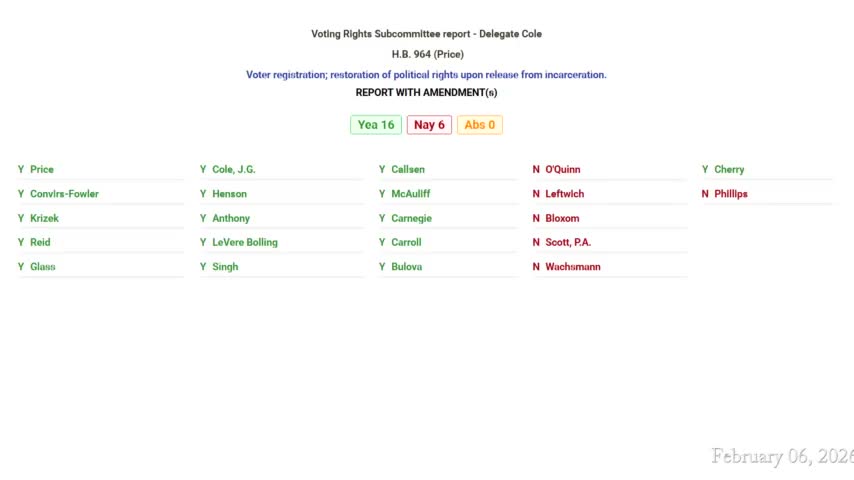
The House Privileges and Elections Committee voted 14–8 to report House Bill 965, which would enter Virginia into the National Popular Vote interstate compact, after extended testimony and an amendment adopted earlier in subcommittee.
Scott Drexel, who testified "on behalf of National Popular Vote," told the committee that the compact would "guarantee the candidate who receives the most votes in all 50 states, and the District of Columbia, is the president of the United States" while operating within the state-legislatures authority in Article II. Drexel said the compact does not abolish the Electoral College but adjusts the method states use to appoint electors.
Delegate Cole, presenting the subcommittee recommendation, explained the compact would have Virginia award its electoral votes to the presidential ticket receiving the most popular votes nationwide once enough states join the compact. During committee questioning, Delegate Scott asked whether Virginia's electoral votes would have shifted under the compact in the last presidential election; Drexel replied, "Yes, sir."
Supporters told the committee the compact addresses disputed outcomes and the outsized influence of a small number of states under the current system. Opponents asked technical and constitutional questions; the record shows the subcommittee adopted an amendment before reporting. The committee passed HB965 as amended on a recorded vote of 14–8.
The measure now advances as a reported bill; further steps include any subsequent House floor action and the status of companion measures in other states that determine when the compact would take effect.
Scott Drexel, who testified "on behalf of National Popular Vote," told the committee that the compact would "guarantee the candidate who receives the most votes in all 50 states, and the District of Columbia, is the president of the United States" while operating within the state-legislatures authority in Article II. Drexel said the compact does not abolish the Electoral College but adjusts the method states use to appoint electors.
Delegate Cole, presenting the subcommittee recommendation, explained the compact would have Virginia award its electoral votes to the presidential ticket receiving the most popular votes nationwide once enough states join the compact. During committee questioning, Delegate Scott asked whether Virginia's electoral votes would have shifted under the compact in the last presidential election; Drexel replied, "Yes, sir."
Supporters told the committee the compact addresses disputed outcomes and the outsized influence of a small number of states under the current system. Opponents asked technical and constitutional questions; the record shows the subcommittee adopted an amendment before reporting. The committee passed HB965 as amended on a recorded vote of 14–8.
The measure now advances as a reported bill; further steps include any subsequent House floor action and the status of companion measures in other states that determine when the compact would take effect.
Don't Miss a Word: See the Full Meeting!
Go beyond summaries. Unlock every video, transcript, and key insight with a Founder Membership.
✓
Get instant access to full meeting videos
✓
Search and clip any phrase from complete transcripts
✓
Receive AI-powered summaries & custom alerts
✓
Enjoy lifetime, unrestricted access to government data
30-day money-back guarantee
