Committee advances slate of elections bills; provisional-ballot guidance and voting-rights changes among measures approved
February 07, 2026 | 2026 Legislature VA, Virginia
This article was created by AI summarizing key points discussed. AI makes mistakes, so for full details and context, please refer to the video of the full meeting. Please report any errors so we can fix them. Report an error »
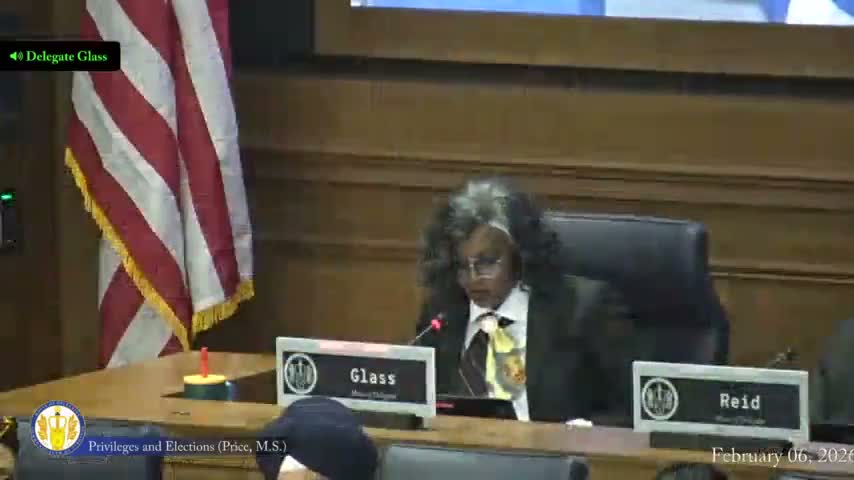
The House Privileges and Elections Committee moved forward on a series of elections-related measures, reporting or approving bills that change administrative practices, criminal penalties, and voting-rights procedures.
Key actions
- HB41: Reported — allows the State Board of Elections to remove an electoral board member or general registrar by two-thirds vote after a public hearing; committee reported the bill on a recorded vote of 19–1.
- HB234: Reported — requires standardized identification badges for acting electoral board members; committee report passed 14–6. The bill includes a civil penalty up to $1,000 for violations.
- HB639: Reported — removes the prohibition on accepting private property or services to fund voter education and outreach. Delegate Waxman questioned whether the text would prohibit use of churches as polling places; Waxman asked, "I'm curious if it's the intention of this bill to deny churches to be used as polling places." A sponsor replied, "That is not the intent." The committee passed the report 15–6.
- HB909: Reported with substitute — clarifies that prohibitions around polling places apply to absentee-voting locations and recount sites and specifies locations where a 100-foot firearm prohibition applies; substitute adopted and committee passed the bill 15–6.
- HB868: Continued to 2027 — a bill to require disclosure for political ads containing synthetic media. Sponsor Delegate Cousins said constitutional issues remain, noting that "the US Court of Appeals for the Ninth Circuit court found a similar law ... unconstitutional and as an infringement on the First Amendment." The sponsor requested continued consideration and a letter to the Joint Commission on Technology and Science; committee continued HB868 to 2027.
- HB964: Reported as amended — restores voting rights to people upon release from incarceration and requires transmission of release information to the Department of Elections to allow for registration. The subcommittee amendment delays enactment until Jan. 1, 2027, contingent on passage of a constitutional amendment providing a fundamental right to vote in November 2026. Committee passed the amended bill 16–6.
- HB965: Reported as amended — National Popular Vote compact; committee passed 14–8 (additional coverage available).
- HB967: Reported — revises standards under the Voting Rights Act to clarify factors courts may consider in dilution and suppression cases and expands who may bring actions; committee passed the bill 15–7.
- HB774: Reported with substitute — clarifies timeline to cure provisional ballots (extends curing period to noon the Monday after the election) and directs the Department of Elections to issue uniform guidance; committee reported the bill with substitute 15–7.
- SJ Resolutions 60 & 61: Reported — governor’s appointment measures reported 21–1 each (one amendment corrected an outgoing secretary’s name).
What matters
Several measures are primarily administrative, but HB964 and HB967 carry legal and civil-rights significance: HB964 changes when and how people leaving incarceration can exercise voter registration rights and ties enactment to a constitutional amendment timeline; HB967 alters litigation standards for vote-dilution and suppression claims. HB965 drew extended public testimony and remains a high-profile, potentially national-impact measure.
Next steps
Reported and passed bills advance to the House floor or appropriate referral (for example, HB1496 was reported and referred to Appropriations). HB868 was continued for additional work and a requested letter to the Joint Commission on Technology and Science.
Key actions
- HB41: Reported — allows the State Board of Elections to remove an electoral board member or general registrar by two-thirds vote after a public hearing; committee reported the bill on a recorded vote of 19–1.
- HB234: Reported — requires standardized identification badges for acting electoral board members; committee report passed 14–6. The bill includes a civil penalty up to $1,000 for violations.
- HB639: Reported — removes the prohibition on accepting private property or services to fund voter education and outreach. Delegate Waxman questioned whether the text would prohibit use of churches as polling places; Waxman asked, "I'm curious if it's the intention of this bill to deny churches to be used as polling places." A sponsor replied, "That is not the intent." The committee passed the report 15–6.
- HB909: Reported with substitute — clarifies that prohibitions around polling places apply to absentee-voting locations and recount sites and specifies locations where a 100-foot firearm prohibition applies; substitute adopted and committee passed the bill 15–6.
- HB868: Continued to 2027 — a bill to require disclosure for political ads containing synthetic media. Sponsor Delegate Cousins said constitutional issues remain, noting that "the US Court of Appeals for the Ninth Circuit court found a similar law ... unconstitutional and as an infringement on the First Amendment." The sponsor requested continued consideration and a letter to the Joint Commission on Technology and Science; committee continued HB868 to 2027.
- HB964: Reported as amended — restores voting rights to people upon release from incarceration and requires transmission of release information to the Department of Elections to allow for registration. The subcommittee amendment delays enactment until Jan. 1, 2027, contingent on passage of a constitutional amendment providing a fundamental right to vote in November 2026. Committee passed the amended bill 16–6.
- HB965: Reported as amended — National Popular Vote compact; committee passed 14–8 (additional coverage available).
- HB967: Reported — revises standards under the Voting Rights Act to clarify factors courts may consider in dilution and suppression cases and expands who may bring actions; committee passed the bill 15–7.
- HB774: Reported with substitute — clarifies timeline to cure provisional ballots (extends curing period to noon the Monday after the election) and directs the Department of Elections to issue uniform guidance; committee reported the bill with substitute 15–7.
- SJ Resolutions 60 & 61: Reported — governor’s appointment measures reported 21–1 each (one amendment corrected an outgoing secretary’s name).
What matters
Several measures are primarily administrative, but HB964 and HB967 carry legal and civil-rights significance: HB964 changes when and how people leaving incarceration can exercise voter registration rights and ties enactment to a constitutional amendment timeline; HB967 alters litigation standards for vote-dilution and suppression claims. HB965 drew extended public testimony and remains a high-profile, potentially national-impact measure.
Next steps
Reported and passed bills advance to the House floor or appropriate referral (for example, HB1496 was reported and referred to Appropriations). HB868 was continued for additional work and a requested letter to the Joint Commission on Technology and Science.
Don't Miss a Word: See the Full Meeting!
Go beyond summaries. Unlock every video, transcript, and key insight with a Founder Membership.
✓
Get instant access to full meeting videos
✓
Search and clip any phrase from complete transcripts
✓
Receive AI-powered summaries & custom alerts
✓
Enjoy lifetime, unrestricted access to government data
30-day money-back guarantee
