NIJ webinar urges researchers to plan for technology transition; FTCOE offers free help and a new postgraduate–lab match
February 06, 2026 | Office of Justice Programs, Department of Justice (DOJ), Executive, Federal
This article was created by AI summarizing key points discussed. AI makes mistakes, so for full details and context, please refer to the video of the full meeting. Please report any errors so we can fix them. Report an error »
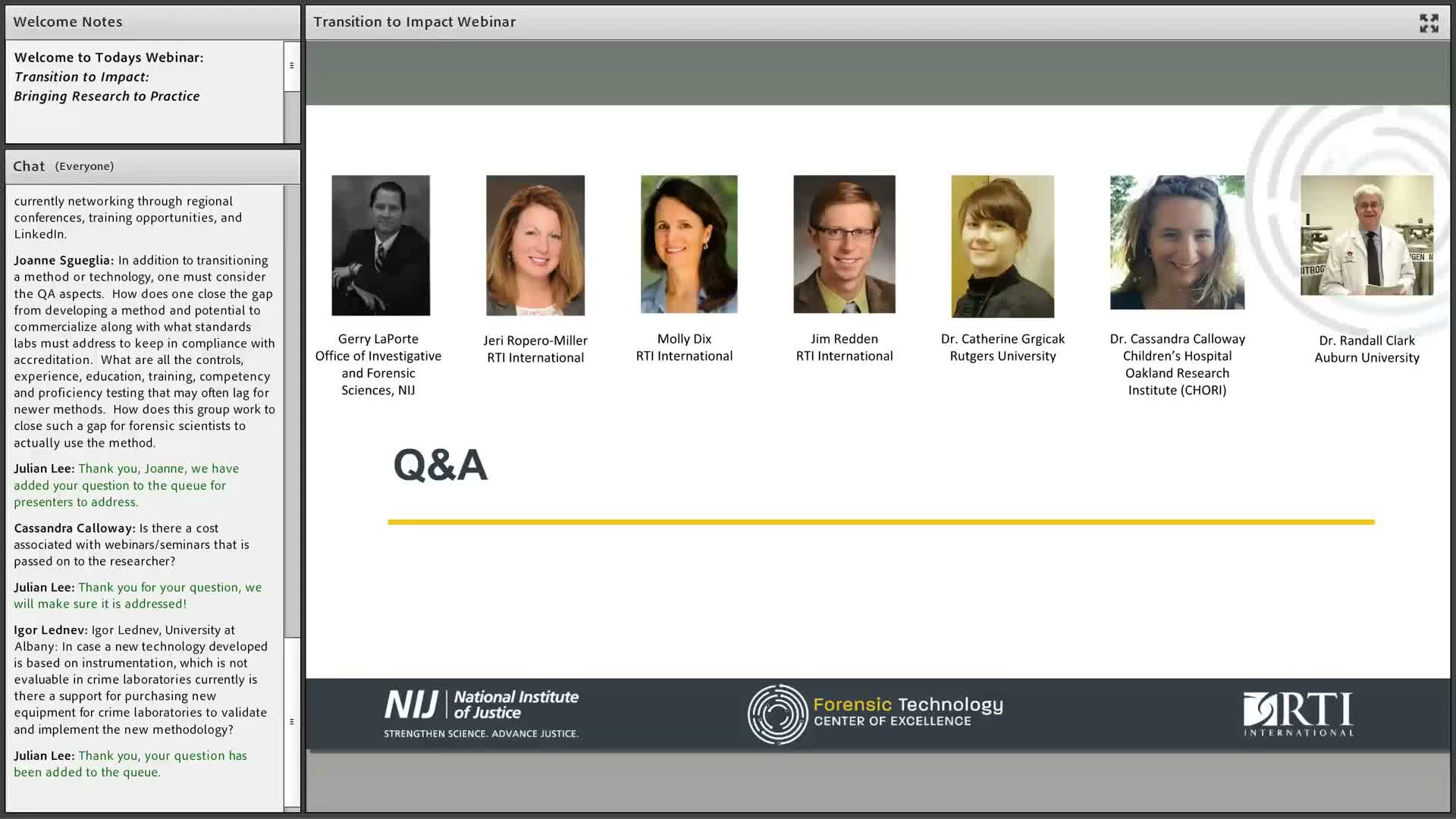
The National Institute of Justice hosted a webinar titled “Transition to Impact: Bringing Research to Practice,” where NIJ and RTI speakers urged researchers to build transition planning into projects from the start and described free support available to translate forensic research into operational use.
“Great research does not always get translated into practice,” said Jerry LaPorte, director of the Office of Investigative and Forensic Sciences at the National Institute of Justice, framing the session and the agency’s goal of connecting laboratory advances to real-world forensic work. LaPorte and other speakers said transition requires attention to three elements—technical feasibility, business viability and end‑user desirability—so innovations survive the realities of casework, cost constraints and field conditions.
Panelists described multiple pathways for transition. Dr. Cassandra Calloway of the Children’s Hospital Oakland Research Institute said transition can take the form of commercial kits, custom probe sets, vendor‑adapted software or open‑source tools, and that early engagement with practitioners and industry partners helps shape feasible, affordable solutions. “Bringing it to practice … is the most rewarding,” Calloway said of seeing research used by laboratory analysts.
Rutgers associate professor Dr. Katherine Grgachek emphasized user‑centered software design, describing three tools her team developed for STR analysis and recommending early user tests and simple interfaces so analysts can adopt methods without onerous retraining. Auburn University’s Dr. Randall Clark urged researchers to present at state and regional practitioner meetings and to publish accessible summaries (for example in Microgram) to surface issues practitioners face and gather feedback to improve methods.
RTI’s Forensic Technology Center of Excellence (FTCOE) and NIJ staff explained how they can help. Jerry Ripero Miller of RTI said FTCOE runs webinars, evaluations, workshops and knowledge‑transfer activities and can help investigators connect with labs and with tech‑transfer offices. Molly Dix, an RTI innovation adviser, urged researchers to define the value proposition—who benefits and at what cost—and to treat tech transfer as a collaborative, ongoing process rather than a final step.
The webinar included several practical announcements. LaPorte described a new NIJ web page intended to match postgraduate researchers with publicly funded forensic laboratories; he said the page already lists at least eight laboratories and will remain a permanent resource. He also told attendees that NIJ’s solicitation “Research and Evaluation for the Testing and Interpretation of Physical Evidence in Publicly Funded Forensic Laboratories” supports laboratory purchases and validation studies and that laboratories can also use Paul Coverdell Forensic Science Improvement Grants for equipment and validation.
In an extended Q&A, panelists addressed accreditation and quality‑assurance concerns, saying FTCOE assistance tends to be provided on a case‑by‑case basis (helping find proficiency testing samples, training partners such as the California Criminalistics Institute, or connecting with standards committees). FTCOE staff stressed that most FTCOE services are provided at no cost to researchers because of NIJ funding.
The session closed with contact information for follow‑up (Molly Dix at Dix@rti.org and phone (919) 541‑5866 was shared during the webinar) and pointers to downloadable slides and a feedback form.
What to watch next: researchers interested in equipment‑oriented validation should review the NIJ solicitation noted above; those seeking partnerships can use the NIJ postgraduate–lab matching page and FTCOE outreach services to locate practitioner collaborators.
“Great research does not always get translated into practice,” said Jerry LaPorte, director of the Office of Investigative and Forensic Sciences at the National Institute of Justice, framing the session and the agency’s goal of connecting laboratory advances to real-world forensic work. LaPorte and other speakers said transition requires attention to three elements—technical feasibility, business viability and end‑user desirability—so innovations survive the realities of casework, cost constraints and field conditions.
Panelists described multiple pathways for transition. Dr. Cassandra Calloway of the Children’s Hospital Oakland Research Institute said transition can take the form of commercial kits, custom probe sets, vendor‑adapted software or open‑source tools, and that early engagement with practitioners and industry partners helps shape feasible, affordable solutions. “Bringing it to practice … is the most rewarding,” Calloway said of seeing research used by laboratory analysts.
Rutgers associate professor Dr. Katherine Grgachek emphasized user‑centered software design, describing three tools her team developed for STR analysis and recommending early user tests and simple interfaces so analysts can adopt methods without onerous retraining. Auburn University’s Dr. Randall Clark urged researchers to present at state and regional practitioner meetings and to publish accessible summaries (for example in Microgram) to surface issues practitioners face and gather feedback to improve methods.
RTI’s Forensic Technology Center of Excellence (FTCOE) and NIJ staff explained how they can help. Jerry Ripero Miller of RTI said FTCOE runs webinars, evaluations, workshops and knowledge‑transfer activities and can help investigators connect with labs and with tech‑transfer offices. Molly Dix, an RTI innovation adviser, urged researchers to define the value proposition—who benefits and at what cost—and to treat tech transfer as a collaborative, ongoing process rather than a final step.
The webinar included several practical announcements. LaPorte described a new NIJ web page intended to match postgraduate researchers with publicly funded forensic laboratories; he said the page already lists at least eight laboratories and will remain a permanent resource. He also told attendees that NIJ’s solicitation “Research and Evaluation for the Testing and Interpretation of Physical Evidence in Publicly Funded Forensic Laboratories” supports laboratory purchases and validation studies and that laboratories can also use Paul Coverdell Forensic Science Improvement Grants for equipment and validation.
In an extended Q&A, panelists addressed accreditation and quality‑assurance concerns, saying FTCOE assistance tends to be provided on a case‑by‑case basis (helping find proficiency testing samples, training partners such as the California Criminalistics Institute, or connecting with standards committees). FTCOE staff stressed that most FTCOE services are provided at no cost to researchers because of NIJ funding.
The session closed with contact information for follow‑up (Molly Dix at Dix@rti.org and phone (919) 541‑5866 was shared during the webinar) and pointers to downloadable slides and a feedback form.
What to watch next: researchers interested in equipment‑oriented validation should review the NIJ solicitation noted above; those seeking partnerships can use the NIJ postgraduate–lab matching page and FTCOE outreach services to locate practitioner collaborators.
View the Full Meeting & All Its Details
This article offers just a summary. Unlock complete video, transcripts, and insights as a Founder Member.
✓
Watch full, unedited meeting videos
✓
Search every word spoken in unlimited transcripts
✓
AI summaries & real-time alerts (all government levels)
✓
Permanent access to expanding government content
30-day money-back guarantee
