Miami Beach adopts flexible spring-break plan, gives city manager authority to tailor enforcement
February 06, 2026 | Miami Beach, Miami-Dade County, Florida
This article was created by AI summarizing key points discussed. AI makes mistakes, so for full details and context, please refer to the video of the full meeting. Please report any errors so we can fix them. Report an error »
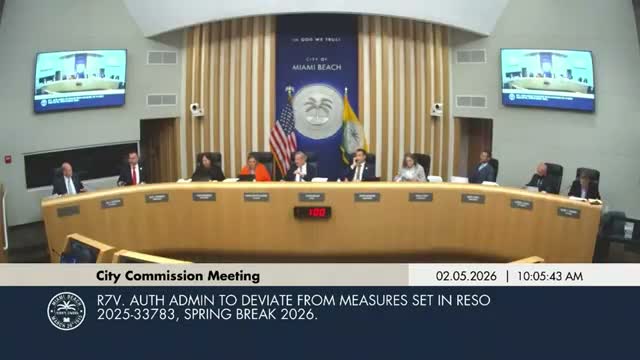
Miami Beach’s City Commission unanimously approved an amended spring‑break operations plan on Feb. 5 that keeps the high‑impact public‑safety tools used in recent years but grants the city manager discretion to apply them more selectively.
City Manager Eric Carpenter and department directors outlined a comprehensive approach that includes increased law‑enforcement staffing on peak weekends, targeted DUI checkpoints and license‑plate reader deployment, stricter enforcement of open‑container and noise rules, and an ability to raise parking rates in the Art Deco District during high‑demand periods. Carpenter said staff will enforce noise and open‑container rules “vigorously” and work with rideshare companies to manage pickup and drop‑off locations.
The administration asked for flexibility on three items the commission had previously approved: closing times for some beaches, the temporary closure of city garages and lots in the Art Deco District, and the placement of barricades on Ocean Drive, Collins Avenue and Washington Avenue. After extended debate, commissioners amended the recommendation so the manager may remove blanket barricading and instead retain barricades only in identified hotspot locations; keep sidewalk cafés open by default; operate garages with flexible pricing (an initial $40 rate that could rise as needed, the manager said); and have the authority to extend beach closures in specific circumstances.
Commissioner Alex Fernandez, who convened a February safety workshop, said the goal is to preserve the “toolbox” that prevented violence and chaos in past years while applying those tools in a targeted, data‑driven way. He recommended rolling back automatic barricading along long stretches of the entertainment corridor and limiting barricades to specific hot spots. City Manager Carpenter said he anticipated starting higher parking rates and adjusting them in real time based on occupancy and crowding.
Police Chief Wayne Jones told commissioners the department has the resources and regional partnerships to support the plan. He described the “knock‑and‑talk” and enhanced staffing plans as standard public‑safety tactics that are used when officers have a reasonable concern for safety.
The adopted motion asks the administration to pursue a “calibrated and flexible” march 2026 plan that prioritizes public safety and preserves restaurant sidewalk operations and other business activities by default unless conditions require stricter measures. The commission voted 7‑0 to adopt the amended item.
What’s next: staff said it will publish operational details and enforcement protocols with partner agencies ahead of March events and will return routine updates to the commission.
City Manager Eric Carpenter and department directors outlined a comprehensive approach that includes increased law‑enforcement staffing on peak weekends, targeted DUI checkpoints and license‑plate reader deployment, stricter enforcement of open‑container and noise rules, and an ability to raise parking rates in the Art Deco District during high‑demand periods. Carpenter said staff will enforce noise and open‑container rules “vigorously” and work with rideshare companies to manage pickup and drop‑off locations.
The administration asked for flexibility on three items the commission had previously approved: closing times for some beaches, the temporary closure of city garages and lots in the Art Deco District, and the placement of barricades on Ocean Drive, Collins Avenue and Washington Avenue. After extended debate, commissioners amended the recommendation so the manager may remove blanket barricading and instead retain barricades only in identified hotspot locations; keep sidewalk cafés open by default; operate garages with flexible pricing (an initial $40 rate that could rise as needed, the manager said); and have the authority to extend beach closures in specific circumstances.
Commissioner Alex Fernandez, who convened a February safety workshop, said the goal is to preserve the “toolbox” that prevented violence and chaos in past years while applying those tools in a targeted, data‑driven way. He recommended rolling back automatic barricading along long stretches of the entertainment corridor and limiting barricades to specific hot spots. City Manager Carpenter said he anticipated starting higher parking rates and adjusting them in real time based on occupancy and crowding.
Police Chief Wayne Jones told commissioners the department has the resources and regional partnerships to support the plan. He described the “knock‑and‑talk” and enhanced staffing plans as standard public‑safety tactics that are used when officers have a reasonable concern for safety.
The adopted motion asks the administration to pursue a “calibrated and flexible” march 2026 plan that prioritizes public safety and preserves restaurant sidewalk operations and other business activities by default unless conditions require stricter measures. The commission voted 7‑0 to adopt the amended item.
What’s next: staff said it will publish operational details and enforcement protocols with partner agencies ahead of March events and will return routine updates to the commission.
View the Full Meeting & All Its Details
This article offers just a summary. Unlock complete video, transcripts, and insights as a Founder Member.
✓
Watch full, unedited meeting videos
✓
Search every word spoken in unlimited transcripts
✓
AI summaries & real-time alerts (all government levels)
✓
Permanent access to expanding government content
30-day money-back guarantee
