RTI presents early evidence that SAMHSA prevention grants are linked to community‑level reductions in poisoning calls
February 06, 2026 | Office of Justice Programs, Department of Justice (DOJ), Executive, Federal
This article was created by AI summarizing key points discussed. AI makes mistakes, so for full details and context, please refer to the video of the full meeting. Please report any errors so we can fix them. Report an error »
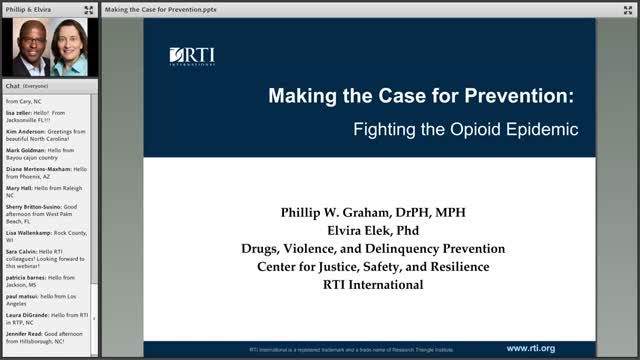
RTI International researchers presented preliminary evaluation findings on SAMHSA‑funded prevention grants during a webinar that emphasized upstream approaches to the opioid crisis. Dr. Philip Graham, senior director of RTI’s Drugs, Violence and Delinquency program, and Dr. Elvira Ehlich, a public‑health analyst on RTI’s evaluation team, said community‑level analyses show early signals that Partnerships for Success (PFS) activities are associated with modest reductions in poisoning calls for prescription drugs.
Graham framed the problem and approach: "We cannot treat ourselves out of this problem," he said, urging an ecological prevention model that addresses individual, family and community drivers of misuse. He cited national context: "nearly 3,000,000 Americans reporting a substance use disorder to prescription pain relievers or heroin in 2015," and an "estimated 91 U.S. deaths daily," to explain why prevention should focus upstream of overdose and death.
Ehlich outlined how PFS operates and how RTI evaluated it. States, tribes and territories serve as grantees and fund community subrecipients to implement interventions. RTI measured implementation through subrecipient reports and tracked outcomes using existing state and community surveys (for example, past 30‑day prescription‑drug misuse) and national poison‑call data from the National Poison Data System (NPDS). "We did see an effect on the overall poisoning calls," Ehlich said, adding that the signal was driven primarily by prescription‑drug categories.
The evaluation found wide variation in what communities implemented. Roughly 1,197 interventions were reported across PFS subrecipients through FY2016, reaching more than 10,000,000 individuals, researchers said. Intervention types included media campaigns (~21%), environmental strategies such as take‑back events (~22%), information dissemination (~18%), prevention education (~20%) and smaller shares for community‑based or alternative activities. RTI reported that 52% of interventions targeted whole communities, while 20% targeted individuals; 43% of prescription‑drug‑focused interventions were reported by subrecipients to be evidence‑based, and 51% of all PFS interventions were reported as evidence‑based overall. Ehlich cautioned that the evidence‑based designation was often self‑reported by subrecipients.
On effectiveness, RTI used qualitative comparative analysis and truth tables to examine combinations of strategies. Some combinations showed higher proportions of communities with reduced past‑30‑day prescription‑drug misuse; other combinations did not. Ehlich said results are preliminary and inconsistent across pathways, in part because many interventions had limited follow‑up time.
On costs and implementation burden, RTI’s early cost work (submitted to SAMHSA) indicates community subrecipients spend on average about $7,200 per prevention intervention (rough range cited: about $1,700 for low‑intensity information activities to over $12,000 for enforcement or ordinance work). Personnel represented about 67% of expenditures. Ehlich said more complete cost analyses and additional outcome data are expected within about a year.
Webinar participants asked whether PFS activities address counterfeit oxycodone and fentanyl tablets. Ehlich said PFS did not specifically target counterfeit opioid tablets; she said the newer Strategic Prevention Framework for Prescription Drugs (SPF‑Rx) grants were designed to work more directly with pharmacies, prescribers and prescription‑monitoring data and could address that issue. Graham noted parallel law‑enforcement and supply‑side efforts.
RTI said the next cross‑site evaluation report will be posted on SAMHSA’s website when available (Ehlich estimated roughly 15 months) and that conference presentations and related materials are sometimes posted online. Graham closed by urging collaboration across public health, law enforcement, education and health systems to scale prevention and build evidence. "Success is not final. Failure is not fatal. It is the courage to continue that counts," he said.
RTI emphasized the tentative nature of the findings: the analysis covers early cohorts and FY2012–FY2016 NPDS data, many interventions were newly implemented under PFS, and follow‑up outcome data remain incomplete. The researchers recommended continuing to expand follow‑up measurement, include later cohorts, increase attention to implementation capacity, and study the SPF‑Rx pharmacy work to understand effects on counterfeit opioids and prescribing practices.
What’s next: RTI will publish its next evaluation report to SAMHSA and continue refining the evidence on which intervention combinations are most likely to reduce prescription‑drug misuse at the community level.
Graham framed the problem and approach: "We cannot treat ourselves out of this problem," he said, urging an ecological prevention model that addresses individual, family and community drivers of misuse. He cited national context: "nearly 3,000,000 Americans reporting a substance use disorder to prescription pain relievers or heroin in 2015," and an "estimated 91 U.S. deaths daily," to explain why prevention should focus upstream of overdose and death.
Ehlich outlined how PFS operates and how RTI evaluated it. States, tribes and territories serve as grantees and fund community subrecipients to implement interventions. RTI measured implementation through subrecipient reports and tracked outcomes using existing state and community surveys (for example, past 30‑day prescription‑drug misuse) and national poison‑call data from the National Poison Data System (NPDS). "We did see an effect on the overall poisoning calls," Ehlich said, adding that the signal was driven primarily by prescription‑drug categories.
The evaluation found wide variation in what communities implemented. Roughly 1,197 interventions were reported across PFS subrecipients through FY2016, reaching more than 10,000,000 individuals, researchers said. Intervention types included media campaigns (~21%), environmental strategies such as take‑back events (~22%), information dissemination (~18%), prevention education (~20%) and smaller shares for community‑based or alternative activities. RTI reported that 52% of interventions targeted whole communities, while 20% targeted individuals; 43% of prescription‑drug‑focused interventions were reported by subrecipients to be evidence‑based, and 51% of all PFS interventions were reported as evidence‑based overall. Ehlich cautioned that the evidence‑based designation was often self‑reported by subrecipients.
On effectiveness, RTI used qualitative comparative analysis and truth tables to examine combinations of strategies. Some combinations showed higher proportions of communities with reduced past‑30‑day prescription‑drug misuse; other combinations did not. Ehlich said results are preliminary and inconsistent across pathways, in part because many interventions had limited follow‑up time.
On costs and implementation burden, RTI’s early cost work (submitted to SAMHSA) indicates community subrecipients spend on average about $7,200 per prevention intervention (rough range cited: about $1,700 for low‑intensity information activities to over $12,000 for enforcement or ordinance work). Personnel represented about 67% of expenditures. Ehlich said more complete cost analyses and additional outcome data are expected within about a year.
Webinar participants asked whether PFS activities address counterfeit oxycodone and fentanyl tablets. Ehlich said PFS did not specifically target counterfeit opioid tablets; she said the newer Strategic Prevention Framework for Prescription Drugs (SPF‑Rx) grants were designed to work more directly with pharmacies, prescribers and prescription‑monitoring data and could address that issue. Graham noted parallel law‑enforcement and supply‑side efforts.
RTI said the next cross‑site evaluation report will be posted on SAMHSA’s website when available (Ehlich estimated roughly 15 months) and that conference presentations and related materials are sometimes posted online. Graham closed by urging collaboration across public health, law enforcement, education and health systems to scale prevention and build evidence. "Success is not final. Failure is not fatal. It is the courage to continue that counts," he said.
RTI emphasized the tentative nature of the findings: the analysis covers early cohorts and FY2012–FY2016 NPDS data, many interventions were newly implemented under PFS, and follow‑up outcome data remain incomplete. The researchers recommended continuing to expand follow‑up measurement, include later cohorts, increase attention to implementation capacity, and study the SPF‑Rx pharmacy work to understand effects on counterfeit opioids and prescribing practices.
What’s next: RTI will publish its next evaluation report to SAMHSA and continue refining the evidence on which intervention combinations are most likely to reduce prescription‑drug misuse at the community level.
View the Full Meeting & All Its Details
This article offers just a summary. Unlock complete video, transcripts, and insights as a Founder Member.
✓
Watch full, unedited meeting videos
✓
Search every word spoken in unlimited transcripts
✓
AI summaries & real-time alerts (all government levels)
✓
Permanent access to expanding government content
30-day money-back guarantee
