Vermont advocates and agriculture agency clash on how to define municipal authority and a broad 'right to grow food'
February 06, 2026 | Agriculture, Food Resiliency, & Forestry, HOUSE OF REPRESENTATIVES, Committees, Legislative , Vermont
This article was created by AI summarizing key points discussed. AI makes mistakes, so for full details and context, please refer to the video of the full meeting. Please report any errors so we can fix them. Report an error »
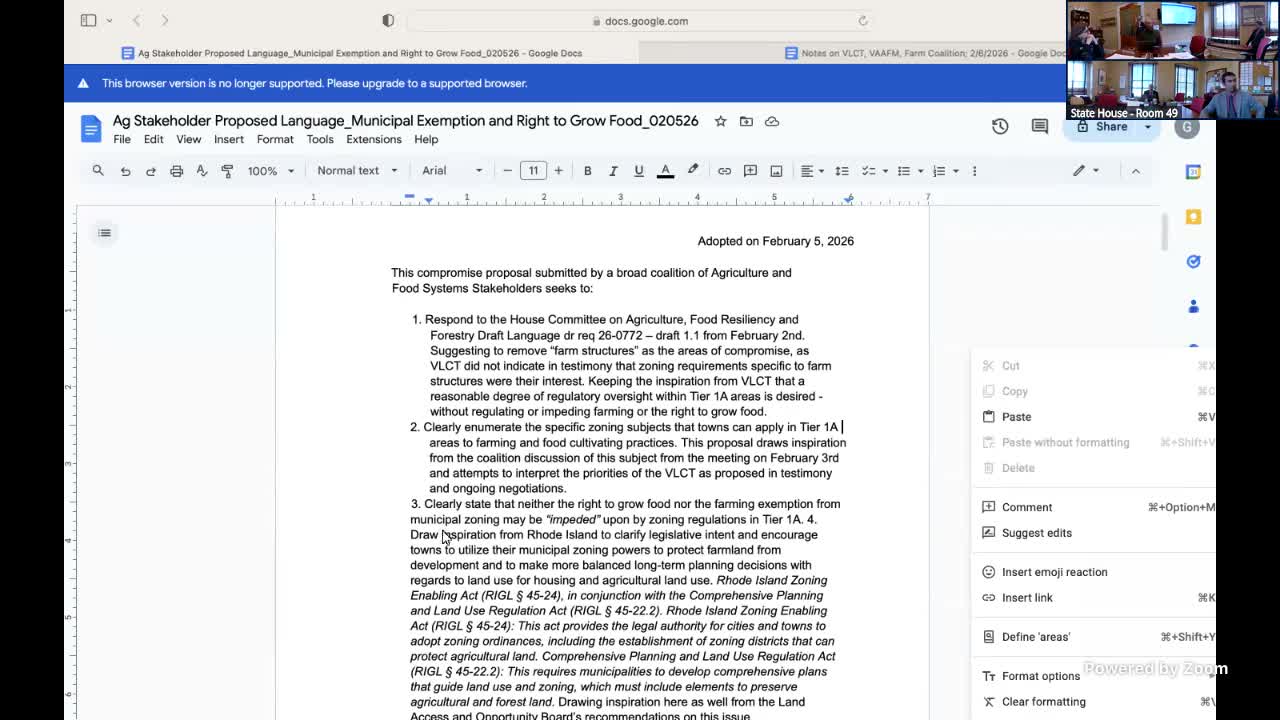
Graham Euneng Strofenoff, policy director at Rural Vermont, told the committee that farm groups want the Legislature to restore the long-standing rule that agriculture is exempt from municipal zoning and to protect a broad "right to grow food," including small-scale sales and donations.
The proposal, Strofenoff said, would protect anyone producing food under farm production and avoid reopening the RAPs for wholesale revision. He warned that local rules in some towns—citing Essex Junction—now restrict agricultural activities to planned agricultural areas and require permits for poultry; Essex allows four laying hens with a $35 permit fee, he said.
Steve Collier of the Agency of Agriculture said the agency also wanted to return to the status quo but identified gaps in the prior eligibility tests. Historically, the agency used a four-acre threshold plus a $2,000 sales test or a Schedule F filing to define farming. Collier said those sales-based tests could label small commercial operations as "farming" even when they lack sufficient land to manage animals and waste safely.
To address that gap, Collier described a two-part approach the agency supports: give people a clear "right to grow food" (backyard poultry and plant production would be protected regardless of commercial status), and set an acreage-based floor for livestock. Under the agency’s description, livestock kept on less than one acre would be subject to local regulation unless the town opted to allow smaller-lot livestock; operations from one to four acres would be evaluated for whether they can adequately manage nutrients and waste.
Both witnesses offered an alternative to rushing into new Tier 1 mapping or wholesale RAPs amendments: either enumerate narrowly the municipal zoning topics towns may apply in Tier 1 areas, or send unresolved questions (for example livestock rules and Tier 1 boundaries) to a study committee for careful review. Strofenoff argued municipalities should not be given broad authority that could be used to restrict farming based on aesthetics rather than public health or safety.
The committee paused for lunch and said it would reconvene at 1 p.m.
The proposal, Strofenoff said, would protect anyone producing food under farm production and avoid reopening the RAPs for wholesale revision. He warned that local rules in some towns—citing Essex Junction—now restrict agricultural activities to planned agricultural areas and require permits for poultry; Essex allows four laying hens with a $35 permit fee, he said.
Steve Collier of the Agency of Agriculture said the agency also wanted to return to the status quo but identified gaps in the prior eligibility tests. Historically, the agency used a four-acre threshold plus a $2,000 sales test or a Schedule F filing to define farming. Collier said those sales-based tests could label small commercial operations as "farming" even when they lack sufficient land to manage animals and waste safely.
To address that gap, Collier described a two-part approach the agency supports: give people a clear "right to grow food" (backyard poultry and plant production would be protected regardless of commercial status), and set an acreage-based floor for livestock. Under the agency’s description, livestock kept on less than one acre would be subject to local regulation unless the town opted to allow smaller-lot livestock; operations from one to four acres would be evaluated for whether they can adequately manage nutrients and waste.
Both witnesses offered an alternative to rushing into new Tier 1 mapping or wholesale RAPs amendments: either enumerate narrowly the municipal zoning topics towns may apply in Tier 1 areas, or send unresolved questions (for example livestock rules and Tier 1 boundaries) to a study committee for careful review. Strofenoff argued municipalities should not be given broad authority that could be used to restrict farming based on aesthetics rather than public health or safety.
The committee paused for lunch and said it would reconvene at 1 p.m.
View the Full Meeting & All Its Details
This article offers just a summary. Unlock complete video, transcripts, and insights as a Founder Member.
✓
Watch full, unedited meeting videos
✓
Search every word spoken in unlimited transcripts
✓
AI summaries & real-time alerts (all government levels)
✓
Permanent access to expanding government content
30-day money-back guarantee
