Committee reviews bill limiting municipal control over farm structures, debates narrow "right to grow" protections
February 06, 2026 | Agriculture, Food Resiliency, & Forestry, HOUSE OF REPRESENTATIVES, Committees, Legislative , Vermont
This article was created by AI summarizing key points discussed. AI makes mistakes, so for full details and context, please refer to the video of the full meeting. Please report any errors so we can fix them. Report an error »
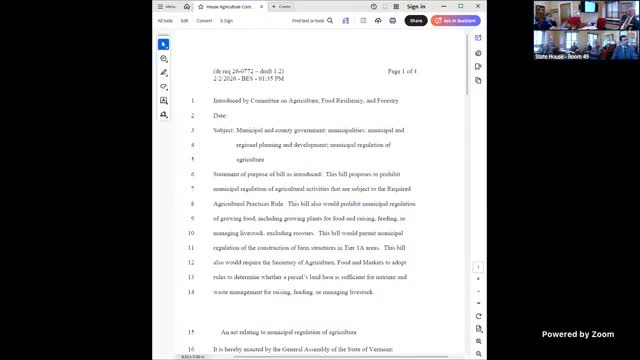
A legislative committee on Agriculture, Food Resiliency, & Forestry on Friday reviewed a draft bill that would limit municipal regulation of agricultural activity while allowing local zoning control over the construction of farm structures in designated tier 1a areas.
Bradley Shelman, of the Office of Legislative Counsel, told the committee the bill "focuses solely on municipal regulation of agriculture by by law" and described a proposed grandfather clause: "Municipality shall not regulate by by law the construction repair improvement of farm structures built in a tier 1 area prior to 07/01/2026," a placeholder date Shelman said could be changed by the committee.
The committee debated the scope of that protection. Representative Bartholomew asked, "If it's already there, why would you be constructing it?" to highlight whether "construction" would cover rebuilding, repairs or additions. Shelman said the word was intended to capture reconstruction or repair after events such as fire or flood and that the text could be broadened to include "expansion" or explicitly name "reconstruction" to avoid confusion.
Members also discussed whether an existing farm should be able to add an entirely new farm structure after the grandfather date. Several members said the intent was to allow a landowner already farming as of the chosen date to construct new farm structures; Shelman cautioned that language changes would be needed to make that explicit and to define what counts as "farming."
The draft separates construction of farm structures from farming practices that fall under the state's Required Agricultural Practices (RAP). Shelman said farms with more than about $2,000 in annual sales would be subject to RAP statewide and thus not subject to municipal bylaws, while smaller, household-level activity would be treated differently.
The committee considered a new "right to grow" provision. Shelman said he revised the phrase to protect "growing food for the landowner's household or nonpaying guests," and asked whether the committee wanted protections to extend to selling food. Representative Nelson and others emphasized the committee's intent was to protect individuals' ability to feed themselves, not to enable commercial activity: the exemption would cover household use but sales could remain subject to RAP or municipal regulations.
Members raised practical overlaps with private property and lease arrangements. Shelman noted the bill would not change a property owner's rights under leases or homeowners association rules and that a separate rental/lease bill would be needed to override lease terms; the committee discussed whether the statute should say "occupants" rather than "owner's household" to avoid excluding renters where owners permit gardening.
On livestock, Shelman said the draft conditions household livestock exemptions on a parcel having a "sufficient land base for appropriate nutrient waste management" as determined by the secretary of agriculture, food, and markets, and on compliance with RAP. The bill requests that the secretary adopt rules to define sufficient land base and establish a petition process for owners or municipalities to seek determinations.
Representative Boswell and others raised nuisance concerns about certain species, urging the committee to consider whether roosters or guinea fowl should be excluded from automatically acceptable categories because of noise or harassment complaints. "If roosters weren't noisy, I don't think they would be on that list," Boswell said.
The committee discussed the bill's effective date and whether grandfathering should use a later date to give owners more notice. Shelman said the draft had been changed to make the act effective "on passage" but that the committee could set a later grandfather date (for example, 07/01/2027) if it wished.
Shelman said he had intended to address cannabis-related language but the committee agreed to defer that topic to focus on the grandfathering and "right to grow" questions. The chair proposed inviting the League of Cities and Towns and other stakeholders for further input and called a short recess to allow additional testimony.
No formal motions or votes were recorded during the segment on this bill; the committee asked counsel to draft clarifications on expansion/reconstruction, consider changing "owner's household" to a broader occupant definition, and to circulate language for the secretary's petition and rulemaking process.
Bradley Shelman, of the Office of Legislative Counsel, told the committee the bill "focuses solely on municipal regulation of agriculture by by law" and described a proposed grandfather clause: "Municipality shall not regulate by by law the construction repair improvement of farm structures built in a tier 1 area prior to 07/01/2026," a placeholder date Shelman said could be changed by the committee.
The committee debated the scope of that protection. Representative Bartholomew asked, "If it's already there, why would you be constructing it?" to highlight whether "construction" would cover rebuilding, repairs or additions. Shelman said the word was intended to capture reconstruction or repair after events such as fire or flood and that the text could be broadened to include "expansion" or explicitly name "reconstruction" to avoid confusion.
Members also discussed whether an existing farm should be able to add an entirely new farm structure after the grandfather date. Several members said the intent was to allow a landowner already farming as of the chosen date to construct new farm structures; Shelman cautioned that language changes would be needed to make that explicit and to define what counts as "farming."
The draft separates construction of farm structures from farming practices that fall under the state's Required Agricultural Practices (RAP). Shelman said farms with more than about $2,000 in annual sales would be subject to RAP statewide and thus not subject to municipal bylaws, while smaller, household-level activity would be treated differently.
The committee considered a new "right to grow" provision. Shelman said he revised the phrase to protect "growing food for the landowner's household or nonpaying guests," and asked whether the committee wanted protections to extend to selling food. Representative Nelson and others emphasized the committee's intent was to protect individuals' ability to feed themselves, not to enable commercial activity: the exemption would cover household use but sales could remain subject to RAP or municipal regulations.
Members raised practical overlaps with private property and lease arrangements. Shelman noted the bill would not change a property owner's rights under leases or homeowners association rules and that a separate rental/lease bill would be needed to override lease terms; the committee discussed whether the statute should say "occupants" rather than "owner's household" to avoid excluding renters where owners permit gardening.
On livestock, Shelman said the draft conditions household livestock exemptions on a parcel having a "sufficient land base for appropriate nutrient waste management" as determined by the secretary of agriculture, food, and markets, and on compliance with RAP. The bill requests that the secretary adopt rules to define sufficient land base and establish a petition process for owners or municipalities to seek determinations.
Representative Boswell and others raised nuisance concerns about certain species, urging the committee to consider whether roosters or guinea fowl should be excluded from automatically acceptable categories because of noise or harassment complaints. "If roosters weren't noisy, I don't think they would be on that list," Boswell said.
The committee discussed the bill's effective date and whether grandfathering should use a later date to give owners more notice. Shelman said the draft had been changed to make the act effective "on passage" but that the committee could set a later grandfather date (for example, 07/01/2027) if it wished.
Shelman said he had intended to address cannabis-related language but the committee agreed to defer that topic to focus on the grandfathering and "right to grow" questions. The chair proposed inviting the League of Cities and Towns and other stakeholders for further input and called a short recess to allow additional testimony.
No formal motions or votes were recorded during the segment on this bill; the committee asked counsel to draft clarifications on expansion/reconstruction, consider changing "owner's household" to a broader occupant definition, and to circulate language for the secretary's petition and rulemaking process.
Don't Miss a Word: See the Full Meeting!
Go beyond summaries. Unlock every video, transcript, and key insight with a Founder Membership.
✓
Get instant access to full meeting videos
✓
Search and clip any phrase from complete transcripts
✓
Receive AI-powered summaries & custom alerts
✓
Enjoy lifetime, unrestricted access to government data
30-day money-back guarantee
