Rutherford County committee approves $650,000 to study new jail options
February 06, 2026 | Rutherford County, Tennessee
This article was created by AI summarizing key points discussed. AI makes mistakes, so for full details and context, please refer to the video of the full meeting. Please report any errors so we can fix them. Report an error »
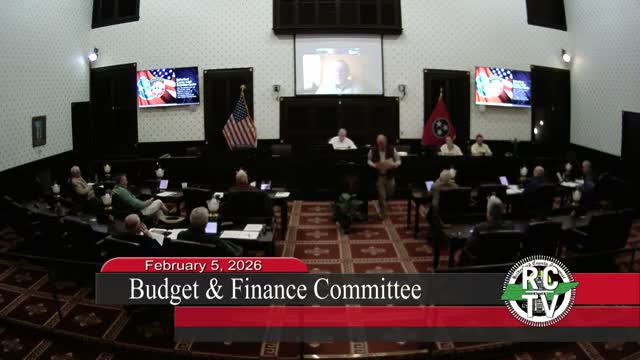
Rutherford County’s Budget, Finance and Investment Committee voted unanimously Feb. 5 to fund a six‑month programming study — not to exceed $650,000 — to evaluate whether the county should renovate, expand or build a new adult detention facility.
Commissioner Gooch, who chaired the corrections partnership study group, told the committee the group concluded "we desperately need a new jail" after touring the county’s adult detention center and reviewing a needs assessment. Commissioners and outside consultants described a facility built for roughly 500 inmates now routinely housing more than 1,000 people and operating near TCI (Tennessee Correctional Institute) capacity limits.
Sheriff Fitzhugh detailed operational problems that staff say have grown with the county’s population: "We are at full capacity…we are over capacity," he said, explaining that aging infrastructure — from a cramped sally port to undersized laundry and storage — hampers operations and programming for inmates. Consultants and TCI representatives highlighted classification challenges, increased violence among some inmate populations, expanded medical needs and constraints on staff and evidence storage.
Bart Klein, the project client for the county’s architect team, outlined the proposed programming phase. The work would assemble roughly a dozen subject‑matter consultants, document operational and policy needs, evaluate the existing site and potential alternate sites, and produce a ‘‘holy‑grail’’ program document that lists required spaces, staffing implications and order‑of‑magnitude costs. Klein estimated the programming task would take about six months and set a not‑to‑exceed fee of $650,000, with any unused funds credited toward later design phases if the county proceeds.
Finance staff recommended using leftover capital projects funds (Fund 1170) to pay the fee rather than issuing new debt. Finance Director Michael told the committee the amount is small relative to the county’s overall budget and that about $3.1 million of available capital project funds could be shifted to avoid borrowing.
Commissioners pressed for transparency and public engagement: staff and consultants agreed to produce regular reports and public materials during the programming phase, including options analysis and site investigations. The committee’s vote authorizes staff to work with bond counsel and the project team on procurement steps and returns the final funding appropriation decision to the commission if the county proceeds into design.
Votes at a glance: the committee recorded a roll‑call vote with commissioners present voting "Yes," and the motion carried.
What comes next: staff and the consultant team will begin the programming work, compile deliverables — including site options, operational models and cost estimates — and report back to the Budget Committee and Public Works as the work proceeds.
Commissioner Gooch, who chaired the corrections partnership study group, told the committee the group concluded "we desperately need a new jail" after touring the county’s adult detention center and reviewing a needs assessment. Commissioners and outside consultants described a facility built for roughly 500 inmates now routinely housing more than 1,000 people and operating near TCI (Tennessee Correctional Institute) capacity limits.
Sheriff Fitzhugh detailed operational problems that staff say have grown with the county’s population: "We are at full capacity…we are over capacity," he said, explaining that aging infrastructure — from a cramped sally port to undersized laundry and storage — hampers operations and programming for inmates. Consultants and TCI representatives highlighted classification challenges, increased violence among some inmate populations, expanded medical needs and constraints on staff and evidence storage.
Bart Klein, the project client for the county’s architect team, outlined the proposed programming phase. The work would assemble roughly a dozen subject‑matter consultants, document operational and policy needs, evaluate the existing site and potential alternate sites, and produce a ‘‘holy‑grail’’ program document that lists required spaces, staffing implications and order‑of‑magnitude costs. Klein estimated the programming task would take about six months and set a not‑to‑exceed fee of $650,000, with any unused funds credited toward later design phases if the county proceeds.
Finance staff recommended using leftover capital projects funds (Fund 1170) to pay the fee rather than issuing new debt. Finance Director Michael told the committee the amount is small relative to the county’s overall budget and that about $3.1 million of available capital project funds could be shifted to avoid borrowing.
Commissioners pressed for transparency and public engagement: staff and consultants agreed to produce regular reports and public materials during the programming phase, including options analysis and site investigations. The committee’s vote authorizes staff to work with bond counsel and the project team on procurement steps and returns the final funding appropriation decision to the commission if the county proceeds into design.
Votes at a glance: the committee recorded a roll‑call vote with commissioners present voting "Yes," and the motion carried.
What comes next: staff and the consultant team will begin the programming work, compile deliverables — including site options, operational models and cost estimates — and report back to the Budget Committee and Public Works as the work proceeds.
View the Full Meeting & All Its Details
This article offers just a summary. Unlock complete video, transcripts, and insights as a Founder Member.
✓
Watch full, unedited meeting videos
✓
Search every word spoken in unlimited transcripts
✓
AI summaries & real-time alerts (all government levels)
✓
Permanent access to expanding government content
30-day money-back guarantee
