Medical experts on MegaTrends criticize RFK Jr.-linked advisory moves and warn of vaccine-policy risks
February 06, 2026 | Half Moon Bay, Half Moon Bay City, San Mateo County, California
This article was created by AI summarizing key points discussed. AI makes mistakes, so for full details and context, please refer to the video of the full meeting. Please report any errors so we can fix them. Report an error »
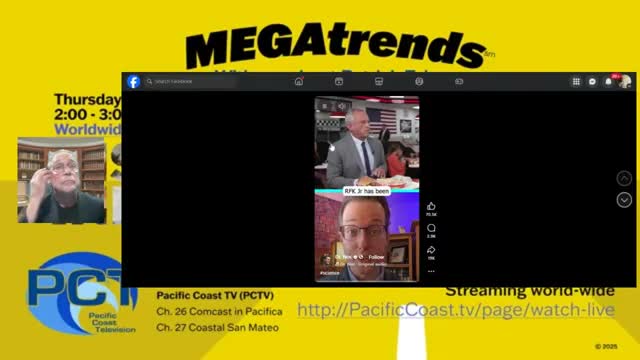
MegaTrends' Feb. 5 episode aired a series of medical-expert clips criticizing what guests called selective citation and poor evidence use by Robert F. Kennedy Jr. and an advisory group influencing vaccine recommendations. A commentator in the episode said a study Kennedy cited actually found no association between COVID-19 vaccination and miscarriage and accused Kennedy of citing only a paper title rather than the results.
"In the abstract of the study, right at the top, it says very clearly that SARS CoV 2 vaccination was not associated with miscarriage," the broadcast quoted one expert saying as they walked through study tables and hazard ratios.
A separate clip attributed to a CDC-affiliated expert said a vaccine advisory panel linked on-air to Kennedy's influence was scheduled to vote on whether to remove the recommendation for newborn hepatitis B vaccination. The expert argued that removing the universal newborn dose would reduce access because insurance coverage and routine administration are tied to official recommendations. "If the committee votes tomorrow to no longer recommend protecting children against hepatitis B at birth, it would impact financial coverage of that vaccine," the clip asserted.
The program also aired a segment explaining that earlier U.S. policy relied on screening pregnant women for hepatitis B instead of universal newborn dosing, and that approach had left children at risk because of testing gaps and exposures from household contacts. The broadcast stressed that public-health experts commonly present evidence that universal newborn hepatitis B dosing helps prevent later liver disease and cancer.
MegaTrends linked these concerns to wider public-health outcomes, including reported measles cases and local exposure events tied on the show to vaccine hesitancy. The host warned that removing expert briefings and sidelining career scientists from advisory processes could produce immediate public-health impacts.
The episode included no direct interview with Robert F. Kennedy Jr. or members of the advisory panel; medical- and public-health voices were the primary sources presented. The program called for listeners to follow published evidence, support public-health experts and watch advisory votes closely.
"In the abstract of the study, right at the top, it says very clearly that SARS CoV 2 vaccination was not associated with miscarriage," the broadcast quoted one expert saying as they walked through study tables and hazard ratios.
A separate clip attributed to a CDC-affiliated expert said a vaccine advisory panel linked on-air to Kennedy's influence was scheduled to vote on whether to remove the recommendation for newborn hepatitis B vaccination. The expert argued that removing the universal newborn dose would reduce access because insurance coverage and routine administration are tied to official recommendations. "If the committee votes tomorrow to no longer recommend protecting children against hepatitis B at birth, it would impact financial coverage of that vaccine," the clip asserted.
The program also aired a segment explaining that earlier U.S. policy relied on screening pregnant women for hepatitis B instead of universal newborn dosing, and that approach had left children at risk because of testing gaps and exposures from household contacts. The broadcast stressed that public-health experts commonly present evidence that universal newborn hepatitis B dosing helps prevent later liver disease and cancer.
MegaTrends linked these concerns to wider public-health outcomes, including reported measles cases and local exposure events tied on the show to vaccine hesitancy. The host warned that removing expert briefings and sidelining career scientists from advisory processes could produce immediate public-health impacts.
The episode included no direct interview with Robert F. Kennedy Jr. or members of the advisory panel; medical- and public-health voices were the primary sources presented. The program called for listeners to follow published evidence, support public-health experts and watch advisory votes closely.
View the Full Meeting & All Its Details
This article offers just a summary. Unlock complete video, transcripts, and insights as a Founder Member.
✓
Watch full, unedited meeting videos
✓
Search every word spoken in unlimited transcripts
✓
AI summaries & real-time alerts (all government levels)
✓
Permanent access to expanding government content
30-day money-back guarantee
