County adopts updates to animal-services fees, eliminates impound fees after heated public testimony on euthanasia
February 06, 2026 | Multnomah County, Oregon
This article was created by AI summarizing key points discussed. AI makes mistakes, so for full details and context, please refer to the video of the full meeting. Please report any errors so we can fix them. Report an error »
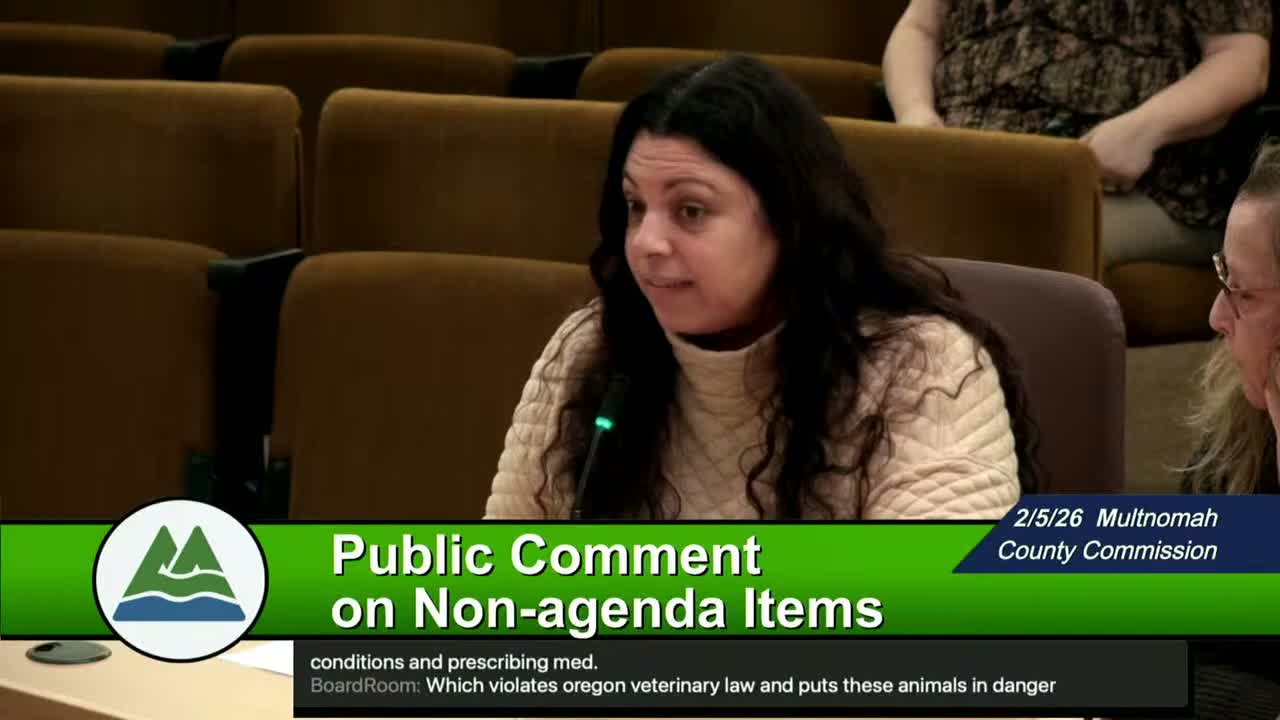
Public testimony accusing the county’s animal-shelter operations of mistreating animals and misusing a donor fund gave urgency to a fee-study the board adopted Monday, when commissioners voted to update Chapter 13 of the County Code and approve a set of fee-policy changes for Multnomah County Animal Services (MCAS).
An unidentified public commenter opened the meeting’s testimony by saying MCAS had "$700,000 in Dolly's Fund that does not get used for medical treatments" and alleging that shelter staff had euthanized treatable dogs, citing specific cases and asking, "Why was the vet not alerted right away?" The speaker concluded, "This is medical negligence, not even close to meeting the accepted standard of care," and named a vet tech and the shelter manager for accountability. MCAS staff later said they follow an established euthanasia policy and offered to share it with the board.
The action before the board was the final step in a fee study conducted by DCS and MCAS that examined five years of data. MCAS Director Erin Gramaheck summarized the study’s four recommendations: modernize licensing to raise participation rather than raise fees; explore variable adoption fees to cross-subsidize harder-to-place animals; eliminate impound fees for stray pets to promote reunification; and remove obsolete fees from county code. Gramaheck said the goal is to "center the pet and the human bond," increase reunifications, and align fee policy with equity and public-health aims.
Staff told commissioners that licensing is the largest single fee revenue source (about $1,000,000 last fiscal year) and that current licensing revenue posts to the county general fund. County budget staff said that while the fees are credited to animal services, they are budgeted in the general fund and included in overall forecasts. Commissioners pressed staff for follow-up data on the dollar amounts and for alternatives to increasing fees, and staff described options including technology upgrades, vendor partnerships, and outreach to veterinarians to make licensing easier.
On the public-health front, commissioners and staff discussed the link between rabies vaccination and licensing. Staff advised the board that the state statute couples rabies vaccination and dog licensing, though there was some back-and-forth about cats and county code; staff promised to return with a clarification on statutory vs. code requirements.
The board adopted the resolution by roll call. Commissioners praised the study as foundational for the budget process and asked staff to return with implementation details — including clearer revenue accounting, criteria for fee waivers, and publication of the shelter’s euthanasia policy.
What happens next: staff will share requested follow-up data, send the euthanasia policy to the board, and proceed with the code changes and administrative steps required to eliminate impound fees for non-dangerous animals and update fee-waiver criteria.
An unidentified public commenter opened the meeting’s testimony by saying MCAS had "$700,000 in Dolly's Fund that does not get used for medical treatments" and alleging that shelter staff had euthanized treatable dogs, citing specific cases and asking, "Why was the vet not alerted right away?" The speaker concluded, "This is medical negligence, not even close to meeting the accepted standard of care," and named a vet tech and the shelter manager for accountability. MCAS staff later said they follow an established euthanasia policy and offered to share it with the board.
The action before the board was the final step in a fee study conducted by DCS and MCAS that examined five years of data. MCAS Director Erin Gramaheck summarized the study’s four recommendations: modernize licensing to raise participation rather than raise fees; explore variable adoption fees to cross-subsidize harder-to-place animals; eliminate impound fees for stray pets to promote reunification; and remove obsolete fees from county code. Gramaheck said the goal is to "center the pet and the human bond," increase reunifications, and align fee policy with equity and public-health aims.
Staff told commissioners that licensing is the largest single fee revenue source (about $1,000,000 last fiscal year) and that current licensing revenue posts to the county general fund. County budget staff said that while the fees are credited to animal services, they are budgeted in the general fund and included in overall forecasts. Commissioners pressed staff for follow-up data on the dollar amounts and for alternatives to increasing fees, and staff described options including technology upgrades, vendor partnerships, and outreach to veterinarians to make licensing easier.
On the public-health front, commissioners and staff discussed the link between rabies vaccination and licensing. Staff advised the board that the state statute couples rabies vaccination and dog licensing, though there was some back-and-forth about cats and county code; staff promised to return with a clarification on statutory vs. code requirements.
The board adopted the resolution by roll call. Commissioners praised the study as foundational for the budget process and asked staff to return with implementation details — including clearer revenue accounting, criteria for fee waivers, and publication of the shelter’s euthanasia policy.
What happens next: staff will share requested follow-up data, send the euthanasia policy to the board, and proceed with the code changes and administrative steps required to eliminate impound fees for non-dangerous animals and update fee-waiver criteria.
Don't Miss a Word: See the Full Meeting!
Go beyond summaries. Unlock every video, transcript, and key insight with a Founder Membership.
✓
Get instant access to full meeting videos
✓
Search and clip any phrase from complete transcripts
✓
Receive AI-powered summaries & custom alerts
✓
Enjoy lifetime, unrestricted access to government data
30-day money-back guarantee
