DOC officials brief committee on inmate tablets, phone service and projected costs
February 06, 2026 | Corrections & Institutions, HOUSE OF REPRESENTATIVES, Committees, Legislative , Vermont
This article was created by AI summarizing key points discussed. AI makes mistakes, so for full details and context, please refer to the video of the full meeting. Please report any errors so we can fix them. Report an error »
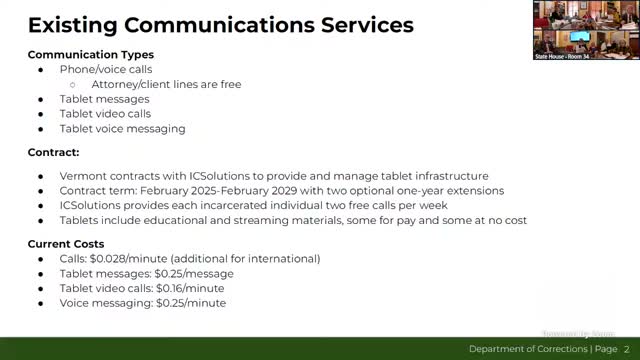
Department of Corrections finance officials told the Corrections & Institutions committee that the state’s contract with a telecommunications vendor provides tablets and telephony infrastructure with no upfront cost to DOC, and that vendor revenues are recovered through fees charged to incarcerated people and commissary pricing.
Committee members were shown the contract term (February 2025 through February 2029, with two optional one-year extensions) and a list of services that includes voice calls, attorney-client landlines, tablet messages, tablet video calls and tablet voice messaging. DOC staff described the agreement as structured so that the vendor supplies hardware and infrastructure while recouping costs through per-service charges.
DOC presented recent usage figures for a roughly quarter-long period: 161,633 phone calls (about 946,000 minutes) that cost roughly $82,003.83 and 13,572 video calls (about 141,148 minutes) that cost about $18,937. Using that quarter as a baseline, DOC estimated the annual cost to the department to absorb all phone and video fees would be approximately $405,284.
Committee members asked how account balances are funded and who ultimately pays for services. DOC explained funds are typically added to incarcerated individuals’ accounts by friends and family through a vendor portal (reported to include a $500-per-day funding limit) or via mail-in options; those accounts are used for commissary and telephony charges. DOC staff said the vendor assumes the financial risk if usage and pricing revenue fall short of projections.
The committee raised security and privacy questions. A facility operations manager told members that all calls are recorded, that intelligence officers can actively monitor communications, and that recordings are retained for operational use. DOC also said vendor-held data is stored off-site at multiple U.S. data centers (testimony identified Atlanta, San Antonio and St. Louis) and is retained for three years unless transferred to the state on contract termination.
Members pressed DOC about the transition between vendors earlier this cycle. DOC acknowledged a migration gap that briefly left roughly 330 people without access to funds or phone services; staff said they worked with vendors to restore access and described data handoffs between contractors as challenging.
The committee discussed options if the state were to absorb telephony fees (for example, unlimited free calls). DOC noted usage typically rises after free-call policies are adopted elsewhere and said consideration of a usage cap or limits per person would likely be necessary to control costs.
Next steps: Committee members asked DOC for additional cost estimates (including what replacing vendor-supplied hardware would cost if the state assumed that obligation) and for clearer detail on data ownership and monitoring protocols. DOC indicated it could follow up with more detailed estimates and contract language for the committee to review.
Committee members were shown the contract term (February 2025 through February 2029, with two optional one-year extensions) and a list of services that includes voice calls, attorney-client landlines, tablet messages, tablet video calls and tablet voice messaging. DOC staff described the agreement as structured so that the vendor supplies hardware and infrastructure while recouping costs through per-service charges.
DOC presented recent usage figures for a roughly quarter-long period: 161,633 phone calls (about 946,000 minutes) that cost roughly $82,003.83 and 13,572 video calls (about 141,148 minutes) that cost about $18,937. Using that quarter as a baseline, DOC estimated the annual cost to the department to absorb all phone and video fees would be approximately $405,284.
Committee members asked how account balances are funded and who ultimately pays for services. DOC explained funds are typically added to incarcerated individuals’ accounts by friends and family through a vendor portal (reported to include a $500-per-day funding limit) or via mail-in options; those accounts are used for commissary and telephony charges. DOC staff said the vendor assumes the financial risk if usage and pricing revenue fall short of projections.
The committee raised security and privacy questions. A facility operations manager told members that all calls are recorded, that intelligence officers can actively monitor communications, and that recordings are retained for operational use. DOC also said vendor-held data is stored off-site at multiple U.S. data centers (testimony identified Atlanta, San Antonio and St. Louis) and is retained for three years unless transferred to the state on contract termination.
Members pressed DOC about the transition between vendors earlier this cycle. DOC acknowledged a migration gap that briefly left roughly 330 people without access to funds or phone services; staff said they worked with vendors to restore access and described data handoffs between contractors as challenging.
The committee discussed options if the state were to absorb telephony fees (for example, unlimited free calls). DOC noted usage typically rises after free-call policies are adopted elsewhere and said consideration of a usage cap or limits per person would likely be necessary to control costs.
Next steps: Committee members asked DOC for additional cost estimates (including what replacing vendor-supplied hardware would cost if the state assumed that obligation) and for clearer detail on data ownership and monitoring protocols. DOC indicated it could follow up with more detailed estimates and contract language for the committee to review.
View the Full Meeting & All Its Details
This article offers just a summary. Unlock complete video, transcripts, and insights as a Founder Member.
✓
Watch full, unedited meeting videos
✓
Search every word spoken in unlimited transcripts
✓
AI summaries & real-time alerts (all government levels)
✓
Permanent access to expanding government content
30-day money-back guarantee
