Committee hears how commissary revenue funds recreation staff and programs
February 06, 2026 | Corrections & Institutions, HOUSE OF REPRESENTATIVES, Committees, Legislative , Vermont
This article was created by AI summarizing key points discussed. AI makes mistakes, so for full details and context, please refer to the video of the full meeting. Please report any errors so we can fix them. Report an error »
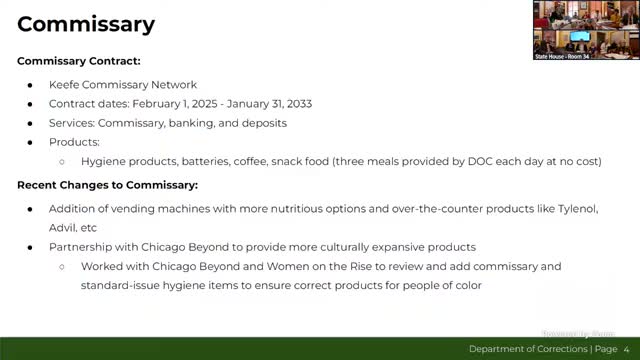
The Corrections & Institutions committee reviewed DOC testimony on the state’s commissary contract and how commissary revenue is allocated.
DOC described the commissary agreement (transcribed as with "peak commissary network") covering commissary operations, banking and deposits from Feb. 1, 2025, to Jan. 31, 2033, and said recent changes include vending machines with more nutritious options and partnerships to expand culturally appropriate products.
DOC reported commissary revenue figures and described the recreation fund’s uses. For FY25 DOC listed $713,997 in commissary revenue and FY26 year-to-date revenue of $344,201; officials said the recreation fund largely supports the salary for each facility’s recreation coordinator (one full-time coordinator per facility was reported) and that rec committees at each facility develop annual budgets covering gym equipment, subscriptions, repairs and special events.
Committee members pressed how incarcerated people without family or outside funds obtain basic hygiene or over-the-counter items. DOC said health services providers can supply certain items (for example, analgesics) when clinically appropriate and that incentive programs and rec-fund purchases help ensure people do not go without basic necessities.
DOC staff described the revenue share: testimony indicated approximately 32% of gross commissary sales is recorded as revenue that supports the recreation fund (one speaker referenced an example of 33% for a facility-specific breakdown) and clarified that the percentage applies to gross sales rather than net profit.
Members requested more facility-level breakdowns and asked DOC staff to provide the detailed rec-fund and salary figures by facility. DOC said it would follow up with the requested spreadsheets and the committee discussed potential alternatives if revenue declined or contracts changed.
Next steps: DOC agreed to provide facility-level breakdowns of commissary revenue, rec-fund spending and the composition of rec committees for committee review.
DOC described the commissary agreement (transcribed as with "peak commissary network") covering commissary operations, banking and deposits from Feb. 1, 2025, to Jan. 31, 2033, and said recent changes include vending machines with more nutritious options and partnerships to expand culturally appropriate products.
DOC reported commissary revenue figures and described the recreation fund’s uses. For FY25 DOC listed $713,997 in commissary revenue and FY26 year-to-date revenue of $344,201; officials said the recreation fund largely supports the salary for each facility’s recreation coordinator (one full-time coordinator per facility was reported) and that rec committees at each facility develop annual budgets covering gym equipment, subscriptions, repairs and special events.
Committee members pressed how incarcerated people without family or outside funds obtain basic hygiene or over-the-counter items. DOC said health services providers can supply certain items (for example, analgesics) when clinically appropriate and that incentive programs and rec-fund purchases help ensure people do not go without basic necessities.
DOC staff described the revenue share: testimony indicated approximately 32% of gross commissary sales is recorded as revenue that supports the recreation fund (one speaker referenced an example of 33% for a facility-specific breakdown) and clarified that the percentage applies to gross sales rather than net profit.
Members requested more facility-level breakdowns and asked DOC staff to provide the detailed rec-fund and salary figures by facility. DOC said it would follow up with the requested spreadsheets and the committee discussed potential alternatives if revenue declined or contracts changed.
Next steps: DOC agreed to provide facility-level breakdowns of commissary revenue, rec-fund spending and the composition of rec committees for committee review.
View the Full Meeting & All Its Details
This article offers just a summary. Unlock complete video, transcripts, and insights as a Founder Member.
✓
Watch full, unedited meeting videos
✓
Search every word spoken in unlimited transcripts
✓
AI summaries & real-time alerts (all government levels)
✓
Permanent access to expanding government content
30-day money-back guarantee
