State officials outline Waterbury Dam overhaul, say federal funding largely in place
February 06, 2026 | Corrections & Institutions, HOUSE OF REPRESENTATIVES, Committees, Legislative , Vermont
This article was created by AI summarizing key points discussed. AI makes mistakes, so for full details and context, please refer to the video of the full meeting. Please report any errors so we can fix them. Report an error »
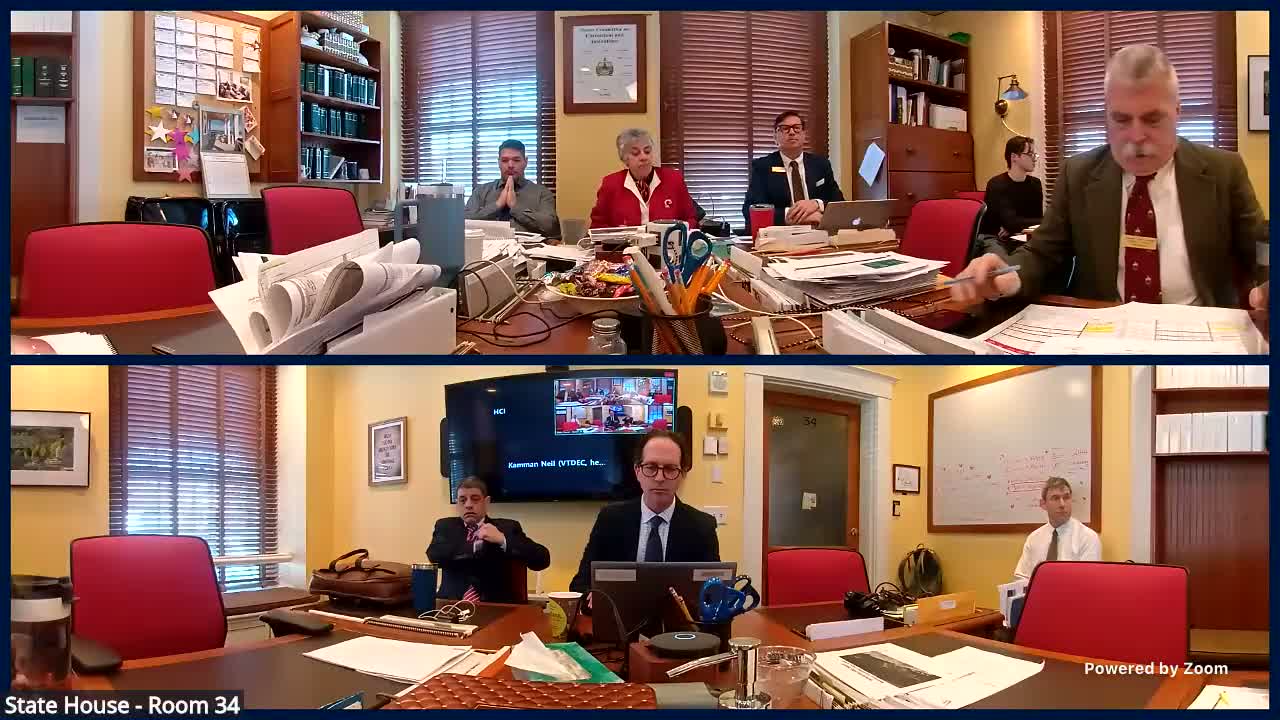
Deputy Commissioner Neil Kamen and Ben Green, the Department of Environmental Conservation’s dam-safety section chief, updated the House Corrections & Institutions Committee on plans to repair and replace the aging spillway and gate system at Waterbury Dam.
Kamen said the project is a partnership with the U.S. Army Corps of Engineers and the state’s congressional delegation, and that the Corps currently holds about $40 million in federal appropriations tied to the project. “We have $40,000,000 of federal funds in the bank,” Kamen said, and DEC is seeking an authorization ceiling lift—through the Water Resources Development Act—so Congress could authorize up to $80 million for the full program.
Green walked members through the dam’s profile and the technical scope of the spillway project. “Waterbury Dam was completed in 1938,” Green said. He described the structure as one of the state’s largest flood-control facilities — 187 feet tall — serving flood protection, a 5-megawatt hydropower plant operated by Green Mountain Power, and popular recreational areas that include two state parks.
DEC officials told the committee the Army Corps’ risk assessment and a subsequent dam-safety modification study identified the spillway as the primary risk driver. The planned scope includes full replacement of the two smaller spillway gates, structural reinforcement of the larger gate, extensive concrete repairs on the spillway, a new spillway bridge and lifting equipment, and bedrock stabilization downstream of the gates.
Construction will require drawing down the reservoir by roughly 30–50 feet so teams can work on the spillway safely. Green said that drawdown is expected to be necessary for about two years and that, during construction, all normal flows will be conveyed through the dam’s tunnel and penstock system. DEC expects construction access works — including temporary access roads and crane pads — to require roughly 20,000 cubic yards of material (about 2,000 truck deliveries) before the spillway work begins.
The revised project estimate shared with the committee was about $76,200,000. Kamen described a favorable cost-share outcome achieved with the congressional delegation, saying the state successfully advocated for a lower state-match rate and currently faces a roughly 7.1% state share for design and construction. Kamen also said DEC has already spent about $3,000,000 on planning and studies and is holding $4,500,000 in state cash funds to support bidding and construction.
Green recounted a safety incident in which the hoist brake for Gate 3 was found unreliable during annual inspection in September; the gate was temporarily taken out of service and DEC activated the dam’s emergency action plan at an advisory level. Replacement parts and installation were completed in January 2026 at a cost DEC staff described as roughly $20,000, and the gates are now operable.
Officials warned committee members that the dam’s original concrete shows alkali‑silica reaction, a chemical deterioration common in early 20th-century concrete that has caused cracking and accelerated wear. That condition helped make the spillway the project’s primary concern and is a factor in whether piers are repaired in place or demolished and rebuilt — a determination the design-phase exploratory drilling this spring will inform.
Kamen advised the committee that while $40 million in federal appropriations are available, the Corps’ authorization ceiling is currently set at $60 million; a congressional effort is under way to raise that ceiling to $80 million in forthcoming Water Resources Development Act language. He said that if the full $80 million is ultimately authorized and appropriated, the state’s maximum match exposure would be small relative to the program; if not, the state exposure would rise and could require additional appropriations.
Committee members raised environmental and historic‑preservation concerns about construction access and the potential loss of hand-placed riprap and the dam’s stone facing. DEC said those trade-offs are still under discussion with the Army Corps and historic‑preservation stakeholders.
The committee did not take action on funding at the hearing; Kamen explained the governor’s budget included a $150,000 cash‑fund recommendation to cover near‑term dewatering and penstock-testing costs so DEC would not need to draw on the $4.5 million cash reserve.
Kamen said the project is a partnership with the U.S. Army Corps of Engineers and the state’s congressional delegation, and that the Corps currently holds about $40 million in federal appropriations tied to the project. “We have $40,000,000 of federal funds in the bank,” Kamen said, and DEC is seeking an authorization ceiling lift—through the Water Resources Development Act—so Congress could authorize up to $80 million for the full program.
Green walked members through the dam’s profile and the technical scope of the spillway project. “Waterbury Dam was completed in 1938,” Green said. He described the structure as one of the state’s largest flood-control facilities — 187 feet tall — serving flood protection, a 5-megawatt hydropower plant operated by Green Mountain Power, and popular recreational areas that include two state parks.
DEC officials told the committee the Army Corps’ risk assessment and a subsequent dam-safety modification study identified the spillway as the primary risk driver. The planned scope includes full replacement of the two smaller spillway gates, structural reinforcement of the larger gate, extensive concrete repairs on the spillway, a new spillway bridge and lifting equipment, and bedrock stabilization downstream of the gates.
Construction will require drawing down the reservoir by roughly 30–50 feet so teams can work on the spillway safely. Green said that drawdown is expected to be necessary for about two years and that, during construction, all normal flows will be conveyed through the dam’s tunnel and penstock system. DEC expects construction access works — including temporary access roads and crane pads — to require roughly 20,000 cubic yards of material (about 2,000 truck deliveries) before the spillway work begins.
The revised project estimate shared with the committee was about $76,200,000. Kamen described a favorable cost-share outcome achieved with the congressional delegation, saying the state successfully advocated for a lower state-match rate and currently faces a roughly 7.1% state share for design and construction. Kamen also said DEC has already spent about $3,000,000 on planning and studies and is holding $4,500,000 in state cash funds to support bidding and construction.
Green recounted a safety incident in which the hoist brake for Gate 3 was found unreliable during annual inspection in September; the gate was temporarily taken out of service and DEC activated the dam’s emergency action plan at an advisory level. Replacement parts and installation were completed in January 2026 at a cost DEC staff described as roughly $20,000, and the gates are now operable.
Officials warned committee members that the dam’s original concrete shows alkali‑silica reaction, a chemical deterioration common in early 20th-century concrete that has caused cracking and accelerated wear. That condition helped make the spillway the project’s primary concern and is a factor in whether piers are repaired in place or demolished and rebuilt — a determination the design-phase exploratory drilling this spring will inform.
Kamen advised the committee that while $40 million in federal appropriations are available, the Corps’ authorization ceiling is currently set at $60 million; a congressional effort is under way to raise that ceiling to $80 million in forthcoming Water Resources Development Act language. He said that if the full $80 million is ultimately authorized and appropriated, the state’s maximum match exposure would be small relative to the program; if not, the state exposure would rise and could require additional appropriations.
Committee members raised environmental and historic‑preservation concerns about construction access and the potential loss of hand-placed riprap and the dam’s stone facing. DEC said those trade-offs are still under discussion with the Army Corps and historic‑preservation stakeholders.
The committee did not take action on funding at the hearing; Kamen explained the governor’s budget included a $150,000 cash‑fund recommendation to cover near‑term dewatering and penstock-testing costs so DEC would not need to draw on the $4.5 million cash reserve.
Don't Miss a Word: See the Full Meeting!
Go beyond summaries. Unlock every video, transcript, and key insight with a Founder Membership.
✓
Get instant access to full meeting videos
✓
Search and clip any phrase from complete transcripts
✓
Receive AI-powered summaries & custom alerts
✓
Enjoy lifetime, unrestricted access to government data
30-day money-back guarantee
