Committee examines fiscal impact of paying incarcerated workers higher wages under H.294
February 06, 2026 | Corrections & Institutions, HOUSE OF REPRESENTATIVES, Committees, Legislative , Vermont
This article was created by AI summarizing key points discussed. AI makes mistakes, so for full details and context, please refer to the video of the full meeting. Please report any errors so we can fix them. Report an error »
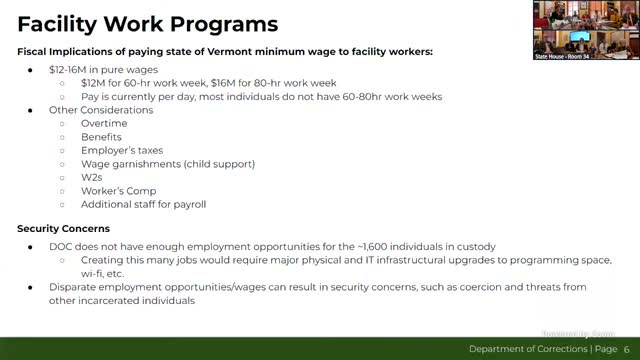
The committee heard a presentation on the fiscal implications of paying incarcerated workers higher wages, a central element of House Bill H.294 described in testimony.
DOC staff presented an estimate that paying facility workers at state minimum wage would result in $12 million to $16 million in pure wages depending on whether the calculation assumes a 60-hour or 80-hour pay period for certain work assignments; DOC staff clarified those figures are biweekly (per pay period) extrapolations based on recent pay-period data and Vermont minimum wage assumptions used in the analysis.
Staff cautioned these figures do not include additional costs that would accompany a change to paid wages: overtime, benefits, employer taxes, payroll administration, W-2 processing, workers’ compensation, and the need for additional staff and infrastructure to expand employment opportunities across the incarcerated population. DOC also said it currently does not have enough work opportunities to employ the roughly 1,600 people in custody and that creating enough paid positions would require physical and IT upgrades.
Committee debate included ethical and legal framing. A committee member who identified themselves as a bill sponsor called current pay rates (testimony cited as low as $0.25 per hour and an average of $0.65 per hour) exploitative and linked the issue to constitutional concerns; other members pressed DOC for comparative costing to hiring state BGS workers for the same roles and asked whether the state would face added costs such as travel reimbursements or benefits for hired staff.
DOC responded that replacing incarcerated labor with state employees would have different cost dynamics depending on job classification and that some facility work (for example kitchen positions) would not neatly transfer to an outsourced or state-worker model without creating new job classifications. DOC offered to provide the underlying pay-period data and the assumptions used to produce the $12–$16 million figures.
Next steps: Committee requested spreadsheets and the underlying methodology used for the wage-impact estimates, and asked DOC to present options for phased implementation and infrastructure needs should H.294 or similar measures proceed.
DOC staff presented an estimate that paying facility workers at state minimum wage would result in $12 million to $16 million in pure wages depending on whether the calculation assumes a 60-hour or 80-hour pay period for certain work assignments; DOC staff clarified those figures are biweekly (per pay period) extrapolations based on recent pay-period data and Vermont minimum wage assumptions used in the analysis.
Staff cautioned these figures do not include additional costs that would accompany a change to paid wages: overtime, benefits, employer taxes, payroll administration, W-2 processing, workers’ compensation, and the need for additional staff and infrastructure to expand employment opportunities across the incarcerated population. DOC also said it currently does not have enough work opportunities to employ the roughly 1,600 people in custody and that creating enough paid positions would require physical and IT upgrades.
Committee debate included ethical and legal framing. A committee member who identified themselves as a bill sponsor called current pay rates (testimony cited as low as $0.25 per hour and an average of $0.65 per hour) exploitative and linked the issue to constitutional concerns; other members pressed DOC for comparative costing to hiring state BGS workers for the same roles and asked whether the state would face added costs such as travel reimbursements or benefits for hired staff.
DOC responded that replacing incarcerated labor with state employees would have different cost dynamics depending on job classification and that some facility work (for example kitchen positions) would not neatly transfer to an outsourced or state-worker model without creating new job classifications. DOC offered to provide the underlying pay-period data and the assumptions used to produce the $12–$16 million figures.
Next steps: Committee requested spreadsheets and the underlying methodology used for the wage-impact estimates, and asked DOC to present options for phased implementation and infrastructure needs should H.294 or similar measures proceed.
Don't Miss a Word: See the Full Meeting!
Go beyond summaries. Unlock every video, transcript, and key insight with a Founder Membership.
✓
Get instant access to full meeting videos
✓
Search and clip any phrase from complete transcripts
✓
Receive AI-powered summaries & custom alerts
✓
Enjoy lifetime, unrestricted access to government data
30-day money-back guarantee
