Ways & Means debates aligning regional assessment districts with school-district boundaries
February 06, 2026 | Ways & Means, HOUSE OF REPRESENTATIVES, Committees, Legislative , Vermont
This article was created by AI summarizing key points discussed. AI makes mistakes, so for full details and context, please refer to the video of the full meeting. Please report any errors so we can fix them. Report an error »
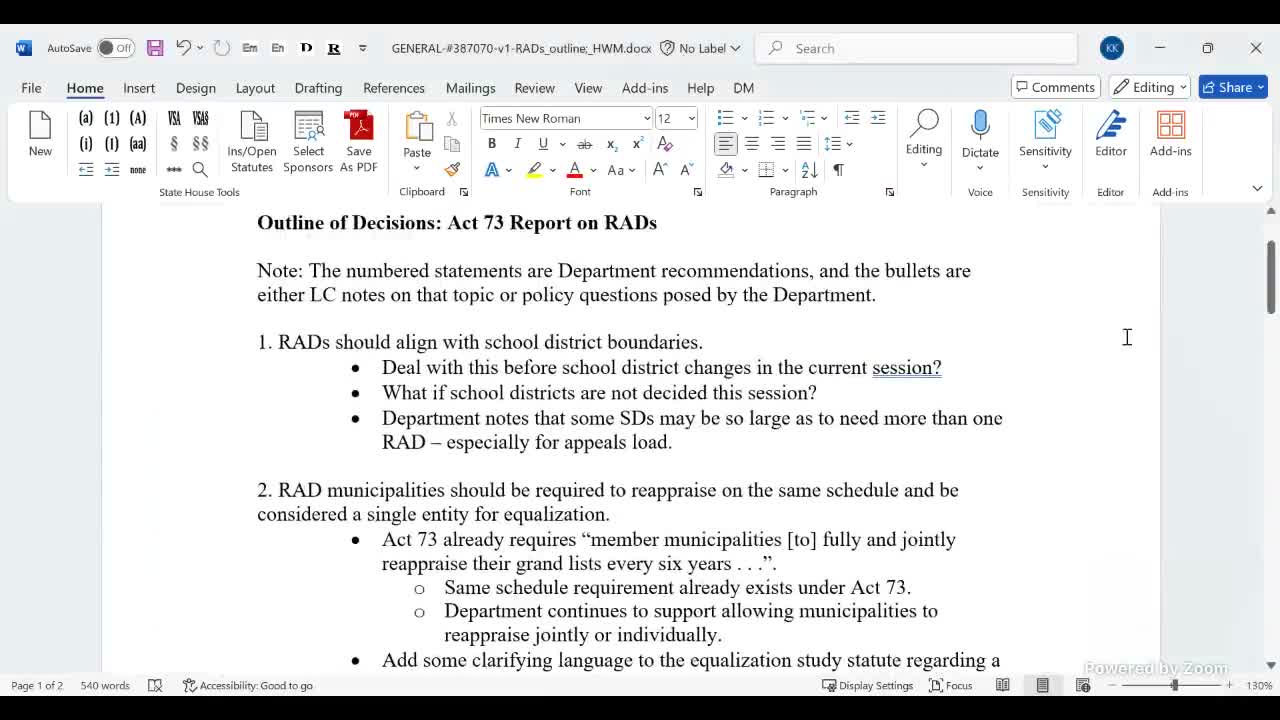
Lawmakers on the Ways & Means Committee spent much of a Feb. 6 meeting weighing whether Vermont’s new regional assessment districts should generally align with school district boundaries, a change the Department of Taxes recommended in its RAD report.
Kirby Keane, legislative counsel, summarized the department’s recommendation that “the RAD boundary should align with school district boundaries,” arguing that alignment could allow jurisdictions to use a single Common Level of Appraisal (CLA), share homestead-exemption values and speak with “one education tax rate” when assessing supplemental district votes. Rebecca Samoroff of the Department of Taxes described the proposal as part of an incremental, “walk before you run” approach meant to build administrative capacity while reducing variation in taxpayers’ bills.
Members raised practical concerns. Some representatives pushed for a fallback approach if school-district maps are not finalized, urging contingency language that would divide or combine districts by a parcel-count threshold for RAD purposes only. One member urged that the statute could delegate boundary-setting to the department with statutory priorities — first to follow school districts when possible, then to consider parcel counts and appeals load, and finally a county-level backup if necessary.
Committee members also debated the appropriate number and size of RADs. Advocates for larger, roughly 12 RADs argued that bigger districts would make contracting for reappraisals easier and reduce administrative fragmentation; others said school-district alignment was worth pursuing even if the map is likely to change over time.
The committee did not take formal votes. Members asked staff to convert the discussion into draft committee language with contingency provisions and to convene stakeholders — including municipal groups and education-policy staff — before producing a subsequent draft. The meeting closed with the committee scheduling continued drafting work next week.
Ending: The committee agreed on next steps rather than a policy decision: staff will produce conditional bill text for future consideration and bring stakeholders in for comment before a subsequent draft is circulated.
Kirby Keane, legislative counsel, summarized the department’s recommendation that “the RAD boundary should align with school district boundaries,” arguing that alignment could allow jurisdictions to use a single Common Level of Appraisal (CLA), share homestead-exemption values and speak with “one education tax rate” when assessing supplemental district votes. Rebecca Samoroff of the Department of Taxes described the proposal as part of an incremental, “walk before you run” approach meant to build administrative capacity while reducing variation in taxpayers’ bills.
Members raised practical concerns. Some representatives pushed for a fallback approach if school-district maps are not finalized, urging contingency language that would divide or combine districts by a parcel-count threshold for RAD purposes only. One member urged that the statute could delegate boundary-setting to the department with statutory priorities — first to follow school districts when possible, then to consider parcel counts and appeals load, and finally a county-level backup if necessary.
Committee members also debated the appropriate number and size of RADs. Advocates for larger, roughly 12 RADs argued that bigger districts would make contracting for reappraisals easier and reduce administrative fragmentation; others said school-district alignment was worth pursuing even if the map is likely to change over time.
The committee did not take formal votes. Members asked staff to convert the discussion into draft committee language with contingency provisions and to convene stakeholders — including municipal groups and education-policy staff — before producing a subsequent draft. The meeting closed with the committee scheduling continued drafting work next week.
Ending: The committee agreed on next steps rather than a policy decision: staff will produce conditional bill text for future consideration and bring stakeholders in for comment before a subsequent draft is circulated.
View the Full Meeting & All Its Details
This article offers just a summary. Unlock complete video, transcripts, and insights as a Founder Member.
✓
Watch full, unedited meeting videos
✓
Search every word spoken in unlimited transcripts
✓
AI summaries & real-time alerts (all government levels)
✓
Permanent access to expanding government content
30-day money-back guarantee
