Joint Fiscal Office says data gaps complicate fiscal picture as UPK draft would change eligibility and weights
February 06, 2026 | Ways & Means, HOUSE OF REPRESENTATIVES, Committees, Legislative , Vermont
This article was created by AI summarizing key points discussed. AI makes mistakes, so for full details and context, please refer to the video of the full meeting. Please report any errors so we can fix them. Report an error »
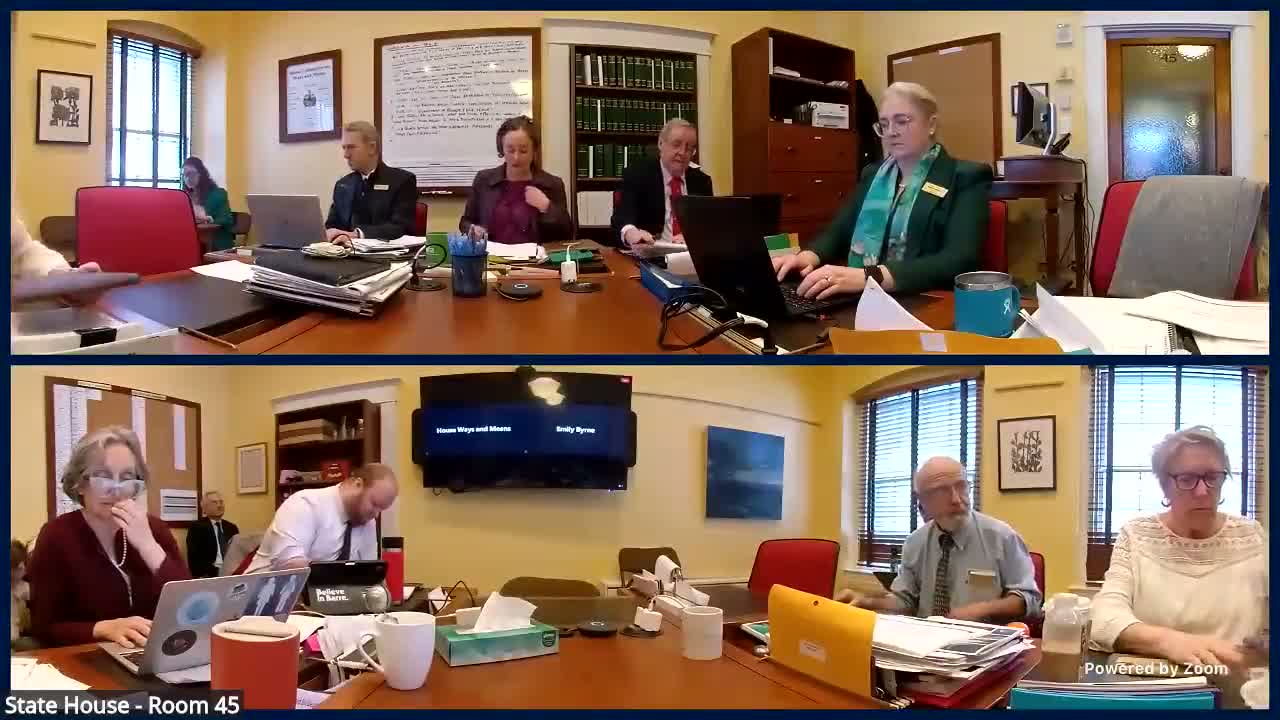
A Joint Fiscal Office analyst told the Ways & Means committee Friday that proposed changes to universal prekindergarten (UPK) funding would narrow eligibility, create a supervisory-union coordinator role and shift how students are counted for state education funding — but she said inconsistent district accounting makes precise fiscal estimates difficult.
"This is not a science. It's an art," said Emily Byrne of the Joint Fiscal Office, describing the limits of the data used in the office's analysis. Byrne urged caution about headline per-pupil numbers and said the committee should view the figures as high-level approximations rather than district-level costs.
Byrne summarized the current statutory framework: under existing law districts must provide access to publicly funded UPK for 10 hours per week for 35 weeks to eligible 3-, 4- and 5-year-olds not yet enrolled in kindergarten. If a family secures a slot at a prequalified provider outside the home district, the sending district pays the statewide UPK tuition to the selected program.
Using Agency of Education (AOE) FY25 data, Byrne said the office estimated roughly $60 million in general-education prekindergarten expenditures in FY25. After removing about $11 million in federal funds, the analysis attributes approximately $48.6 million of education-fund spending to UPK. Byrne said tuition payments to private providers totaled about $14,860,000; excluding those payments left an estimated $33.7 million of direct public-system spending.
The JFO used the FY25 statewide tuition rate of $3,884 to estimate enrollment splits. AOE reported about 7,800 UPK long-term ADM in FY25; dividing tuition totals by the FY25 rate produced an estimated 3,800 UPK students attending private providers and roughly 3,900 attending UPK in public schools.
Dividing the estimated public-system spending ($33.7 million) by the approximate public enrollment (≈3,900) yielded an average public-system figure of roughly $8,400–$8,500 per UPK pupil. "That $8,400 number is a loaded number," Byrne said, stressing it includes administrative and overhead allocations and is not a clean measure of instructional cost.
Committee members pressed Byrne on indirect and administrative costs — building occupancy, supervisory staff allocations and other overhead that are often not coded consistently in district accounting. "We don't know what is everybody doing right now," Byrne said, noting the state lacks a common chart of accounts that would permit apples-to-apples comparisons.
Byrne also summarized proposed bill language that would apply to public providers: it would mandate a UPK coordinator at each supervisory union, limit eligibility to 4- and 5-year-olds (removing 3-year-olds), and change how UPK students are counted in long-term average daily membership and funding weights. She said under Act 73 the pre-k weights correspond to funding and that, as written in the Act 73 formula, pre-k students would receive $6,915 in FY25 along with any other qualifying weights.
Legislators raised operational questions about how the draft language aligns with enrollment-count timing and practices such as "redshirting" (parents delaying kindergarten entry). Byrne acknowledged the draft language may not align cleanly with current enrollment rules — for example, how October 1 counts interact with children born in late summer — and recommended further technical work on counting and implementation.
Byrne and members urged improved data collection if policy changes move forward: consistent coding of hours, program dosage, administrative allocations and a statewide chart of accounts would be needed to evaluate costs and impacts more precisely. The committee paused the session and scheduled follow-up: AOE fiscal analysts are slated to present Tuesday afternoon, and Byrne said she will return for further questioning.
"This is not a science. It's an art," said Emily Byrne of the Joint Fiscal Office, describing the limits of the data used in the office's analysis. Byrne urged caution about headline per-pupil numbers and said the committee should view the figures as high-level approximations rather than district-level costs.
Byrne summarized the current statutory framework: under existing law districts must provide access to publicly funded UPK for 10 hours per week for 35 weeks to eligible 3-, 4- and 5-year-olds not yet enrolled in kindergarten. If a family secures a slot at a prequalified provider outside the home district, the sending district pays the statewide UPK tuition to the selected program.
Using Agency of Education (AOE) FY25 data, Byrne said the office estimated roughly $60 million in general-education prekindergarten expenditures in FY25. After removing about $11 million in federal funds, the analysis attributes approximately $48.6 million of education-fund spending to UPK. Byrne said tuition payments to private providers totaled about $14,860,000; excluding those payments left an estimated $33.7 million of direct public-system spending.
The JFO used the FY25 statewide tuition rate of $3,884 to estimate enrollment splits. AOE reported about 7,800 UPK long-term ADM in FY25; dividing tuition totals by the FY25 rate produced an estimated 3,800 UPK students attending private providers and roughly 3,900 attending UPK in public schools.
Dividing the estimated public-system spending ($33.7 million) by the approximate public enrollment (≈3,900) yielded an average public-system figure of roughly $8,400–$8,500 per UPK pupil. "That $8,400 number is a loaded number," Byrne said, stressing it includes administrative and overhead allocations and is not a clean measure of instructional cost.
Committee members pressed Byrne on indirect and administrative costs — building occupancy, supervisory staff allocations and other overhead that are often not coded consistently in district accounting. "We don't know what is everybody doing right now," Byrne said, noting the state lacks a common chart of accounts that would permit apples-to-apples comparisons.
Byrne also summarized proposed bill language that would apply to public providers: it would mandate a UPK coordinator at each supervisory union, limit eligibility to 4- and 5-year-olds (removing 3-year-olds), and change how UPK students are counted in long-term average daily membership and funding weights. She said under Act 73 the pre-k weights correspond to funding and that, as written in the Act 73 formula, pre-k students would receive $6,915 in FY25 along with any other qualifying weights.
Legislators raised operational questions about how the draft language aligns with enrollment-count timing and practices such as "redshirting" (parents delaying kindergarten entry). Byrne acknowledged the draft language may not align cleanly with current enrollment rules — for example, how October 1 counts interact with children born in late summer — and recommended further technical work on counting and implementation.
Byrne and members urged improved data collection if policy changes move forward: consistent coding of hours, program dosage, administrative allocations and a statewide chart of accounts would be needed to evaluate costs and impacts more precisely. The committee paused the session and scheduled follow-up: AOE fiscal analysts are slated to present Tuesday afternoon, and Byrne said she will return for further questioning.
View the Full Meeting & All Its Details
This article offers just a summary. Unlock complete video, transcripts, and insights as a Founder Member.
✓
Watch full, unedited meeting videos
✓
Search every word spoken in unlimited transcripts
✓
AI summaries & real-time alerts (all government levels)
✓
Permanent access to expanding government content
30-day money-back guarantee
