Vermont AHS proposes $3.75 billion budget, seeks $86 million general‑fund increase to sustain services and tackle homelessness and mental health
February 06, 2026 | Health Care, HOUSE OF REPRESENTATIVES, Committees, Legislative , Vermont
This article was created by AI summarizing key points discussed. AI makes mistakes, so for full details and context, please refer to the video of the full meeting. Please report any errors so we can fix them. Report an error »
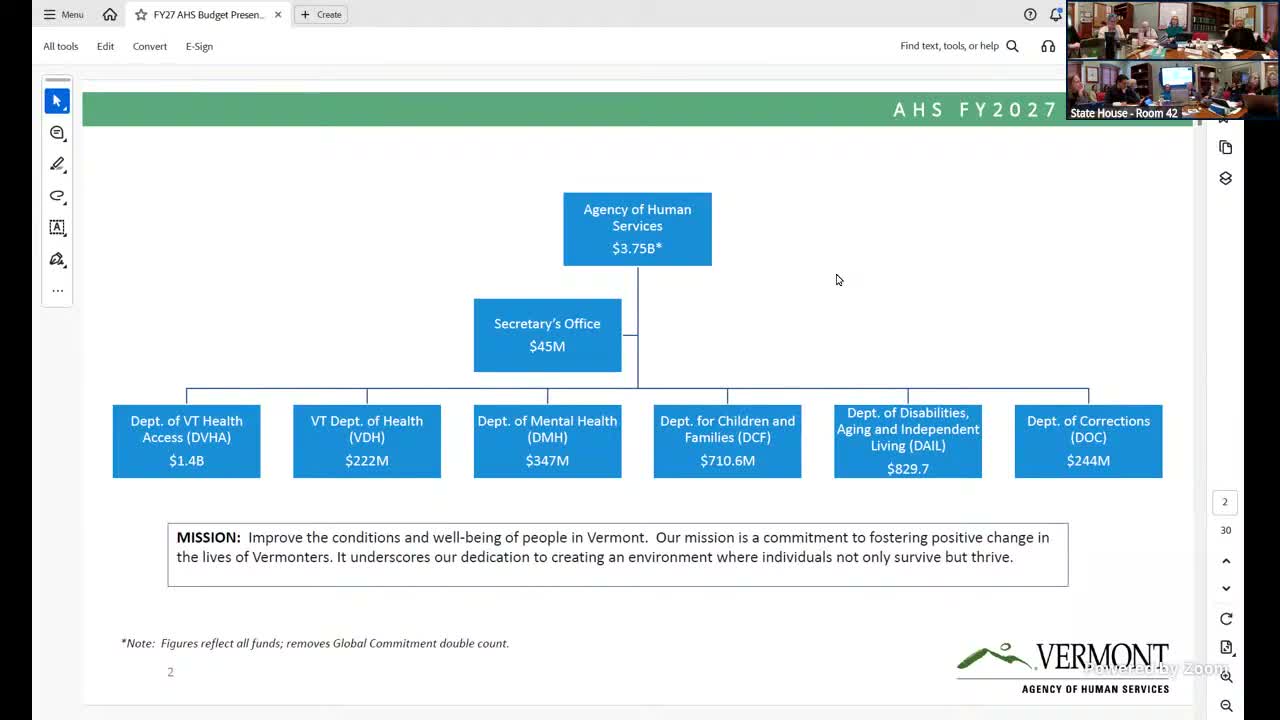
The Vermont Agency of Human Services presented a proposed $3.75 billion budget on Feb. 5, asking for an $86 million (about 6.1%) increase in general‑fund support to sustain existing programs and fund targeted initiatives. "Overall, our budget as proposed is $3,750,000,000," Secretary Jenny Samuelson said at the outset of the briefing.
Agency leaders said Medicaid is the largest component of AHS spending and anchored the budget review. Officials identified two categories of need: baseline funding to "keep the lights on" and a smaller set of strategic initiatives totaling about $11.2 million. AHS leaders said they began the process by aligning departmental proposals with the administration’s priorities: housing (with a focus on homelessness), substance‑use and mental‑health services, health‑care affordability and workforce resilience.
Presenters described several drivers of the requested general‑fund increase. A change in the federal medical‑assistance percentage (FMAP) requires a roughly $13 million state backfill for lost federal Medicaid match. Federal changes tied to HR1 reduced the federal match for SNAP administration from roughly 50% to about 25%, producing an estimated $4.5 million state backfill this budget cycle. Projected shortfalls in childcare payroll tax receipts require about $8.7 million in general‑fund support, and AHS flagged roughly $27.8 million in caseload and utilization pressures across programs.
The agency also seeks to cover salary and fringe cost growth (about $21.3 million) and requested 12 eligibility/enrollment positions to support biannual Medicaid redeterminations, which AHS staff said are focused on the newly enrolled adult population. Contract and vendor costs — including the Medicaid MMIS vendor, a call center contractor, and other data and transport vendors — were cited as adding roughly $17 million in gross contract increases; AHS said some of those costs were already reflected in prior budget adjustments.
Officials identified revenue offsets and savings that reduce the net new ask. Those include an enhanced 90% FMAP for the new‑adult population (estimated $3.0 million saved), enhanced federal match from expanding five CCBHCs (roughly $6.6 million), a projected $461,000 adjustment from a prescription‑drug copay change and about $7.3 million in programmatic efficiencies and vacancy‑based savings. Vacancy savings at the Department of Mental Health and Department of Corrections were cited jointly at about $6.1 million.
The administration proposed roughly $31 million in one‑time and base investments for emergency housing and related supports, including $10.1 million for family‑specific domestic‑violence and medically vulnerable shelter options, substance‑use recovery shelter capacity, rental assistance and case management; AHS is also seeking roughly $875,000 to continue an opioid recovery employment program and $200,000 to expand statewide pretrial supervision staffing.
Samuelson and agency finance staff emphasized the new cross‑department budgeting process, in which commissioners collectively reviewed program effectiveness and duplication prior to recommendations reaching the secretary’s office. "These were very difficult decisions that we didn't take lightly," Samuelson said when describing program reviews and reductions.
AHS said the next step is to provide additional written detail to the committee, including a condensed two‑page ups/down summary by department and follow‑up charts on FMAP and other federal match changes. The briefing concluded with a transition to the Department of Vermont Health Access, which will present its portion of the budget next.
Agency leaders said Medicaid is the largest component of AHS spending and anchored the budget review. Officials identified two categories of need: baseline funding to "keep the lights on" and a smaller set of strategic initiatives totaling about $11.2 million. AHS leaders said they began the process by aligning departmental proposals with the administration’s priorities: housing (with a focus on homelessness), substance‑use and mental‑health services, health‑care affordability and workforce resilience.
Presenters described several drivers of the requested general‑fund increase. A change in the federal medical‑assistance percentage (FMAP) requires a roughly $13 million state backfill for lost federal Medicaid match. Federal changes tied to HR1 reduced the federal match for SNAP administration from roughly 50% to about 25%, producing an estimated $4.5 million state backfill this budget cycle. Projected shortfalls in childcare payroll tax receipts require about $8.7 million in general‑fund support, and AHS flagged roughly $27.8 million in caseload and utilization pressures across programs.
The agency also seeks to cover salary and fringe cost growth (about $21.3 million) and requested 12 eligibility/enrollment positions to support biannual Medicaid redeterminations, which AHS staff said are focused on the newly enrolled adult population. Contract and vendor costs — including the Medicaid MMIS vendor, a call center contractor, and other data and transport vendors — were cited as adding roughly $17 million in gross contract increases; AHS said some of those costs were already reflected in prior budget adjustments.
Officials identified revenue offsets and savings that reduce the net new ask. Those include an enhanced 90% FMAP for the new‑adult population (estimated $3.0 million saved), enhanced federal match from expanding five CCBHCs (roughly $6.6 million), a projected $461,000 adjustment from a prescription‑drug copay change and about $7.3 million in programmatic efficiencies and vacancy‑based savings. Vacancy savings at the Department of Mental Health and Department of Corrections were cited jointly at about $6.1 million.
The administration proposed roughly $31 million in one‑time and base investments for emergency housing and related supports, including $10.1 million for family‑specific domestic‑violence and medically vulnerable shelter options, substance‑use recovery shelter capacity, rental assistance and case management; AHS is also seeking roughly $875,000 to continue an opioid recovery employment program and $200,000 to expand statewide pretrial supervision staffing.
Samuelson and agency finance staff emphasized the new cross‑department budgeting process, in which commissioners collectively reviewed program effectiveness and duplication prior to recommendations reaching the secretary’s office. "These were very difficult decisions that we didn't take lightly," Samuelson said when describing program reviews and reductions.
AHS said the next step is to provide additional written detail to the committee, including a condensed two‑page ups/down summary by department and follow‑up charts on FMAP and other federal match changes. The briefing concluded with a transition to the Department of Vermont Health Access, which will present its portion of the budget next.
View the Full Meeting & All Its Details
This article offers just a summary. Unlock complete video, transcripts, and insights as a Founder Member.
✓
Watch full, unedited meeting videos
✓
Search every word spoken in unlimited transcripts
✓
AI summaries & real-time alerts (all government levels)
✓
Permanent access to expanding government content
30-day money-back guarantee
