Vermont Senate Education Committee hears views on S.313, CTE access and governance
February 06, 2026 | Education, SENATE, Committees, Legislative , Vermont
This article was created by AI summarizing key points discussed. AI makes mistakes, so for full details and context, please refer to the video of the full meeting. Please report any errors so we can fix them. Report an error »
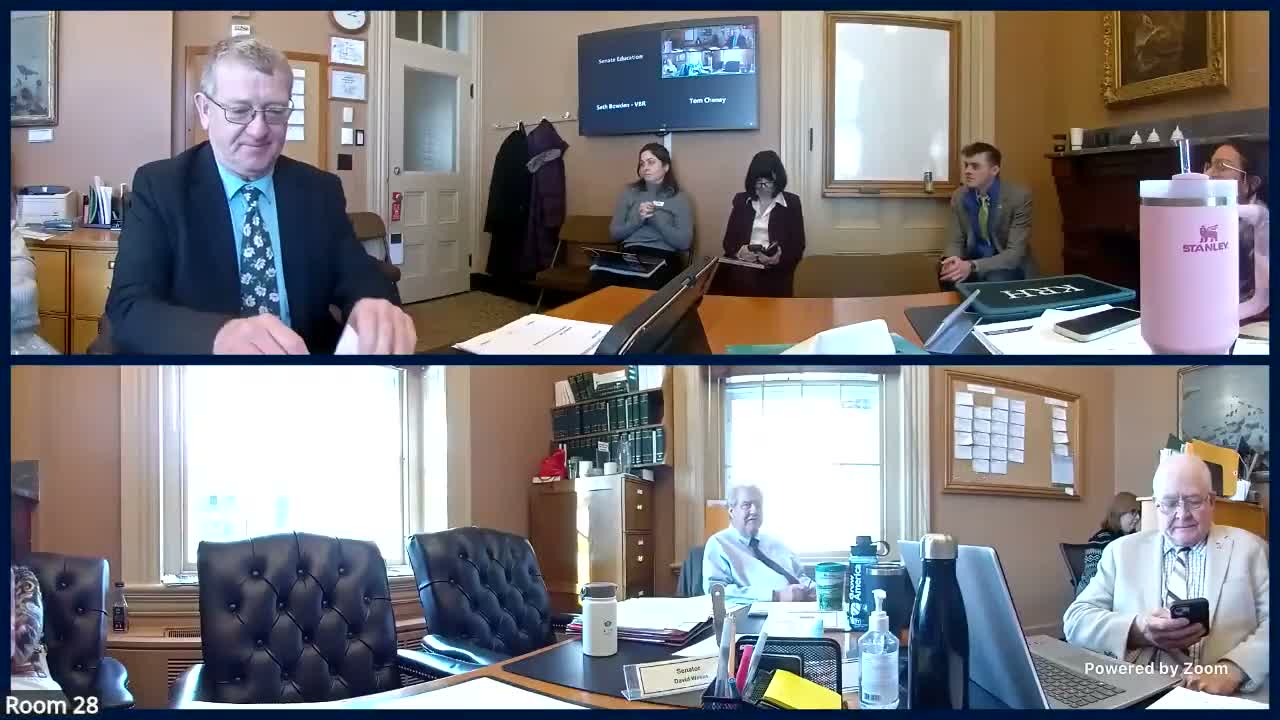
At a Senate Education Committee hearing on Feb. 5, stakeholders urged lawmakers to use S.313 and related policy work to expand access to career and technical education and create clearer governance and funding so students do not ‘fall off a cliff’ after high school.
Tom Chaney, executive director of Advanced Vermont, told the committee the bill grew from a working group that included legislators, education practitioners, students and employers. “CTE is an incredibly important part of our career navigation system,” Chaney said, and the state should pursue models that broaden access — including homeschool, hybrid and adult‑education options — while building consistency between local and state systems.
Seth Bowden, president of the Vermont Business Roundtable, made a case for urgency, citing workforce numbers and CTE outcomes. “Even though Vermont is at almost our highest population level we’ve ever experienced, our workforce has dipped below 350,000 for the first time since the pandemic,” Bowden said. He added that “more than 50% of all Vermont high school graduates go on to no further education. That’s about 2,500 students every year.” Bowden cited evidence that CTE concentrators have higher graduation and employment rates and that, nationally, students with even a few CTE credits see lower unemployment.
Both presenters told the committee they encountered recurring operational barriers: wait lists for critical CTE programming, uneven application of credentialing and friction created by a funding model in which “money follows the student,” which can discourage sending schools from cooperating. Chaney and Bowden said some issues might be handled through rule changes but that broader policy adjustments would be required to ensure equitable access and predictable funding for CTE and adult programs.
Committee members pressed for practical short‑term options for smaller or rural schools. Committee discussion highlighted technology‑enabled instruction, blended delivery models, staff sharing and regional centers as possible ways to expand access without immediately building new facilities. Business support was raised as a source of capital and equipment — with participants pointing to local apprenticeship centers and past employer donations as examples — but presenters advised that private gifts should be additive rather than the sole funding base.
Presenters also recommended clearer career‑navigation standards beginning in middle school so students receive purposeful exposure to pathways before high school. Chaney described efforts to create consistent competencies and timing of exposure so employers and education partners can better coordinate.
No vote or formal committee action on S.313 was recorded during the session. Both Chaney and Bowden offered to stay engaged with the committee as lawmakers refine proposals; the hearing adjourned after members thanked the witnesses.
Note: the transcript identifies the meeting date as “February 5” but does not specify the year. The bill number S.313 and a linkage to Act 73 were discussed in the hearing; the transcript does not contain the bill text or specific statutory changes proposed.
Tom Chaney, executive director of Advanced Vermont, told the committee the bill grew from a working group that included legislators, education practitioners, students and employers. “CTE is an incredibly important part of our career navigation system,” Chaney said, and the state should pursue models that broaden access — including homeschool, hybrid and adult‑education options — while building consistency between local and state systems.
Seth Bowden, president of the Vermont Business Roundtable, made a case for urgency, citing workforce numbers and CTE outcomes. “Even though Vermont is at almost our highest population level we’ve ever experienced, our workforce has dipped below 350,000 for the first time since the pandemic,” Bowden said. He added that “more than 50% of all Vermont high school graduates go on to no further education. That’s about 2,500 students every year.” Bowden cited evidence that CTE concentrators have higher graduation and employment rates and that, nationally, students with even a few CTE credits see lower unemployment.
Both presenters told the committee they encountered recurring operational barriers: wait lists for critical CTE programming, uneven application of credentialing and friction created by a funding model in which “money follows the student,” which can discourage sending schools from cooperating. Chaney and Bowden said some issues might be handled through rule changes but that broader policy adjustments would be required to ensure equitable access and predictable funding for CTE and adult programs.
Committee members pressed for practical short‑term options for smaller or rural schools. Committee discussion highlighted technology‑enabled instruction, blended delivery models, staff sharing and regional centers as possible ways to expand access without immediately building new facilities. Business support was raised as a source of capital and equipment — with participants pointing to local apprenticeship centers and past employer donations as examples — but presenters advised that private gifts should be additive rather than the sole funding base.
Presenters also recommended clearer career‑navigation standards beginning in middle school so students receive purposeful exposure to pathways before high school. Chaney described efforts to create consistent competencies and timing of exposure so employers and education partners can better coordinate.
No vote or formal committee action on S.313 was recorded during the session. Both Chaney and Bowden offered to stay engaged with the committee as lawmakers refine proposals; the hearing adjourned after members thanked the witnesses.
Note: the transcript identifies the meeting date as “February 5” but does not specify the year. The bill number S.313 and a linkage to Act 73 were discussed in the hearing; the transcript does not contain the bill text or specific statutory changes proposed.
View the Full Meeting & All Its Details
This article offers just a summary. Unlock complete video, transcripts, and insights as a Founder Member.
✓
Watch full, unedited meeting videos
✓
Search every word spoken in unlimited transcripts
✓
AI summaries & real-time alerts (all government levels)
✓
Permanent access to expanding government content
30-day money-back guarantee
