Encinitas planning commissioners direct staff to draft denial for Newman setback variance, allow redesign
February 06, 2026 | Encinitas, San Diego County, California
This article was created by AI summarizing key points discussed. AI makes mistakes, so for full details and context, please refer to the video of the full meeting. Please report any errors so we can fix them. Report an error »
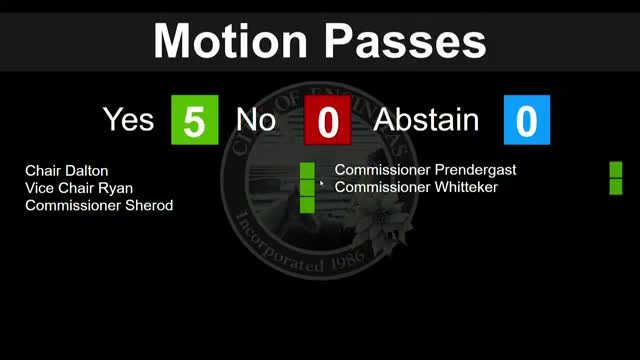
The Encinitas Planning Commission on a 3–2 vote directed staff to prepare a resolution denying a variance request that would reduce the required 25-foot front-yard setback to 14 feet 1 inch for the Newman residence (Case Multi0071762024), while specifically allowing the applicant to work with staff on a redesign and resubmit.
Senior Planner Christina Bustamante told the commission the application would reduce the required front-yard setback to 14 feet 1 inch to the building wall (13 feet 11 inches to the roof eave) and apply to portions of a basement garage, an office and bedroom on the first floor, and a small portion of a second-floor deck. She said the lot is substandard — about 39.58 feet wide in an R-8 zone — and that the California Coastal Commission’s de novo review imposed bluff-edge setbacks of 62 feet for the house and 90 feet for the basement, which shifted the approved house plan roughly 11 feet landward and produced the front-yard encroachment staff described tonight.
Applicant representative Shondra Slavin and architect Gary Cohn said the relief is needed because combining a narrow lot, Coastal Commission-imposed bluff setbacks and required parking left an unusually constrained buildable envelope; Cohn showed a basement parking layout with the three spaces required by code and explained the site’s steep grade necessitates basement parking. The applicant emphasized that aside from the front-yard relief, the project complies with floor-area-ratio, lot-coverage and height limits described in the staff report.
One neighbor, Max, who lives immediately north of the site, said he was generally not opposed to the project but warned that, at 14 feet of setback, an average car could protrude over the sidewalk, creating a hazard for pedestrians and cyclists on a poorly lit stretch of Neptune.
During deliberations commissioners split over whether the claimed hardship was “self-created.” Several commissioners said the parcel’s narrow width was known when the owners purchased the lot and that the applicants could reduce house size or parking demand rather than seek a variance. Other commissioners and staff said the Coastal Commission’s later imposition of deeper bluff setbacks materially changed the circumstances after city approval and that the property’s resulting buildable envelope is more constrained than what existed when the earlier city approvals were granted.
Commissioners also debated precedent, citing a recent de novo case (the “Martin” residence) in which a smaller house was approved to accommodate bluff setbacks, and whether granting this variance would encourage additional exceptions along Neptune. Concerns about sidewalk safety and on-site parking prevailed among those opposing the variance.
Faced with four procedural choices — approve, deny, continue to allow redesign, or direct staff to draft findings — the commission chose to close the current variance request by directing staff to prepare a written denial (including findings from tonight’s discussion) while also including language that allows the applicant to work with staff on a revised design and resubmit. The motion to have staff return the denial resolution with the resubmittal allowance passed 3–2.
Under the city’s procedural rules, if the commission formally denies the variance, the applicant may need to submit a substantially different application to return within the one-year window; staff said the denial resolution can be written to allow the applicant to continue working with staff without triggering a full new application in some circumstances. Staff will return to the commission with the written resolution and findings at the next regular meeting.
The commission’s action tonight focused solely on the variance application; design review and coastal development permit matters remain tied to the broader Coastal Commission process and any subsequent city actions. The meeting concluded after future-agenda items and reports were called and the chair adjourned the session.
Senior Planner Christina Bustamante told the commission the application would reduce the required front-yard setback to 14 feet 1 inch to the building wall (13 feet 11 inches to the roof eave) and apply to portions of a basement garage, an office and bedroom on the first floor, and a small portion of a second-floor deck. She said the lot is substandard — about 39.58 feet wide in an R-8 zone — and that the California Coastal Commission’s de novo review imposed bluff-edge setbacks of 62 feet for the house and 90 feet for the basement, which shifted the approved house plan roughly 11 feet landward and produced the front-yard encroachment staff described tonight.
Applicant representative Shondra Slavin and architect Gary Cohn said the relief is needed because combining a narrow lot, Coastal Commission-imposed bluff setbacks and required parking left an unusually constrained buildable envelope; Cohn showed a basement parking layout with the three spaces required by code and explained the site’s steep grade necessitates basement parking. The applicant emphasized that aside from the front-yard relief, the project complies with floor-area-ratio, lot-coverage and height limits described in the staff report.
One neighbor, Max, who lives immediately north of the site, said he was generally not opposed to the project but warned that, at 14 feet of setback, an average car could protrude over the sidewalk, creating a hazard for pedestrians and cyclists on a poorly lit stretch of Neptune.
During deliberations commissioners split over whether the claimed hardship was “self-created.” Several commissioners said the parcel’s narrow width was known when the owners purchased the lot and that the applicants could reduce house size or parking demand rather than seek a variance. Other commissioners and staff said the Coastal Commission’s later imposition of deeper bluff setbacks materially changed the circumstances after city approval and that the property’s resulting buildable envelope is more constrained than what existed when the earlier city approvals were granted.
Commissioners also debated precedent, citing a recent de novo case (the “Martin” residence) in which a smaller house was approved to accommodate bluff setbacks, and whether granting this variance would encourage additional exceptions along Neptune. Concerns about sidewalk safety and on-site parking prevailed among those opposing the variance.
Faced with four procedural choices — approve, deny, continue to allow redesign, or direct staff to draft findings — the commission chose to close the current variance request by directing staff to prepare a written denial (including findings from tonight’s discussion) while also including language that allows the applicant to work with staff on a revised design and resubmit. The motion to have staff return the denial resolution with the resubmittal allowance passed 3–2.
Under the city’s procedural rules, if the commission formally denies the variance, the applicant may need to submit a substantially different application to return within the one-year window; staff said the denial resolution can be written to allow the applicant to continue working with staff without triggering a full new application in some circumstances. Staff will return to the commission with the written resolution and findings at the next regular meeting.
The commission’s action tonight focused solely on the variance application; design review and coastal development permit matters remain tied to the broader Coastal Commission process and any subsequent city actions. The meeting concluded after future-agenda items and reports were called and the chair adjourned the session.
View the Full Meeting & All Its Details
This article offers just a summary. Unlock complete video, transcripts, and insights as a Founder Member.
✓
Watch full, unedited meeting videos
✓
Search every word spoken in unlimited transcripts
✓
AI summaries & real-time alerts (all government levels)
✓
Permanent access to expanding government content
30-day money-back guarantee
