DOE credits secretarial orders, backup generation and mutual aid with averting wider blackouts in winter storm
February 06, 2026 | Department of Energy (DOE), Executive, Federal
This article was created by AI summarizing key points discussed. AI makes mistakes, so for full details and context, please refer to the video of the full meeting. Please report any errors so we can fix them. Report an error »
WASHINGTON
Department of Energy officials on Tuesday defended a set of emergency actions they said kept the lights on for most Americans during a recent multi-day winter storm, saying coordinated use of dispatchable generation, waivers for temporary emergency operation and mass mutual-assistance deployments prevented broader outages.
"Energy is the enabler of everything we do in our life," Secretary Wright said, framing the department's response as focused on affordability, reliability and human impacts.
Wright and DOE deputies said the storm prompted the largest recorded natural gas storage withdrawal in the agency's routine reports and caused roughly one million customers to lose power at the peak of the event. They said most outages stemmed from icing on local distribution lines rather than failures of bulk generation, and that "roughly 98%" of customers had been restored by the department's latest count.
Deputy Secretary James Danley (named in the transcript as James Danley/James Stanley) said DOE used secretarial orders to keep dispatchable coal, gas and backup assets available and temporarily waived some annualized emissions limits to allow emergency operations. "We made available also through secretarial orders all of the backup generation," he said, pointing to industrial and commercial backup units that were permitted to support utilities in scarcity periods.
DOE officials described a three-part approach: preserve dispatchable generation that can be relied on at peak demand, authorize use of available backup generation at commercial and industrial sites, and coordinate a large-scale mutual-assistance response that prepositioned tens of thousands of utility workers across affected states. Danley said the department's prior planning left about 65,000 utility workers ready to move across state lines and that close coordination included the U.S. Army Corps of Engineers and the Department of Homeland Security.
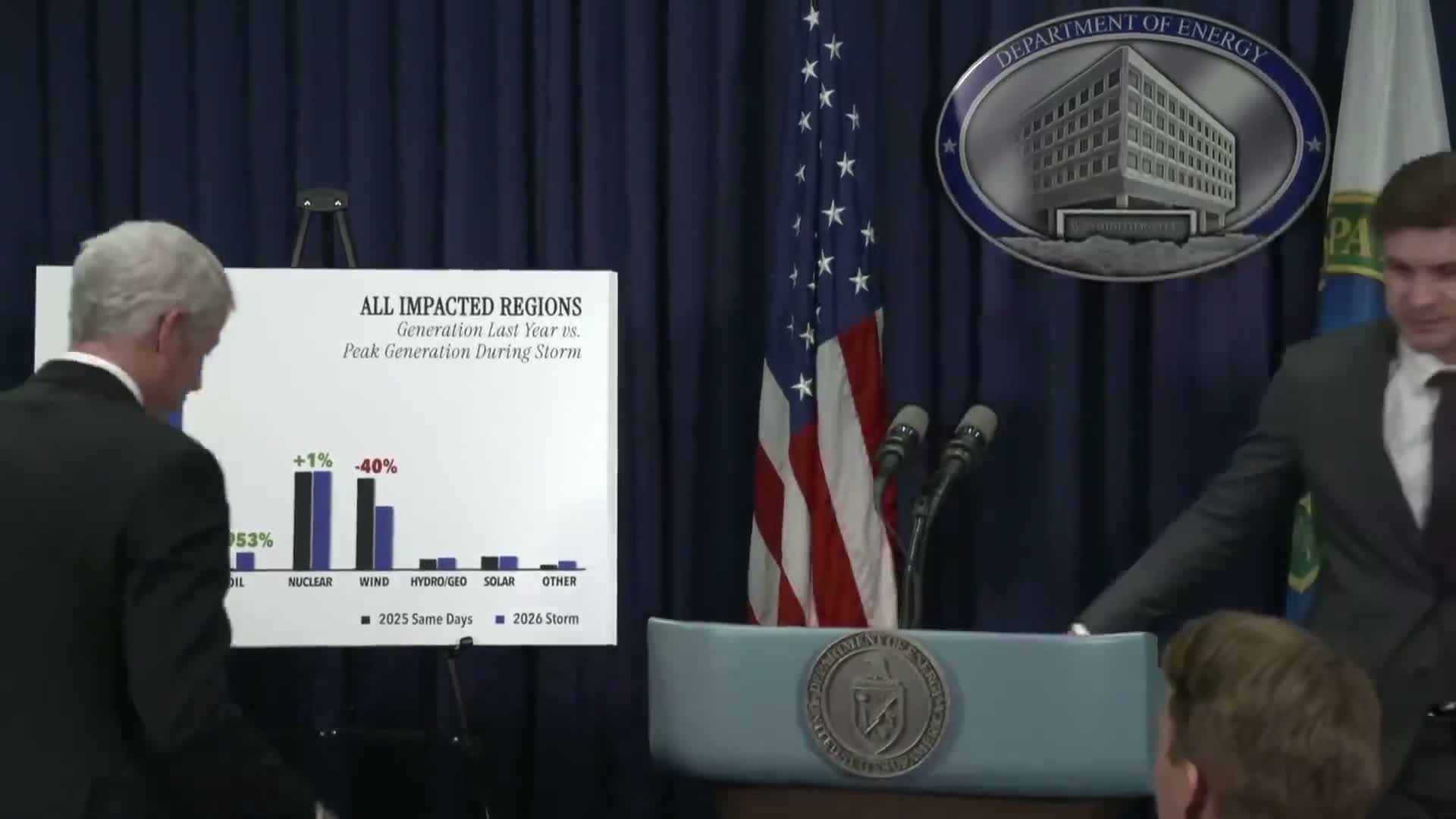
Officials also outlined how different resources performed at peak demand. Wright cited natural gas and coal ramping up during the event and said nuclear provided steady baseload output. He characterized wind and solar as much less reliable at the storm's peak, noting that solar delivered little in the storm's wintertime peak hours and that wind performed below its capacity during the event. "If you want to add to the capacity of our electricity grid, you have to add to our peak generating dispatchability," Wright said.
Reporters pressed DOE on data centers, costs and grid resiliency. Wright said data centers, when contracted and operated to provide steady loads, can lower average system costs; he also acknowledged the department did not have a single aggregate megawatt figure for all backup sites but said "hundreds" of backup generating sites were used and that even 100 megawatts can matter at the margin.
On batteries, officials said present commercially deployed storage (typically two to four hours) helps shave short peaks but is limited in multi-day storms when recharge opportunities are scarce. DOE said it will continue to support next-generation battery technologies.
The department did not release a formal after-action at the briefing but said it will continue coordination with regional operators and publish further analysis. "All of you dedicating your time to learn about energy...that's the only way forward," Wright said in closing.
What's next: DOE officials said studies on gas-electric coordination, capacity procurement processes and longer-duration storage will continue and that the department will provide additional data on generation performance at peak hours.
Department of Energy officials on Tuesday defended a set of emergency actions they said kept the lights on for most Americans during a recent multi-day winter storm, saying coordinated use of dispatchable generation, waivers for temporary emergency operation and mass mutual-assistance deployments prevented broader outages.
"Energy is the enabler of everything we do in our life," Secretary Wright said, framing the department's response as focused on affordability, reliability and human impacts.
Wright and DOE deputies said the storm prompted the largest recorded natural gas storage withdrawal in the agency's routine reports and caused roughly one million customers to lose power at the peak of the event. They said most outages stemmed from icing on local distribution lines rather than failures of bulk generation, and that "roughly 98%" of customers had been restored by the department's latest count.
Deputy Secretary James Danley (named in the transcript as James Danley/James Stanley) said DOE used secretarial orders to keep dispatchable coal, gas and backup assets available and temporarily waived some annualized emissions limits to allow emergency operations. "We made available also through secretarial orders all of the backup generation," he said, pointing to industrial and commercial backup units that were permitted to support utilities in scarcity periods.
DOE officials described a three-part approach: preserve dispatchable generation that can be relied on at peak demand, authorize use of available backup generation at commercial and industrial sites, and coordinate a large-scale mutual-assistance response that prepositioned tens of thousands of utility workers across affected states. Danley said the department's prior planning left about 65,000 utility workers ready to move across state lines and that close coordination included the U.S. Army Corps of Engineers and the Department of Homeland Security.
Officials also outlined how different resources performed at peak demand. Wright cited natural gas and coal ramping up during the event and said nuclear provided steady baseload output. He characterized wind and solar as much less reliable at the storm's peak, noting that solar delivered little in the storm's wintertime peak hours and that wind performed below its capacity during the event. "If you want to add to the capacity of our electricity grid, you have to add to our peak generating dispatchability," Wright said.
Reporters pressed DOE on data centers, costs and grid resiliency. Wright said data centers, when contracted and operated to provide steady loads, can lower average system costs; he also acknowledged the department did not have a single aggregate megawatt figure for all backup sites but said "hundreds" of backup generating sites were used and that even 100 megawatts can matter at the margin.
On batteries, officials said present commercially deployed storage (typically two to four hours) helps shave short peaks but is limited in multi-day storms when recharge opportunities are scarce. DOE said it will continue to support next-generation battery technologies.
The department did not release a formal after-action at the briefing but said it will continue coordination with regional operators and publish further analysis. "All of you dedicating your time to learn about energy...that's the only way forward," Wright said in closing.
What's next: DOE officials said studies on gas-electric coordination, capacity procurement processes and longer-duration storage will continue and that the department will provide additional data on generation performance at peak hours.
View the Full Meeting & All Its Details
This article offers just a summary. Unlock complete video, transcripts, and insights as a Founder Member.
✓
Watch full, unedited meeting videos
✓
Search every word spoken in unlimited transcripts
✓
AI summaries & real-time alerts (all government levels)
✓
Permanent access to expanding government content
30-day money-back guarantee
