House Energy committee hears NCSL briefing on state approaches to data-center energy use
February 06, 2026 | Environment & Energy, HOUSE OF REPRESENTATIVES, Committees, Legislative , Vermont
This article was created by AI summarizing key points discussed. AI makes mistakes, so for full details and context, please refer to the video of the full meeting. Please report any errors so we can fix them. Report an error »
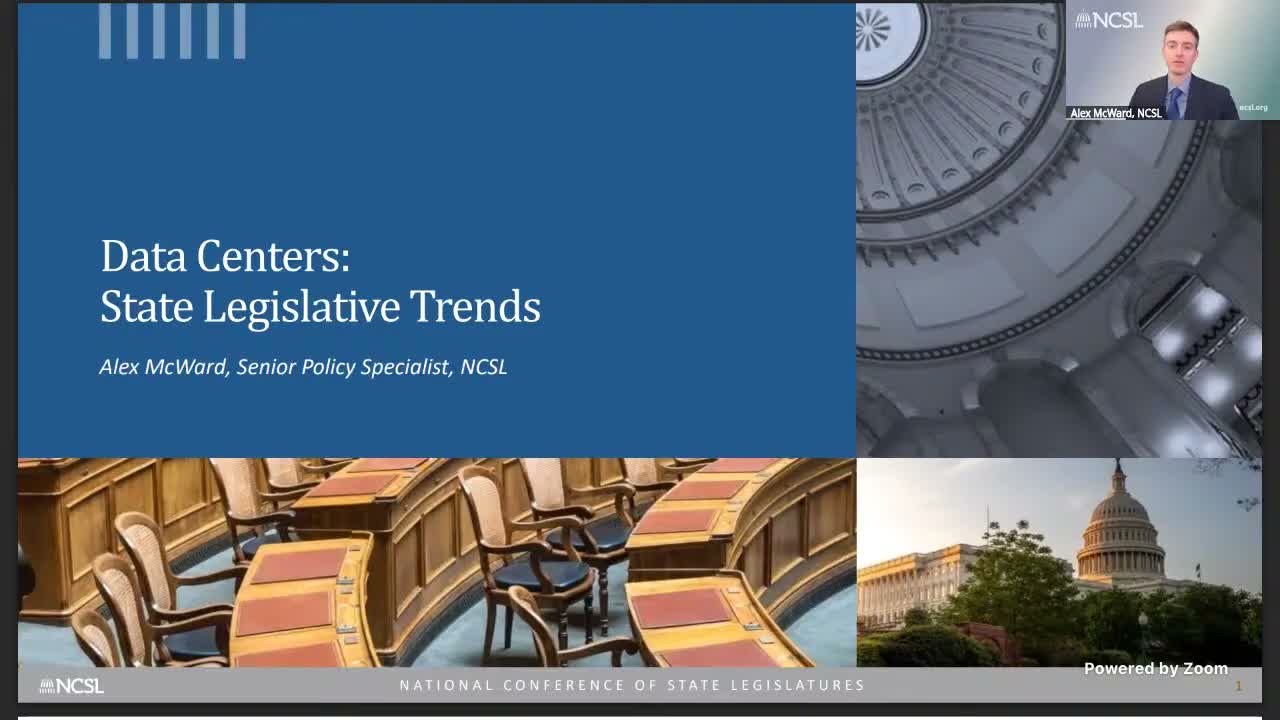
The House Energy and Digital Infrastructure Committee on Feb. 5 heard testimony from the National Conference of State Legislatures on H.727 and how other states are handling the energy implications of data center growth.
Alex McWhorter, a senior policy specialist with NCSL's energy program, told the committee that growing uses for artificial intelligence, cloud computing and cryptocurrency mining are driving construction of high-energy data centers. "Data centers currently account for about 4% of energy consumption in the U.S., but this could double by the end of the decade," McWhorter said, raising concerns about grid capacity and rate impacts for other customers.
McWhorter outlined four broad approaches states have taken. First, several states have required utilities or regulators to assess and, in some cases, create separate customer classes or tariffs so that large loads pay the costs of any transmission or distribution buildout needed to interconnect them. He cited California and Virginia as examples where public utility commissions were asked to study impacts on unrelated customers and said Maryland enacted a law requiring utilities to submit a specific rate schedule for large-load customers. "Creating new customer classes for data centers or other large loads allows specific pricing plans that are separate from other utility customers like residential ratepayers," he said.
Second, some states have mandated demand-management conditions for large loads. McWhorter described Texas' legislation that requires loads of 75 megawatts or greater seeking grid connection to participate in a mandatory demand-management program and to install shutoff equipment so operators may disconnect eligible loads during firm-load events.
Third, lawmakers have promoted localized generation and microgrids to serve data centers. McWhorter cited West Virginia's program that pairs a high-impact data-center designation with a microgrid development program and a designated liaison to coordinate certified microgrids and high-impact centers.
Fourth, he summarized a range of siting and reporting proposals. Florida introduced a bill that would bar hyperscale data centers within 10 miles of agricultural, recreational or conservation land and require local governments to hold hearings; South Dakota introduced a bill limiting siting to at least one mile from residential areas and setting a continuous noise cap of 40 decibels. Several states have proposed energy- and water-use reporting requirements—often including total consumption, power usage effectiveness (PUE) and energy-source disclosures—but McWhorter said those reporting bills have seen few enactments, and some governors have vetoed reporting measures or left metrics to utility regulators.
McWhorter also summarized proposals to direct tax revenue from data centers toward local needs. Examples included bills in West Virginia, Pennsylvania, Virginia, Arizona and Indiana that would allocate increment tax or transaction revenues to counties, homestead/farmstead relief, residential renewable incentives, solar projects or payments-in-lieu for host municipalities.
Committee members pressed for clarification about which measures are already law. In response, McWhorter said the tariff and customer-class examples he cited are largely enacted in the states he mentioned, while the reporting requirements have seen fewer successful enactments; he offered to provide a follow-up list of specific statutes. Representative Scott Campbell asked whether Maryland has enacted a data-center law prompting that clarification; McWhorter said the Maryland example he cited concerns an enacted utility rate-schedule requirement for large loads.
Members also asked about regulatory comparability and decommissioning. Representative Veil asked how many states have vertically integrated electric sectors; McWhorter estimated "around two-thirds of the country" but declined to be quoted on the precise number and offered to follow up with specifics. On decommissioning and stranded-cost protections, McWhorter said interconnection applications in some states require decommissioning plans and he would collect details on which states include explicit decommissioning or stranded-cost provisions.
The committee posted the presentation for the record and McWhorter said NCSL is adding a data-center tag to its legislative energy database. He provided contact information and offered additional follow-up material to the committee.
Alex McWhorter, a senior policy specialist with NCSL's energy program, told the committee that growing uses for artificial intelligence, cloud computing and cryptocurrency mining are driving construction of high-energy data centers. "Data centers currently account for about 4% of energy consumption in the U.S., but this could double by the end of the decade," McWhorter said, raising concerns about grid capacity and rate impacts for other customers.
McWhorter outlined four broad approaches states have taken. First, several states have required utilities or regulators to assess and, in some cases, create separate customer classes or tariffs so that large loads pay the costs of any transmission or distribution buildout needed to interconnect them. He cited California and Virginia as examples where public utility commissions were asked to study impacts on unrelated customers and said Maryland enacted a law requiring utilities to submit a specific rate schedule for large-load customers. "Creating new customer classes for data centers or other large loads allows specific pricing plans that are separate from other utility customers like residential ratepayers," he said.
Second, some states have mandated demand-management conditions for large loads. McWhorter described Texas' legislation that requires loads of 75 megawatts or greater seeking grid connection to participate in a mandatory demand-management program and to install shutoff equipment so operators may disconnect eligible loads during firm-load events.
Third, lawmakers have promoted localized generation and microgrids to serve data centers. McWhorter cited West Virginia's program that pairs a high-impact data-center designation with a microgrid development program and a designated liaison to coordinate certified microgrids and high-impact centers.
Fourth, he summarized a range of siting and reporting proposals. Florida introduced a bill that would bar hyperscale data centers within 10 miles of agricultural, recreational or conservation land and require local governments to hold hearings; South Dakota introduced a bill limiting siting to at least one mile from residential areas and setting a continuous noise cap of 40 decibels. Several states have proposed energy- and water-use reporting requirements—often including total consumption, power usage effectiveness (PUE) and energy-source disclosures—but McWhorter said those reporting bills have seen few enactments, and some governors have vetoed reporting measures or left metrics to utility regulators.
McWhorter also summarized proposals to direct tax revenue from data centers toward local needs. Examples included bills in West Virginia, Pennsylvania, Virginia, Arizona and Indiana that would allocate increment tax or transaction revenues to counties, homestead/farmstead relief, residential renewable incentives, solar projects or payments-in-lieu for host municipalities.
Committee members pressed for clarification about which measures are already law. In response, McWhorter said the tariff and customer-class examples he cited are largely enacted in the states he mentioned, while the reporting requirements have seen fewer successful enactments; he offered to provide a follow-up list of specific statutes. Representative Scott Campbell asked whether Maryland has enacted a data-center law prompting that clarification; McWhorter said the Maryland example he cited concerns an enacted utility rate-schedule requirement for large loads.
Members also asked about regulatory comparability and decommissioning. Representative Veil asked how many states have vertically integrated electric sectors; McWhorter estimated "around two-thirds of the country" but declined to be quoted on the precise number and offered to follow up with specifics. On decommissioning and stranded-cost protections, McWhorter said interconnection applications in some states require decommissioning plans and he would collect details on which states include explicit decommissioning or stranded-cost provisions.
The committee posted the presentation for the record and McWhorter said NCSL is adding a data-center tag to its legislative energy database. He provided contact information and offered additional follow-up material to the committee.
View the Full Meeting & All Its Details
This article offers just a summary. Unlock complete video, transcripts, and insights as a Founder Member.
✓
Watch full, unedited meeting videos
✓
Search every word spoken in unlimited transcripts
✓
AI summaries & real-time alerts (all government levels)
✓
Permanent access to expanding government content
30-day money-back guarantee
