Marblehead schools propose level-funded FY2027 budget that would cut about 14.75 staff positions
February 06, 2026 | Marblehead Public Schools, School Boards, Massachusetts
This article was created by AI summarizing key points discussed. AI makes mistakes, so for full details and context, please refer to the video of the full meeting. Please report any errors so we can fix them. Report an error »
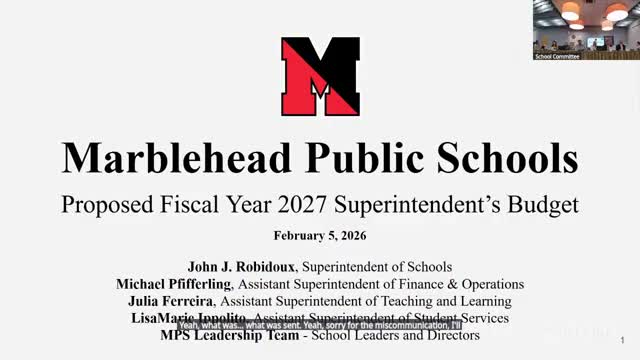
Marblehead School Committee members received a presentation on the superintendent’s proposed fiscal year 2027 budget on Feb. 6, a plan that holds total spending at $49,000,122.85 and seeks to meet the town’s directive to be “level funded.” The administration told the committee that reaching that target will require roughly $1.7 million in offsets and would result in about 14.75 full-time-equivalent (FTE) position reductions across the district.
The district framed the proposal as an exercise to maintain services within the same dollars as the current year. “Level funded… is using the same money this year, next year to provide” the same services, the superintendent said during the presentation, explaining that the approach typically requires reductions in staff, programming or supplies. Assistant Superintendent for Finance and Operations Mike Biffling told the committee that salaries account for just under 80% of district spending and that out-of-district tuitions and contracted services are the other major budget drivers.
Why it matters
Administrators and committee members repeatedly warned that holding funding flat while contractual obligations and student needs continue would constrain the district’s ability to provide “high-quality rigorous education.” The superintendent summarized the risk plainly: operating at the same funding level “equates to significant staffing cuts and operational efficiencies that place constraints on our ability to provide high-quality… education.” The presentation also highlighted a long-term staffing trend — the district reported a decline in licensed-teacher FTEs over the past decade and proposed additional reductions as part of the FY27 plan.
What’s in the budget
The budget document posted with the presentation shows total FY26 spending of $49,000,122.85 and treats next year’s allocation as unchanged. The administration detailed two rounds of offsets. Round 1 focused on non-staff efficiencies and accounting moves: negotiated copier and supply savings, tighter controls on contracted services, and shifting portions of specific administrative positions to revolving or grant accounts where legally permitted. Round 2 contains the personnel changes that would have direct classroom and operations impacts: a mix of unfilled vacancies, eliminated stipends and reductions or non-replacements that together total about 14.75 FTEs. Examples cited in the presentation included reductions at multiple schools, a speech-language pathologist dropping from full time to 0.6 FTE in one scenario, and the potential loss of a maintenance field position.
Special education, revolving funds and tuition prepayments
Committee discussion emphasized that special-education needs have increased while enrollment has declined, complicating the budget picture. A committee member cited DESE data showing the district’s high-needs population rose from 27% in 2016 to 32% in 2025 and noted large percentage increases in students with autism and neurological/health-related disabilities.
Administration staff explained they are using several non-recurring or semi-recurring sources to bridge part of the FY27 gap: the district is planning to draw more from revolving accounts (pre-K/k tuition, special-education revolving accounts) and reduce a traditional prepayment practice for out-of-district tuitions from $1,000,000 to $800,000. Mike Biffling described the prepayment practice as permitted and planful, saying it helps the district manage high-cost tuition events, but he warned some revolving balances will not sustain those positions beyond one to three years without replenishment. The district also noted it can keep one year of circuit-breaker reimbursement in reserve but that circuit-breaker reimbursements are received in arrears and are therefore not a direct operating revenue source for the current year.
Enrollment and class-size implications
Administrators presented enrollment as a "moment in time," reporting the district had 2,394 students on Oct. 1 and rose to 2,435 as of the Monday before the meeting. Presenters and committee members discussed the difficulty of mapping class-size changes across the district, but the superintendent said principals were consulted and reductions were prioritized to minimize immediate classroom impacts. Committee members asked the administration to add clearer historical enrollment and staffing tables and direct links to DESE data before the public hearing to help residents understand where cuts will affect class sizes.
Process and next steps
The committee set a public hearing on the proposed FY2027 budget for Feb. 26; the school committee is expected to vote on the proposal at its March meeting and then participate in finance committee and town-warrant hearings ahead of Town Meeting in May. Administrators emphasized the budget will continue to be refined between now and the vote as grant and state reimbursement figures become clearer.
Votes at a glance
- Consent agenda (bills totaling $321,620.66; meeting dates and 01/29/2026 minutes): motion made by Kate, seconded by Henry — approved 5-0.
- Motion to adjourn: motion made by Melissa, seconded by Henry — approved 5-0.
What comes next
The administration said it will revise the posted materials to include clearer enrollment charts and DESE links before the Feb. 26 public hearing and welcomed questions at that hearing. The committee signaled it may reconvene the budget subcommittee as needed to provide direction should the town’s fiscal picture change.
(Reporting note: quotes and attributions in this article come from speakers identified during the Feb. 6 meeting. Where a speaker did not introduce a full name on the record, the role used is that given in the meeting.)
The district framed the proposal as an exercise to maintain services within the same dollars as the current year. “Level funded… is using the same money this year, next year to provide” the same services, the superintendent said during the presentation, explaining that the approach typically requires reductions in staff, programming or supplies. Assistant Superintendent for Finance and Operations Mike Biffling told the committee that salaries account for just under 80% of district spending and that out-of-district tuitions and contracted services are the other major budget drivers.
Why it matters
Administrators and committee members repeatedly warned that holding funding flat while contractual obligations and student needs continue would constrain the district’s ability to provide “high-quality rigorous education.” The superintendent summarized the risk plainly: operating at the same funding level “equates to significant staffing cuts and operational efficiencies that place constraints on our ability to provide high-quality… education.” The presentation also highlighted a long-term staffing trend — the district reported a decline in licensed-teacher FTEs over the past decade and proposed additional reductions as part of the FY27 plan.
What’s in the budget
The budget document posted with the presentation shows total FY26 spending of $49,000,122.85 and treats next year’s allocation as unchanged. The administration detailed two rounds of offsets. Round 1 focused on non-staff efficiencies and accounting moves: negotiated copier and supply savings, tighter controls on contracted services, and shifting portions of specific administrative positions to revolving or grant accounts where legally permitted. Round 2 contains the personnel changes that would have direct classroom and operations impacts: a mix of unfilled vacancies, eliminated stipends and reductions or non-replacements that together total about 14.75 FTEs. Examples cited in the presentation included reductions at multiple schools, a speech-language pathologist dropping from full time to 0.6 FTE in one scenario, and the potential loss of a maintenance field position.
Special education, revolving funds and tuition prepayments
Committee discussion emphasized that special-education needs have increased while enrollment has declined, complicating the budget picture. A committee member cited DESE data showing the district’s high-needs population rose from 27% in 2016 to 32% in 2025 and noted large percentage increases in students with autism and neurological/health-related disabilities.
Administration staff explained they are using several non-recurring or semi-recurring sources to bridge part of the FY27 gap: the district is planning to draw more from revolving accounts (pre-K/k tuition, special-education revolving accounts) and reduce a traditional prepayment practice for out-of-district tuitions from $1,000,000 to $800,000. Mike Biffling described the prepayment practice as permitted and planful, saying it helps the district manage high-cost tuition events, but he warned some revolving balances will not sustain those positions beyond one to three years without replenishment. The district also noted it can keep one year of circuit-breaker reimbursement in reserve but that circuit-breaker reimbursements are received in arrears and are therefore not a direct operating revenue source for the current year.
Enrollment and class-size implications
Administrators presented enrollment as a "moment in time," reporting the district had 2,394 students on Oct. 1 and rose to 2,435 as of the Monday before the meeting. Presenters and committee members discussed the difficulty of mapping class-size changes across the district, but the superintendent said principals were consulted and reductions were prioritized to minimize immediate classroom impacts. Committee members asked the administration to add clearer historical enrollment and staffing tables and direct links to DESE data before the public hearing to help residents understand where cuts will affect class sizes.
Process and next steps
The committee set a public hearing on the proposed FY2027 budget for Feb. 26; the school committee is expected to vote on the proposal at its March meeting and then participate in finance committee and town-warrant hearings ahead of Town Meeting in May. Administrators emphasized the budget will continue to be refined between now and the vote as grant and state reimbursement figures become clearer.
Votes at a glance
- Consent agenda (bills totaling $321,620.66; meeting dates and 01/29/2026 minutes): motion made by Kate, seconded by Henry — approved 5-0.
- Motion to adjourn: motion made by Melissa, seconded by Henry — approved 5-0.
What comes next
The administration said it will revise the posted materials to include clearer enrollment charts and DESE links before the Feb. 26 public hearing and welcomed questions at that hearing. The committee signaled it may reconvene the budget subcommittee as needed to provide direction should the town’s fiscal picture change.
(Reporting note: quotes and attributions in this article come from speakers identified during the Feb. 6 meeting. Where a speaker did not introduce a full name on the record, the role used is that given in the meeting.)
View the Full Meeting & All Its Details
This article offers just a summary. Unlock complete video, transcripts, and insights as a Founder Member.
✓
Watch full, unedited meeting videos
✓
Search every word spoken in unlimited transcripts
✓
AI summaries & real-time alerts (all government levels)
✓
Permanent access to expanding government content
30-day money-back guarantee
