Vermont outdoor-recreation leaders press for steady grant funding, new economic study and workforce support
February 06, 2026 | Economic Development, Housing & General Affairs, SENATE, Committees, Legislative , Vermont
This article was created by AI summarizing key points discussed. AI makes mistakes, so for full details and context, please refer to the video of the full meeting. Please report any errors so we can fix them. Report an error »
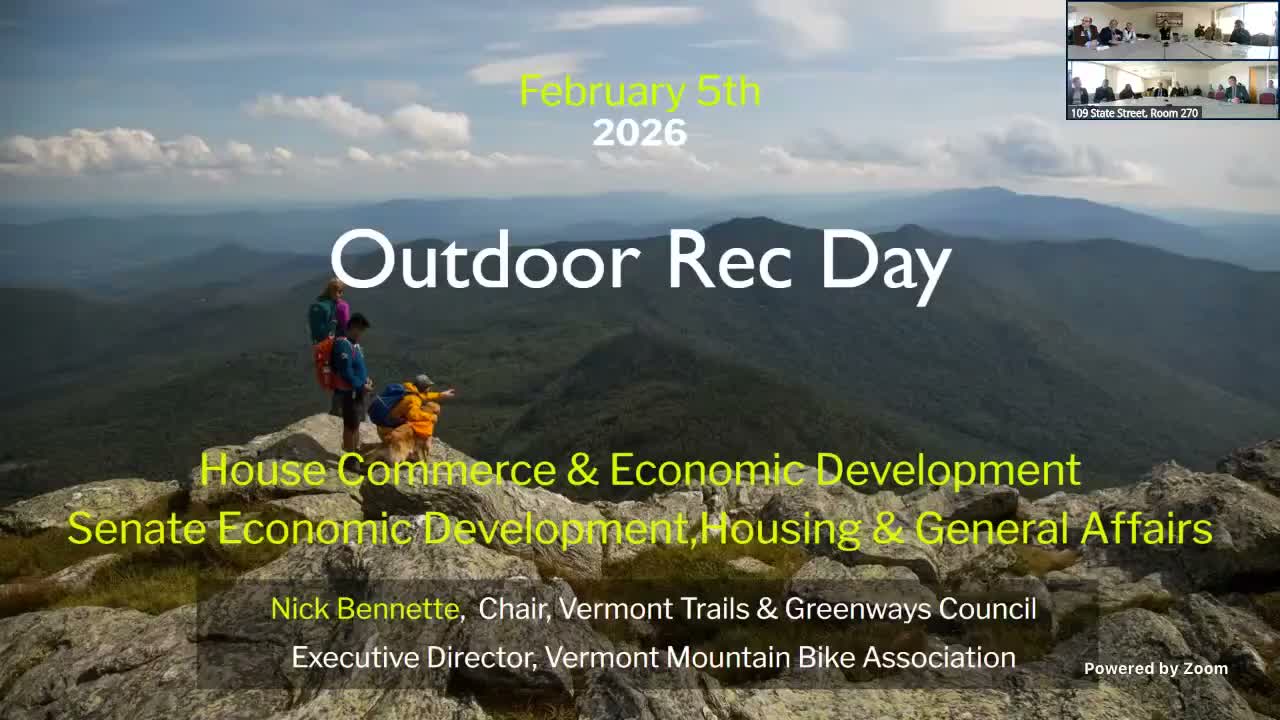
State legislators heard more than four hours of testimony Feb. 5 from outdoor recreation businesses, nonprofits and municipal managers who urged steady funding, a statewide economic-impact study and regulatory fixes to support an industry they said underpins rural economies.
At a joint hearing of the House Commerce and Economic Development Committee and the Senate Economic Development, Housing & General Affairs committee, witnesses described the scope of the sector and specific requests for action. "The economic engine for the state is Vermont's outdoor sector," Kelly Alt, executive director of the Vermont Outdoor Business Alliance, told lawmakers. Testimony cited a recent estimate placing outdoor recreation’s contribution to Vermont’s economy at roughly $2.1 billion and linked that activity to thousands of jobs statewide.
Advocates pressed two near-term funding priorities. Several witnesses noted the governor’s recommended budget includes $500,000 for another round of community grants and pointed to a bill (referred to in testimony as S.327) that would fund a modern, comprehensive outdoor recreation impact study with $200,000. "We need an outdoor recreation impact study that helps us understand where the greatest risks are," said Nick Bennett, executive director of the Vermont Mountain Bike Association, who also described earlier VORAC-funded grant cycles that awarded more than $11 million in 2022–23.
Speakers emphasized that grant programs historically have been one-time appropriations rather than stable revenue streams. "Securing ongoing funding for community grants should be a top priority," Jessica Brody, executive director of the Vermont Recreation and Park Association, told the committee, citing more than $6 million previously awarded through community grant cycles that supported accessibility upgrades, trails and resilience projects.
Testimony also highlighted workforce and small-business pressures: Alex Rasico, co-founder of Boot Pro Ski & Bike in Ludlow, described difficulty recruiting and retaining skilled technicians and recounted that flooding in 2023 left town businesses with few customers that summer. "When the flood hit, there were virtually no visitors to Ludlow that entire summer," Rasico said, and urged programs to help small businesses cover overhead during climate-related revenue losses.
Accessibility and adaptive recreation were recurring themes. Jeff Alexander of Vermont Adaptive Ski and Sports said his organization provided 5,757 individual outings last year and that an impact study of adaptive programs found roughly $10.3 million in annual economic activity tied to those services. "These programs bring people here and support jobs in hospitality and local services," he said.
Several witnesses said permitting and land-use rules—including the state’s Act 250 process and mapping tiers—create delays and, in some cases, prohibitively high time and cost for trail projects and ski-area improvements. A speaker involved in trail development said even projects on already disturbed recreational land can face onerous review that stalls community-driven construction.
Lawmakers asked practical questions about aligning the career-and-technical-education system with outdoor-sector job needs, and witnesses urged use of CTE programs and targeted training to build local capacity. Panelists also described specific tools: a new community toolkit to help towns measure local recreation impacts (planned for a March launch) and a Climate Outdoor Workforce Initiative aimed at climate‑adaptation jobs in the sector.
The hearing concluded with no formal votes; committee chairs and members are expected to consider the testimony as they work on the budget and pending bills in coming weeks. The House Commerce committee scheduled a reconvening at 1:00 p.m. same day.
At a joint hearing of the House Commerce and Economic Development Committee and the Senate Economic Development, Housing & General Affairs committee, witnesses described the scope of the sector and specific requests for action. "The economic engine for the state is Vermont's outdoor sector," Kelly Alt, executive director of the Vermont Outdoor Business Alliance, told lawmakers. Testimony cited a recent estimate placing outdoor recreation’s contribution to Vermont’s economy at roughly $2.1 billion and linked that activity to thousands of jobs statewide.
Advocates pressed two near-term funding priorities. Several witnesses noted the governor’s recommended budget includes $500,000 for another round of community grants and pointed to a bill (referred to in testimony as S.327) that would fund a modern, comprehensive outdoor recreation impact study with $200,000. "We need an outdoor recreation impact study that helps us understand where the greatest risks are," said Nick Bennett, executive director of the Vermont Mountain Bike Association, who also described earlier VORAC-funded grant cycles that awarded more than $11 million in 2022–23.
Speakers emphasized that grant programs historically have been one-time appropriations rather than stable revenue streams. "Securing ongoing funding for community grants should be a top priority," Jessica Brody, executive director of the Vermont Recreation and Park Association, told the committee, citing more than $6 million previously awarded through community grant cycles that supported accessibility upgrades, trails and resilience projects.
Testimony also highlighted workforce and small-business pressures: Alex Rasico, co-founder of Boot Pro Ski & Bike in Ludlow, described difficulty recruiting and retaining skilled technicians and recounted that flooding in 2023 left town businesses with few customers that summer. "When the flood hit, there were virtually no visitors to Ludlow that entire summer," Rasico said, and urged programs to help small businesses cover overhead during climate-related revenue losses.
Accessibility and adaptive recreation were recurring themes. Jeff Alexander of Vermont Adaptive Ski and Sports said his organization provided 5,757 individual outings last year and that an impact study of adaptive programs found roughly $10.3 million in annual economic activity tied to those services. "These programs bring people here and support jobs in hospitality and local services," he said.
Several witnesses said permitting and land-use rules—including the state’s Act 250 process and mapping tiers—create delays and, in some cases, prohibitively high time and cost for trail projects and ski-area improvements. A speaker involved in trail development said even projects on already disturbed recreational land can face onerous review that stalls community-driven construction.
Lawmakers asked practical questions about aligning the career-and-technical-education system with outdoor-sector job needs, and witnesses urged use of CTE programs and targeted training to build local capacity. Panelists also described specific tools: a new community toolkit to help towns measure local recreation impacts (planned for a March launch) and a Climate Outdoor Workforce Initiative aimed at climate‑adaptation jobs in the sector.
The hearing concluded with no formal votes; committee chairs and members are expected to consider the testimony as they work on the budget and pending bills in coming weeks. The House Commerce committee scheduled a reconvening at 1:00 p.m. same day.
View the Full Meeting & All Its Details
This article offers just a summary. Unlock complete video, transcripts, and insights as a Founder Member.
✓
Watch full, unedited meeting videos
✓
Search every word spoken in unlimited transcripts
✓
AI summaries & real-time alerts (all government levels)
✓
Permanent access to expanding government content
30-day money-back guarantee
