Seaside staff list 26 vacant commercial properties; council asks for study of a commercial vacancy tax
February 06, 2026 | Seaside, Monterey County, California
This article was created by AI summarizing key points discussed. AI makes mistakes, so for full details and context, please refer to the video of the full meeting. Please report any errors so we can fix them. Report an error »
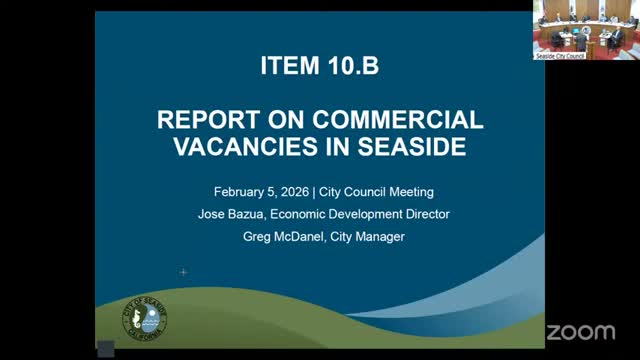
Seaside staff told the City Council on Feb. 5 that a recent inventory identified 26 commercial properties of interest — including nine vacant lots concentrated on Broadway and Fremont — and outlined barriers that make re‑tenancy costly and slow.
Economic development director Jose Pazur said his team catalogued vacant sites and flagged common deterrents to reuse: tenant‑improvement costs, sprinkler and water connection requirements, permit fees and long timelines for utilities and upgrades. He illustrated one example where converting a 3,300‑square‑foot building triggered a sprinkler requirement, water connection fees and nearly a two‑year timeline and large capital outlay. "When you change the use of a building, it triggers certain costs, certain timelines," Pazur said.
Staff described ongoing efforts to attract tenants and support property owners: a Placer AI data agreement to provide real‑time foot‑traffic and demographic analytics, a contract with Retail Strategies for national retail recruitment, a planned Seaside economic development action plan, and an ombudsman‑style service to help navigate permitting and agency coordination.
Public commenters and some council members urged stronger measures. Resident speakers and business groups debated a vacancy tax: supporters said a targeted commercial vacancy tax could provide seed money for incentives or façade grants; opponents cautioned that such a tax could penalize small family owners, move investment to neighboring cities or require complex exceptions. The Monterey County Association of Realtors warned that a vacancy tax would not address root causes and recommended caution.
Council Member Garcia Rosales asked staff to move forward with a study of a commercial vacancy tax for possible placement on the November ballot and requested a follow‑up report with more precise vacancy metrics, timelines, and options. City staff said they will continue outreach, track vacancy rates and include proposed actions in a forthcoming economic development plan.
Economic development director Jose Pazur said his team catalogued vacant sites and flagged common deterrents to reuse: tenant‑improvement costs, sprinkler and water connection requirements, permit fees and long timelines for utilities and upgrades. He illustrated one example where converting a 3,300‑square‑foot building triggered a sprinkler requirement, water connection fees and nearly a two‑year timeline and large capital outlay. "When you change the use of a building, it triggers certain costs, certain timelines," Pazur said.
Staff described ongoing efforts to attract tenants and support property owners: a Placer AI data agreement to provide real‑time foot‑traffic and demographic analytics, a contract with Retail Strategies for national retail recruitment, a planned Seaside economic development action plan, and an ombudsman‑style service to help navigate permitting and agency coordination.
Public commenters and some council members urged stronger measures. Resident speakers and business groups debated a vacancy tax: supporters said a targeted commercial vacancy tax could provide seed money for incentives or façade grants; opponents cautioned that such a tax could penalize small family owners, move investment to neighboring cities or require complex exceptions. The Monterey County Association of Realtors warned that a vacancy tax would not address root causes and recommended caution.
Council Member Garcia Rosales asked staff to move forward with a study of a commercial vacancy tax for possible placement on the November ballot and requested a follow‑up report with more precise vacancy metrics, timelines, and options. City staff said they will continue outreach, track vacancy rates and include proposed actions in a forthcoming economic development plan.
Don't Miss a Word: See the Full Meeting!
Go beyond summaries. Unlock every video, transcript, and key insight with a Founder Membership.
✓
Get instant access to full meeting videos
✓
Search and clip any phrase from complete transcripts
✓
Receive AI-powered summaries & custom alerts
✓
Enjoy lifetime, unrestricted access to government data
30-day money-back guarantee
