State transportation staff say town‑highway grants fall short of requests as demand outpaces funding
February 06, 2026 | Transportation, HOUSE OF REPRESENTATIVES, Committees, Legislative , Vermont
This article was created by AI summarizing key points discussed. AI makes mistakes, so for full details and context, please refer to the video of the full meeting. Please report any errors so we can fix them. Report an error »
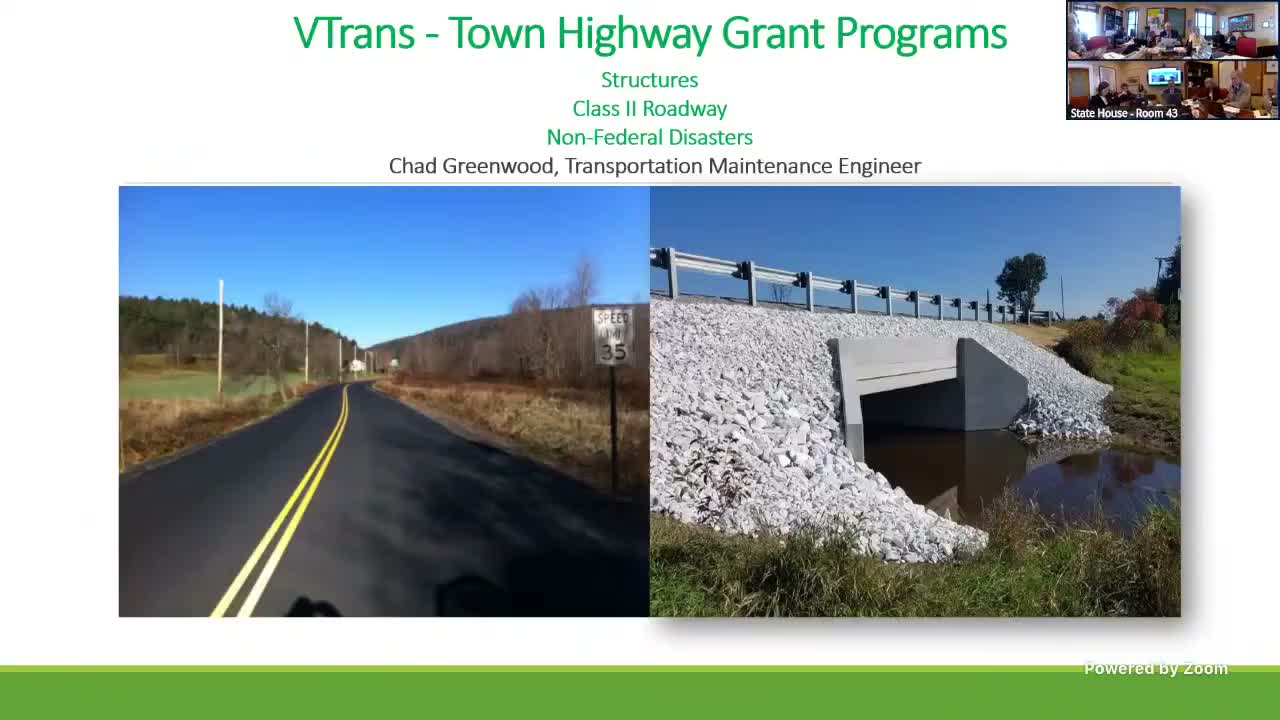
State transportation staff told legislators that demand for town‑level road and bridge grants far exceeds the money available, and they urged a measured view of how those limited funds are allocated.
"This grant program is for bridges, culverts, 36 inch diameter or larger, retaining walls on class 1, 2, and 3 town highways," said Jack Greenwood, a transportation maintenance engineer, describing the town highway structures program and its roughly $7.39 million fiscal‑year 2027 appropriation. Greenwood said the structures grants have a maximum award around $200,000 and require a local match and adherence to town standards.
The agency also described a town highway Class 2 preservation program, which Greenwood said is slated at about $8.8 million for FY27 and is used for resurfacing and reconstruction. For both programs, Greenwood said district personnel coordinate applications and that awards are distributed over time according to an equitable allocation formula tied to the inventory of eligible structures and miles.
Lawmakers pressed staff on how much of submitted requests the programs meet. An unidentified legislator summarized the scale: towns applied for about $32 million in Class 2 work while the agency plans to provide less than $9 million. "They're only getting a third of what they've asked for," the legislator said, prompting staff to explain that program formulas, statutory minimums and multi‑year funding patterns shape annual award levels.
Legislators asked whether the application process or the local match is a barrier for small towns. Greenwood said district staff help towns with applications and that some towns use grants primarily for engineering work to prepare later construction projects. He added that grants are 30‑month awards and that amendments are uncommon, generally limited to time extensions.
The agency described the nonfederal disaster fund, budgeted at about $1.15 million for FY27, as an annual appropriation to repair or reconstruct town highways and drainage structures that do not qualify for FEMA or FHWA emergency aid. Greenwood said the program has no per‑project cap other than available budget and that the agency can prioritize awards within the fiscal year.
Several lawmakers requested more detailed comparisons with other states and a clearer breakdown of how per‑mile costs vary by treatment level. Staff acknowledged they did not have interstate benchmarking on hand and offered to provide chief engineers and additional documentation in a later session.
The committee did not take formal votes during the briefing. Staff said they would provide further data about awarded versus requested amounts, the agency's scoring criteria and examples of recent projects to inform future budget deliberations.
"This grant program is for bridges, culverts, 36 inch diameter or larger, retaining walls on class 1, 2, and 3 town highways," said Jack Greenwood, a transportation maintenance engineer, describing the town highway structures program and its roughly $7.39 million fiscal‑year 2027 appropriation. Greenwood said the structures grants have a maximum award around $200,000 and require a local match and adherence to town standards.
The agency also described a town highway Class 2 preservation program, which Greenwood said is slated at about $8.8 million for FY27 and is used for resurfacing and reconstruction. For both programs, Greenwood said district personnel coordinate applications and that awards are distributed over time according to an equitable allocation formula tied to the inventory of eligible structures and miles.
Lawmakers pressed staff on how much of submitted requests the programs meet. An unidentified legislator summarized the scale: towns applied for about $32 million in Class 2 work while the agency plans to provide less than $9 million. "They're only getting a third of what they've asked for," the legislator said, prompting staff to explain that program formulas, statutory minimums and multi‑year funding patterns shape annual award levels.
Legislators asked whether the application process or the local match is a barrier for small towns. Greenwood said district staff help towns with applications and that some towns use grants primarily for engineering work to prepare later construction projects. He added that grants are 30‑month awards and that amendments are uncommon, generally limited to time extensions.
The agency described the nonfederal disaster fund, budgeted at about $1.15 million for FY27, as an annual appropriation to repair or reconstruct town highways and drainage structures that do not qualify for FEMA or FHWA emergency aid. Greenwood said the program has no per‑project cap other than available budget and that the agency can prioritize awards within the fiscal year.
Several lawmakers requested more detailed comparisons with other states and a clearer breakdown of how per‑mile costs vary by treatment level. Staff acknowledged they did not have interstate benchmarking on hand and offered to provide chief engineers and additional documentation in a later session.
The committee did not take formal votes during the briefing. Staff said they would provide further data about awarded versus requested amounts, the agency's scoring criteria and examples of recent projects to inform future budget deliberations.
View the Full Meeting & All Its Details
This article offers just a summary. Unlock complete video, transcripts, and insights as a Founder Member.
✓
Watch full, unedited meeting videos
✓
Search every word spoken in unlimited transcripts
✓
AI summaries & real-time alerts (all government levels)
✓
Permanent access to expanding government content
30-day money-back guarantee
