State updates EV charging investments; officials cite rural gaps and demand-charge barrier
February 06, 2026 | Transportation, HOUSE OF REPRESENTATIVES, Committees, Legislative , Vermont
This article was created by AI summarizing key points discussed. AI makes mistakes, so for full details and context, please refer to the video of the full meeting. Please report any errors so we can fix them. Report an error »
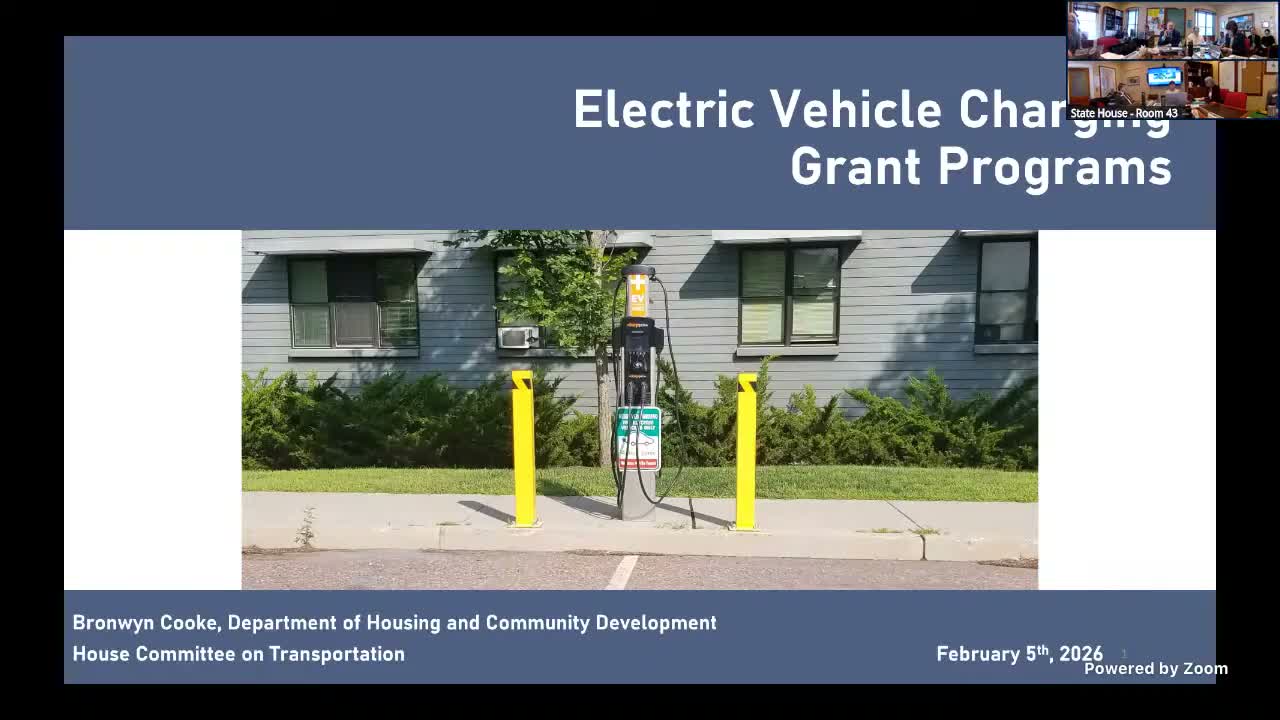
Ronald Cook, community planning and policy manager at the Agency of Commerce and Community Development, told the House Transportation Committee on Feb. 5 that Vermont's state-supported electric-vehicle charging programs are showing rising use but face persistent rural gaps and cost barriers.
Cook said ACCD's early grants (roughly $4 million, awarded 2014'2022) are largely installed and now being monitored. He described Charge Vermont, a $9.12 million program launched in mid-2023 with Green Mountain Power as administrative partner. Cook said ACCD has processed about 610 applications, with roughly 136 projects moving forward; about 200 applications are on hold because funding requested exceeds what ACCD currently has available, and another ~200 were deemed not eligible under program rules.
"If you build it, EV drivers show up," Cook said, summing up results from more than 70,000 anonymized session records cleaned and analyzed by Drive Electric Vermont. ACCD reported that average annual kilowatt-hours per port and the number of unique users have both risen year-over-year in ACCD-funded stations.
But committee members pressed on the practical limits of siting public DC fast chargers in less-dense areas. Cook described demand charges'high fees utilities impose for peak capacity'as a major barrier in several electric-company territories. He said some service providers are unable to absorb demand charges for early DC fast projects and may curtail a charger's output to reduce costs, which undermines the fast-charging function.
Cook gave a recent local example: a planned 60 kW site in Hardwick where the service provider told ACCD it could not carry the demand-charge cost and would have to throttle the unit'making the installation less useful for fast-charging trips.
ACCD also described program design and distribution challenges. Legislative constraints (including a roughly 30% minimum for multi-unit housing funding and per-county caps of roughly 10% per county in the initial allocation) and the sequencing of funds meant Chittenden County and public-attraction categories subscribed quickly in 2023. An additional $1.9 million authorized under subsequent legislation created a county funding floor intended to improve geographic equity, but uptake in some counties has been slower than ACCD expected.
Cook said early evidence shows many projects close for less than the maximum "make-ready" incentive (ACCD allows up to $20,000 per site to cover panel upgrades and trenching), and that adjusting incentive levels or reassigning floor funds to counties ready to build could improve spend-down. He said ACCD's recent two-and-a-half-year average burn rate is about $1.6 million per year.
Two competitive DC fast-charging awards (part of the Charge Vermont competitive stream) were noted as complete at the time of the briefing; Cook named Bridgewater, Lawn Mills, and the Vermont Country Store among completed projects and said more are under construction. He recommended follow-up briefings from Drive Electric Vermont on detailed usage metrics and from state Buildings & General Services staff about workplace charging design and siting.
The committee did not take formal action at the session. Cook said ACCD will continue monitoring deployment and may recommend program changes, including revised incentive levels or limited reallocation of the funding floor if counties remain unable to use their allocations.
What's next: ACCD offered to return with more detailed data (Drive Electric Vermont) and with BGS staff on state workplace charging to inform potential program adjustments or legislative recommendations.
Cook said ACCD's early grants (roughly $4 million, awarded 2014'2022) are largely installed and now being monitored. He described Charge Vermont, a $9.12 million program launched in mid-2023 with Green Mountain Power as administrative partner. Cook said ACCD has processed about 610 applications, with roughly 136 projects moving forward; about 200 applications are on hold because funding requested exceeds what ACCD currently has available, and another ~200 were deemed not eligible under program rules.
"If you build it, EV drivers show up," Cook said, summing up results from more than 70,000 anonymized session records cleaned and analyzed by Drive Electric Vermont. ACCD reported that average annual kilowatt-hours per port and the number of unique users have both risen year-over-year in ACCD-funded stations.
But committee members pressed on the practical limits of siting public DC fast chargers in less-dense areas. Cook described demand charges'high fees utilities impose for peak capacity'as a major barrier in several electric-company territories. He said some service providers are unable to absorb demand charges for early DC fast projects and may curtail a charger's output to reduce costs, which undermines the fast-charging function.
Cook gave a recent local example: a planned 60 kW site in Hardwick where the service provider told ACCD it could not carry the demand-charge cost and would have to throttle the unit'making the installation less useful for fast-charging trips.
ACCD also described program design and distribution challenges. Legislative constraints (including a roughly 30% minimum for multi-unit housing funding and per-county caps of roughly 10% per county in the initial allocation) and the sequencing of funds meant Chittenden County and public-attraction categories subscribed quickly in 2023. An additional $1.9 million authorized under subsequent legislation created a county funding floor intended to improve geographic equity, but uptake in some counties has been slower than ACCD expected.
Cook said early evidence shows many projects close for less than the maximum "make-ready" incentive (ACCD allows up to $20,000 per site to cover panel upgrades and trenching), and that adjusting incentive levels or reassigning floor funds to counties ready to build could improve spend-down. He said ACCD's recent two-and-a-half-year average burn rate is about $1.6 million per year.
Two competitive DC fast-charging awards (part of the Charge Vermont competitive stream) were noted as complete at the time of the briefing; Cook named Bridgewater, Lawn Mills, and the Vermont Country Store among completed projects and said more are under construction. He recommended follow-up briefings from Drive Electric Vermont on detailed usage metrics and from state Buildings & General Services staff about workplace charging design and siting.
The committee did not take formal action at the session. Cook said ACCD will continue monitoring deployment and may recommend program changes, including revised incentive levels or limited reallocation of the funding floor if counties remain unable to use their allocations.
What's next: ACCD offered to return with more detailed data (Drive Electric Vermont) and with BGS staff on state workplace charging to inform potential program adjustments or legislative recommendations.
Don't Miss a Word: See the Full Meeting!
Go beyond summaries. Unlock every video, transcript, and key insight with a Founder Membership.
✓
Get instant access to full meeting videos
✓
Search and clip any phrase from complete transcripts
✓
Receive AI-powered summaries & custom alerts
✓
Enjoy lifetime, unrestricted access to government data
30-day money-back guarantee
