Downtown Transportation Fund briefing: $523,966 annual pot, grants prioritized to designated downtowns
February 06, 2026 | Transportation, HOUSE OF REPRESENTATIVES, Committees, Legislative , Vermont
This article was created by AI summarizing key points discussed. AI makes mistakes, so for full details and context, please refer to the video of the full meeting. Please report any errors so we can fix them. Report an error »
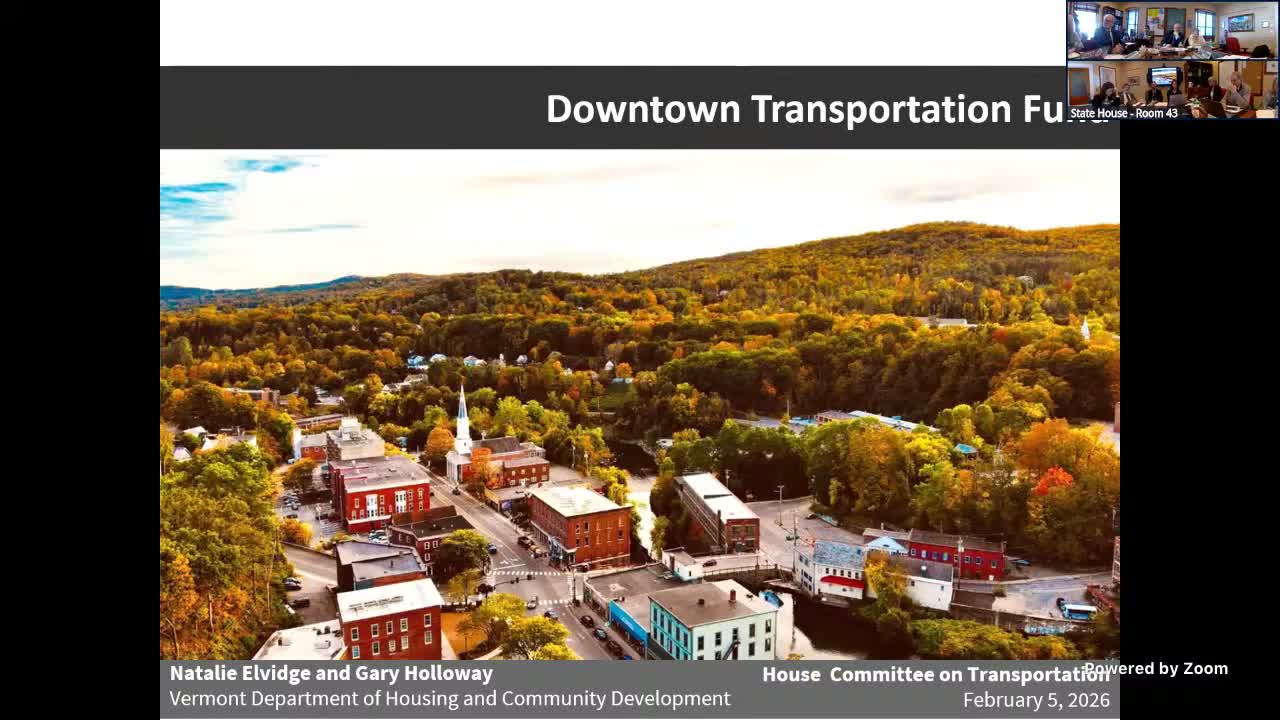
Natalie Aldridge, planning coordinator with the Department of Housing and Community Development, and Gary Holloway, downtown program manager, briefed the House Transportation Committee on Feb. 5 about the Downtown Transportation Fund's purpose, eligibility and recent results.
Aldridge said the fund helps municipalities pay for transportation-related capital improvements within or serving designated downtowns and that the program has invested about $17 million in Vermont downtowns since 1999. The program receives an annual appropriation of roughly $523,966, she said; under the current cycle the maximum grant is $125,000 with a 20% local match. Applications for the 2026 competition are due Feb. 14.
Staff described typical eligible projects as sidewalks, ADA upgrades, streetscaping, lighting, wayfinding signage and other improvements that can catalyze private investment. Aldridge highlighted recent case studies showing catalytic effects in towns (case study materials are available in the presenters' handouts). She noted that in 2025 the program funded eight grantees at just over $1.4 million from roughly 14 applications requesting about $2.5 million.
Committee members asked about designation criteria and Act 181 mapping changes; staff said designation is not population-based but depends on meeting program standards and that Act 181 moved mapping responsibilities to regional processes. Aldridge said staff expect about five to six new downtown designations in coming years and warned that the modest annual appropriation means demand consistently outpaces funding.
Members suggested additional evaluation materials such as heat maps and simple metrics (property values, sales tax growth, business activity) to better show the program's return on investment; staff said a bus tour and continued case studies help illustrate impacts on housing and business revitalization.
What's next: the 2026 competition is active and staff will return with award results after the application review; staff provided handouts with case-study summaries and said grantees typically have 24 months to begin projects and 36 months to complete them.
Aldridge said the fund helps municipalities pay for transportation-related capital improvements within or serving designated downtowns and that the program has invested about $17 million in Vermont downtowns since 1999. The program receives an annual appropriation of roughly $523,966, she said; under the current cycle the maximum grant is $125,000 with a 20% local match. Applications for the 2026 competition are due Feb. 14.
Staff described typical eligible projects as sidewalks, ADA upgrades, streetscaping, lighting, wayfinding signage and other improvements that can catalyze private investment. Aldridge highlighted recent case studies showing catalytic effects in towns (case study materials are available in the presenters' handouts). She noted that in 2025 the program funded eight grantees at just over $1.4 million from roughly 14 applications requesting about $2.5 million.
Committee members asked about designation criteria and Act 181 mapping changes; staff said designation is not population-based but depends on meeting program standards and that Act 181 moved mapping responsibilities to regional processes. Aldridge said staff expect about five to six new downtown designations in coming years and warned that the modest annual appropriation means demand consistently outpaces funding.
Members suggested additional evaluation materials such as heat maps and simple metrics (property values, sales tax growth, business activity) to better show the program's return on investment; staff said a bus tour and continued case studies help illustrate impacts on housing and business revitalization.
What's next: the 2026 competition is active and staff will return with award results after the application review; staff provided handouts with case-study summaries and said grantees typically have 24 months to begin projects and 36 months to complete them.
View the Full Meeting & All Its Details
This article offers just a summary. Unlock complete video, transcripts, and insights as a Founder Member.
✓
Watch full, unedited meeting videos
✓
Search every word spoken in unlimited transcripts
✓
AI summaries & real-time alerts (all government levels)
✓
Permanent access to expanding government content
30-day money-back guarantee
