Kentucky House passes bills on fire-commission membership, chickens, jails, pedestrians and milk transport
February 06, 2026 | 2026 Legislature KY, Kentucky
This article was created by AI summarizing key points discussed. AI makes mistakes, so for full details and context, please refer to the video of the full meeting. Please report any errors so we can fix them. Report an error »
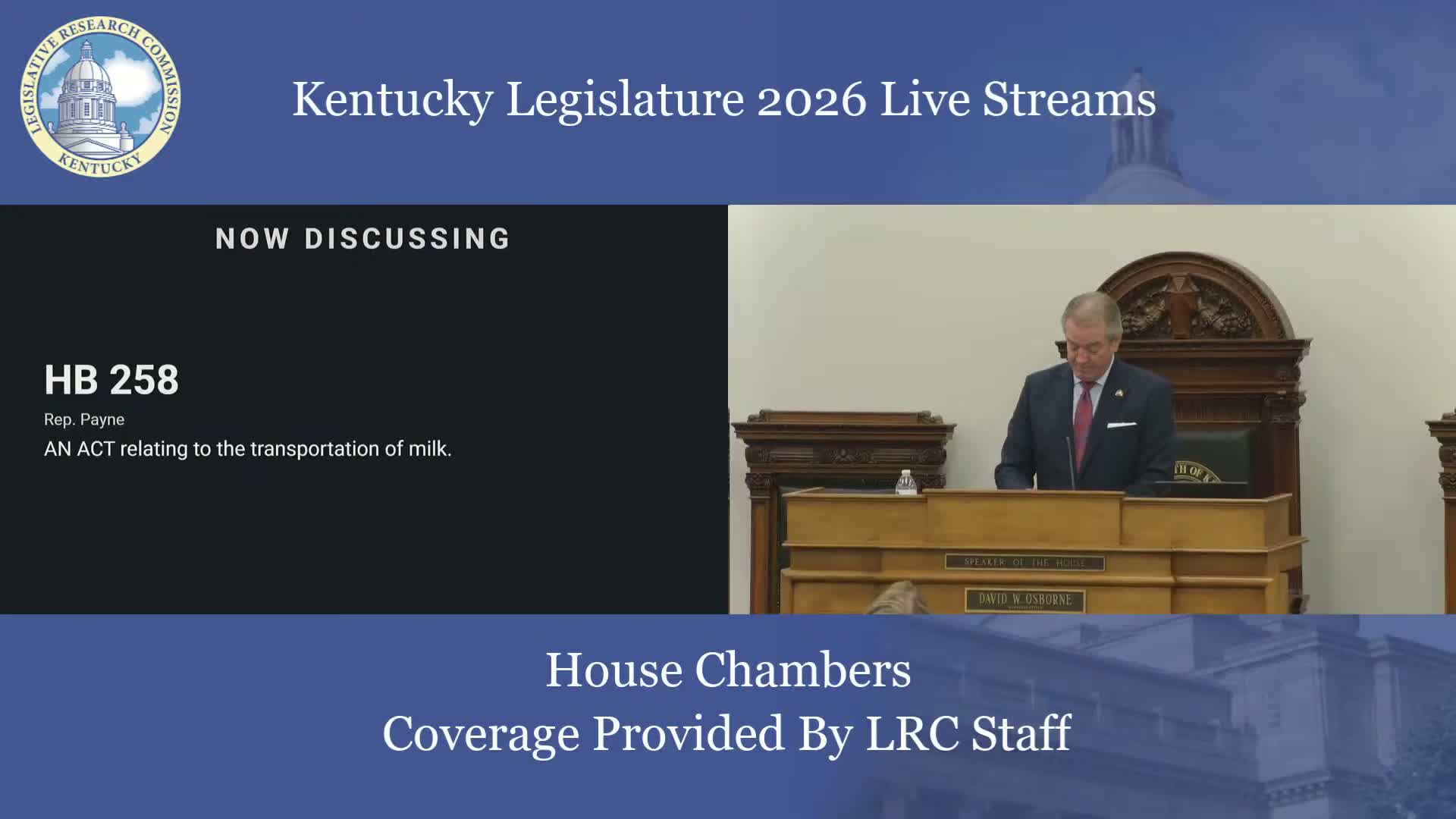
Lawmakers on the Kentucky House floor on Feb. 5 moved through a slate of third-reading bills and adopted several measures addressing administrative boards, local control, corrections, pedestrian safety and agricultural transport.
House Bill 419: Adjusting Kentucky Fire Commission membership and reimbursements
House Committee Substitute 1 for HB 419 was adopted and the bill passed after a short explanation by the Lady from Davis. The substitute expands the commission's membership from 14 to 18 (converting several ex officio seats to voting members), authorizes use of certain excess funds to support firefighter inoculations and cancer screenings, and caps reimbursements to administering entities at 5 percent. The sponsor said the changes were requested by KCTCS and the Kentucky Fire Commission.
House Bill 276: Backyard chickens
HB 276, which would prohibit local governments from restricting residents from keeping six or fewer backyard hens (hens only; roosters prohibited), was explained by the gentleman from Kenton 69 and passed after members debated local-control concerns and practical issues. Local setbacks and health/safety standards remain permissible under the bill.
House Bill 188: Peer support for correctional employees and assault provision
House floor Amendment 1 to HB 188 was adopted. The bill adds peer support counseling eligibility for jailers, deputy jailers and correctional officers and expands the scope of third-degree assault to include health care workers in corrections settings. The sponsor noted support from the Kentucky Jailers Association and other groups; the bill passed unanimously as amended.
House Bill 189: Pedestrian-safety standards
HB 189, introduced in response to local concerns about pedestrian fatalities on state-maintained roads, establishes uniform statewide standards limiting stationary pedestrians on state rights of way not designed for pedestrian use while preserving sidewalks, crosswalks and designated pedestrian areas; the committee substitute was adopted and the bill passed after questions about potential misuse and local exceptions.
House Bill 258: Milk transportation weight limits
HB 258 increases the maximum gross vehicle weight for milk tankers from 80,000 pounds to 90,000 pounds with a 10 percent variance on state highways, classifies milk as a nondivisible product per federal law, and allows permit use on qualifying federal highway networks. Supporters said the change reduces unnecessary trips and benefits small dairy producers; the bill passed as amended.
Other business
The House also received committees' reports, introduced a number of new bills and resolutions for future committee referral, read multiple ceremonial citations (including recognition of a local soft-drink company's centennial and a youth honored for community service), and adjourned until Feb. 6.
House Bill 419: Adjusting Kentucky Fire Commission membership and reimbursements
House Committee Substitute 1 for HB 419 was adopted and the bill passed after a short explanation by the Lady from Davis. The substitute expands the commission's membership from 14 to 18 (converting several ex officio seats to voting members), authorizes use of certain excess funds to support firefighter inoculations and cancer screenings, and caps reimbursements to administering entities at 5 percent. The sponsor said the changes were requested by KCTCS and the Kentucky Fire Commission.
House Bill 276: Backyard chickens
HB 276, which would prohibit local governments from restricting residents from keeping six or fewer backyard hens (hens only; roosters prohibited), was explained by the gentleman from Kenton 69 and passed after members debated local-control concerns and practical issues. Local setbacks and health/safety standards remain permissible under the bill.
House Bill 188: Peer support for correctional employees and assault provision
House floor Amendment 1 to HB 188 was adopted. The bill adds peer support counseling eligibility for jailers, deputy jailers and correctional officers and expands the scope of third-degree assault to include health care workers in corrections settings. The sponsor noted support from the Kentucky Jailers Association and other groups; the bill passed unanimously as amended.
House Bill 189: Pedestrian-safety standards
HB 189, introduced in response to local concerns about pedestrian fatalities on state-maintained roads, establishes uniform statewide standards limiting stationary pedestrians on state rights of way not designed for pedestrian use while preserving sidewalks, crosswalks and designated pedestrian areas; the committee substitute was adopted and the bill passed after questions about potential misuse and local exceptions.
House Bill 258: Milk transportation weight limits
HB 258 increases the maximum gross vehicle weight for milk tankers from 80,000 pounds to 90,000 pounds with a 10 percent variance on state highways, classifies milk as a nondivisible product per federal law, and allows permit use on qualifying federal highway networks. Supporters said the change reduces unnecessary trips and benefits small dairy producers; the bill passed as amended.
Other business
The House also received committees' reports, introduced a number of new bills and resolutions for future committee referral, read multiple ceremonial citations (including recognition of a local soft-drink company's centennial and a youth honored for community service), and adjourned until Feb. 6.
Don't Miss a Word: See the Full Meeting!
Go beyond summaries. Unlock every video, transcript, and key insight with a Founder Membership.
✓
Get instant access to full meeting videos
✓
Search and clip any phrase from complete transcripts
✓
Receive AI-powered summaries & custom alerts
✓
Enjoy lifetime, unrestricted access to government data
30-day money-back guarantee
