South Washington County Schools presents update to American Indian Education Plan
February 06, 2026 | South Washington County Schools, School Boards, Minnesota
This article was created by AI summarizing key points discussed. AI makes mistakes, so for full details and context, please refer to the video of the full meeting. Please report any errors so we can fix them. Report an error »
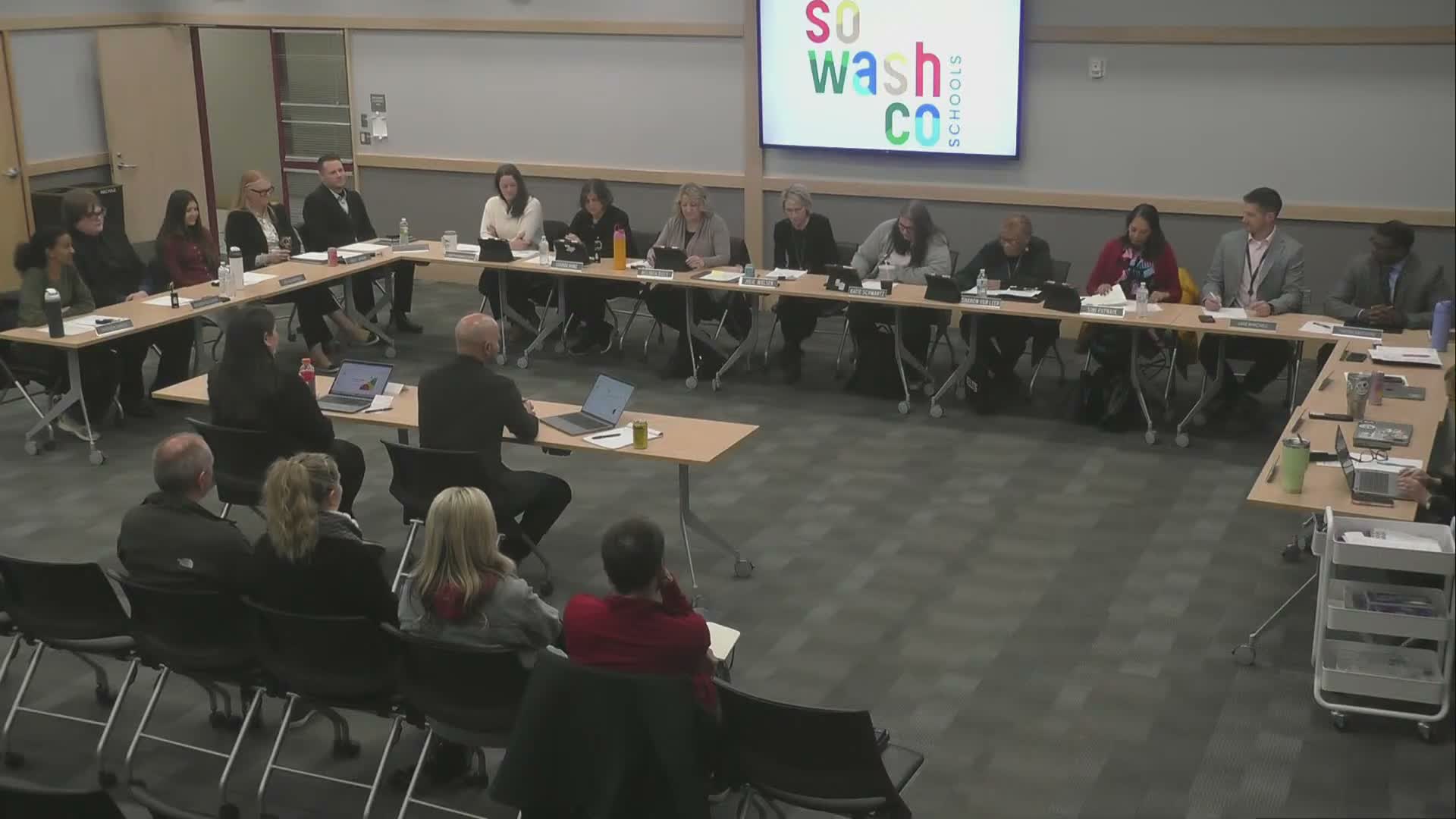
At the Feb. 5 workshop, South Washington County Schools officials presented the district’s annual American Indian Education Plan and said the district’s Native American Parent Advisory Committee (NAPAC) voted to concur with the plan’s goals and strategies.
The presentation, introduced by Assistant Superintendent Kelly Jansen, said the district is eligible for the state American Indian Education Aid because more than 20 students self‑identify as American Indian; the presenter noted the district’s 2025–26 state aid is approximately $222,000. The plan centers on six statutory focus areas: post‑secondary preparation, academic achievement, culturally relevant curriculum, positive reinforcement of self‑image, intercultural awareness and a requirement that district programs supplement — not supplant — state and federal programming.
The indigenous education coordinator described specific strategies under those focus areas: increased college visits and ACT test‑prep (ACT prep participation rose from five to ten juniors this year), a planned FAFSA night and scholarship supports, expansion of K–5 literacy tutoring (from five to ten students enrolled in the district tutoring cohort), middle‑ and high‑school enrichment, and embedding indigenous‑authored books and cultural lessons into curriculum. The coordinator also described two “cultural trunks” used for hands‑on learning — one with animal furs and another with artifacts such as moccasins and traditional games — and family engagement events including storytelling nights and future powwow planning.
During board questions, members asked which schools have higher indigenous student populations; presenters said Park High School has a notable high‑school population but that the district’s roughly 400 self‑identified indigenous students (about 2% of enrollment) are spread across elementary and secondary schools. Board members also sought clarification on NAPAC’s role; presenters explained that NAPAC votes to concur on the statutory focus areas and helps prioritize strategies the district will pursue.
The coordinator said Sewashko’s indigenous student graduation rate is 86.1%, higher than the statewide American Indian rate cited during the presentation (about 62.8%). The presentation emphasized family engagement, culturally responsive instruction and systems to allow school sites to propose and manage cultural programming funded from district allocations tied to the plan. No board action was taken; the item was presented for information.
The presentation, introduced by Assistant Superintendent Kelly Jansen, said the district is eligible for the state American Indian Education Aid because more than 20 students self‑identify as American Indian; the presenter noted the district’s 2025–26 state aid is approximately $222,000. The plan centers on six statutory focus areas: post‑secondary preparation, academic achievement, culturally relevant curriculum, positive reinforcement of self‑image, intercultural awareness and a requirement that district programs supplement — not supplant — state and federal programming.
The indigenous education coordinator described specific strategies under those focus areas: increased college visits and ACT test‑prep (ACT prep participation rose from five to ten juniors this year), a planned FAFSA night and scholarship supports, expansion of K–5 literacy tutoring (from five to ten students enrolled in the district tutoring cohort), middle‑ and high‑school enrichment, and embedding indigenous‑authored books and cultural lessons into curriculum. The coordinator also described two “cultural trunks” used for hands‑on learning — one with animal furs and another with artifacts such as moccasins and traditional games — and family engagement events including storytelling nights and future powwow planning.
During board questions, members asked which schools have higher indigenous student populations; presenters said Park High School has a notable high‑school population but that the district’s roughly 400 self‑identified indigenous students (about 2% of enrollment) are spread across elementary and secondary schools. Board members also sought clarification on NAPAC’s role; presenters explained that NAPAC votes to concur on the statutory focus areas and helps prioritize strategies the district will pursue.
The coordinator said Sewashko’s indigenous student graduation rate is 86.1%, higher than the statewide American Indian rate cited during the presentation (about 62.8%). The presentation emphasized family engagement, culturally responsive instruction and systems to allow school sites to propose and manage cultural programming funded from district allocations tied to the plan. No board action was taken; the item was presented for information.
View the Full Meeting & All Its Details
This article offers just a summary. Unlock complete video, transcripts, and insights as a Founder Member.
✓
Watch full, unedited meeting videos
✓
Search every word spoken in unlimited transcripts
✓
AI summaries & real-time alerts (all government levels)
✓
Permanent access to expanding government content
30-day money-back guarantee
