House panel reviews DCF budget as department proposes targeted program cuts and revenue realignments
February 06, 2026 | Human Services, HOUSE OF REPRESENTATIVES, Committees, Legislative , Vermont
This article was created by AI summarizing key points discussed. AI makes mistakes, so for full details and context, please refer to the video of the full meeting. Please report any errors so we can fix them. Report an error »
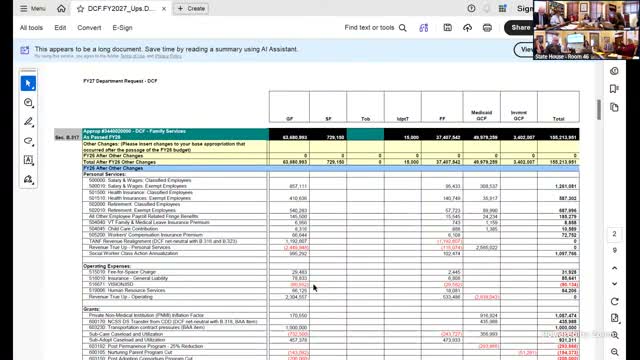
Department for Children and Families officials outlined their proposed fiscal year 2027 budget to the House Human Services Committee, saying constrained resources required prioritizing statutorily mandated services while trimming or eliminating some prevention and grant programs.
Erica Ravecki, deputy commissioner of the Family Services Division, described a three-part, net-neutral TANF revenue realignment intended to maximize federal funding and an annualization of pay-grade changes from last year’s social worker class-action settlement. She also identified programmatic reductions, including a proposed 25% cut to the post-permanence program (limiting eligibility to adoptions facilitated by DCF), a 50% reduction to the Nurturing Parent parenting-classes program administered by Prevent Child Abuse Vermont, and elimination of a $200,000 post-adoption consortium that was largely unspent last year.
The department said two Family First Prevention Services Act (FFPSA) line items would be cut because those programs were never fully operationalized and the main barrier to drawing additional federal IV‑E funds is a missing CCWIS child-welfare information system. "We are doing what you ask, but we're doing it in a thoughtful and deliberate manner," Ravecki told the committee, emphasizing that officials aimed to preserve services where possible while balancing the budget.
Committee members warned that cutting prevention supports risks reversing recent progress: DCF reported fewer children entering custody and higher adoption rates. Ravecki and budget staff said they began with statutorily required items and that reductions are targeted where they believe service impacts will be limited, but acknowledged the tradeoffs. Budget documents also show changes to childcare funding authority, including a $2.5 million childcare special-fund correction (the amount was double‑appropriated last year and needs to flow to the tax department’s appropriation) and an internal $620,000 revenue realignment across personal services, grants out and operating to reflect actual cost allocations.
The proposal removes base funding for the hotel/motel transitional general assistance program and expects to cover emergency lodging with one-time funds in SFY27 as part of a broader housing initiative; limited contracted hotel-room funding would remain. The Office of Economic Opportunity asked to annualize a cold-weather shelter ($6,200,000 noted as base impact) and cited $6,000,000 and other one-time shelter expansion proposals.
Other notable line items include a $2,000,000 increase in federal spending authority for the SNAP/EBT program (3Squares) to match utilization, and a $3,300,000 caseload adjustment (reduction) for Reach Up based on consultant projections. DCF said it would reduce the Reach First diversion program—about 15 cases per month—because costs can be absorbed into other Reach Up budget lines.
The committee asked for more detail on the distribution of grant reductions to providers such as NFI, Lund and Easterseals, the contracting roadmap for temporary secure facilities, and the department’s plan to avoid service reversals if prevention funding is cut. The department agreed to follow up with detailed funding breakouts and to schedule meetings to drill down on contracting and program impacts.
The hearing closed this topic with members scheduling follow-up briefings to review provider-level impacts and contracting details.
Erica Ravecki, deputy commissioner of the Family Services Division, described a three-part, net-neutral TANF revenue realignment intended to maximize federal funding and an annualization of pay-grade changes from last year’s social worker class-action settlement. She also identified programmatic reductions, including a proposed 25% cut to the post-permanence program (limiting eligibility to adoptions facilitated by DCF), a 50% reduction to the Nurturing Parent parenting-classes program administered by Prevent Child Abuse Vermont, and elimination of a $200,000 post-adoption consortium that was largely unspent last year.
The department said two Family First Prevention Services Act (FFPSA) line items would be cut because those programs were never fully operationalized and the main barrier to drawing additional federal IV‑E funds is a missing CCWIS child-welfare information system. "We are doing what you ask, but we're doing it in a thoughtful and deliberate manner," Ravecki told the committee, emphasizing that officials aimed to preserve services where possible while balancing the budget.
Committee members warned that cutting prevention supports risks reversing recent progress: DCF reported fewer children entering custody and higher adoption rates. Ravecki and budget staff said they began with statutorily required items and that reductions are targeted where they believe service impacts will be limited, but acknowledged the tradeoffs. Budget documents also show changes to childcare funding authority, including a $2.5 million childcare special-fund correction (the amount was double‑appropriated last year and needs to flow to the tax department’s appropriation) and an internal $620,000 revenue realignment across personal services, grants out and operating to reflect actual cost allocations.
The proposal removes base funding for the hotel/motel transitional general assistance program and expects to cover emergency lodging with one-time funds in SFY27 as part of a broader housing initiative; limited contracted hotel-room funding would remain. The Office of Economic Opportunity asked to annualize a cold-weather shelter ($6,200,000 noted as base impact) and cited $6,000,000 and other one-time shelter expansion proposals.
Other notable line items include a $2,000,000 increase in federal spending authority for the SNAP/EBT program (3Squares) to match utilization, and a $3,300,000 caseload adjustment (reduction) for Reach Up based on consultant projections. DCF said it would reduce the Reach First diversion program—about 15 cases per month—because costs can be absorbed into other Reach Up budget lines.
The committee asked for more detail on the distribution of grant reductions to providers such as NFI, Lund and Easterseals, the contracting roadmap for temporary secure facilities, and the department’s plan to avoid service reversals if prevention funding is cut. The department agreed to follow up with detailed funding breakouts and to schedule meetings to drill down on contracting and program impacts.
The hearing closed this topic with members scheduling follow-up briefings to review provider-level impacts and contracting details.
View the Full Meeting & All Its Details
This article offers just a summary. Unlock complete video, transcripts, and insights as a Founder Member.
✓
Watch full, unedited meeting videos
✓
Search every word spoken in unlimited transcripts
✓
AI summaries & real-time alerts (all government levels)
✓
Permanent access to expanding government content
30-day money-back guarantee
