AHS outlines FY27 shelter plan: hotels as temporary family options, rental assistance and enhanced case management
February 06, 2026 | Human Services, HOUSE OF REPRESENTATIVES, Committees, Legislative , Vermont
This article was created by AI summarizing key points discussed. AI makes mistakes, so for full details and context, please refer to the video of the full meeting. Please report any errors so we can fix them. Report an error »
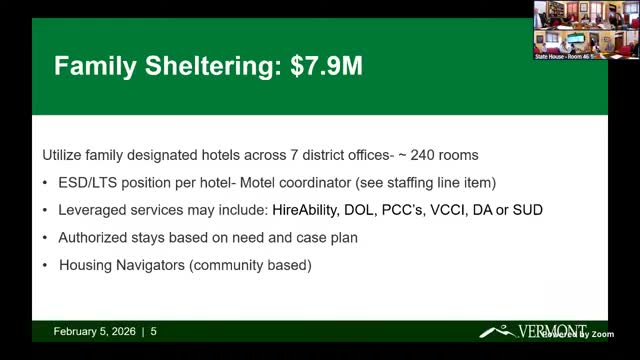
State Agency for Human Services (AHS) officials briefed the House Human Services committee on a multi‑part FY27 homelessness plan that blends transitional hotel placements for families, rental assistance, winter weather response and enhanced case management.
Key elements: AHS said it will reallocate existing limited‑service staff and new base funding to support a transition away from routine motel reliance. The agency described 21 limited‑service positions in the program: 12 would be embedded in hotel sites to support family sheltering and nine would remain to operate the program and handle administrative tasks. ‘‘We would take these 12 to be in hotels ... That would leave us 9 to still be able to operate the program,’’ an AHS representative said.
Budget highlights AHS presented to the committee included:
- $10,000,000 proposed as temporary overflow funding for FY27 to serve approximately 327 households when shelter spaces are unavailable (modified eligibility).
- $3,600,000 for adverse‑weather response, estimated to serve about 513 households depending on weather and duration.
- $1,400,000 in rental assistance targeting roughly 80 households, with an average annual benefit of about $14,800 per household.
- Enhanced case management funding (amounts described in materials) to standardize outreach and coordinate DMH/DSU/VDH efforts and fill gaps in outreach coverage.
Officials said some of the positions and dollars are base funding while other elements have been funded one‑time in prior years; committee members pressed AHS staff to clarify which line items are new base appropriations and which are carry‑forward one‑time funds. On FY25 carry‑forward, AHS reported that of the $11.1 million carried forward for DCF GA emergency housing, roughly $3.1 million remained unliquidated and some funds have been obligated to shelter development projects.
Points of debate: Legislators repeatedly requested a spreadsheet reconciling bed capacity and budget lines across FY25–FY27. Several members urged clearer accounting of how rental assistance, family supportive housing capacity (noted as roughly 465 families at full capacity) and embedded hotel staffing will work together without duplicating services. One legislator warned the plan “is not matching the need” given current numbers of households experiencing homelessness.
AHS officials defended the approach as a pragmatic, phased strategy. They told the committee they had done outreach with Vermont Interfaith Action and municipalities, noted Rutland as an example of municipal engagement in cold‑weather sheltering, and said some municipal entities were eligible to receive awards under prior notices of funding. Several members said they wanted clearer benchmarks — for example, bed totals for each fiscal year — before finalizing appropriations.
What’s next: AHS agreed to provide the requested spreadsheet and more granular carry‑forward accounting. Committee members signaled intent to review the data and follow up during ongoing budget deliberations. There were no committee votes recorded on the proposals during the session.
Direct quotes in context: An AHS official summarized program intent: “So this is in the base budget. So we're planning on continuing to provide services for families, just the manner in which their services are provided ... the funding is in the base budget and would remain.” A committee member pressed: “If you're going to still ... not I think ultimately it would be shelters. It would be shelters if we could.”
No formal actions or law changes were adopted at the hearing; committee members requested additional documentation before taking funding votes.
Key elements: AHS said it will reallocate existing limited‑service staff and new base funding to support a transition away from routine motel reliance. The agency described 21 limited‑service positions in the program: 12 would be embedded in hotel sites to support family sheltering and nine would remain to operate the program and handle administrative tasks. ‘‘We would take these 12 to be in hotels ... That would leave us 9 to still be able to operate the program,’’ an AHS representative said.
Budget highlights AHS presented to the committee included:
- $10,000,000 proposed as temporary overflow funding for FY27 to serve approximately 327 households when shelter spaces are unavailable (modified eligibility).
- $3,600,000 for adverse‑weather response, estimated to serve about 513 households depending on weather and duration.
- $1,400,000 in rental assistance targeting roughly 80 households, with an average annual benefit of about $14,800 per household.
- Enhanced case management funding (amounts described in materials) to standardize outreach and coordinate DMH/DSU/VDH efforts and fill gaps in outreach coverage.
Officials said some of the positions and dollars are base funding while other elements have been funded one‑time in prior years; committee members pressed AHS staff to clarify which line items are new base appropriations and which are carry‑forward one‑time funds. On FY25 carry‑forward, AHS reported that of the $11.1 million carried forward for DCF GA emergency housing, roughly $3.1 million remained unliquidated and some funds have been obligated to shelter development projects.
Points of debate: Legislators repeatedly requested a spreadsheet reconciling bed capacity and budget lines across FY25–FY27. Several members urged clearer accounting of how rental assistance, family supportive housing capacity (noted as roughly 465 families at full capacity) and embedded hotel staffing will work together without duplicating services. One legislator warned the plan “is not matching the need” given current numbers of households experiencing homelessness.
AHS officials defended the approach as a pragmatic, phased strategy. They told the committee they had done outreach with Vermont Interfaith Action and municipalities, noted Rutland as an example of municipal engagement in cold‑weather sheltering, and said some municipal entities were eligible to receive awards under prior notices of funding. Several members said they wanted clearer benchmarks — for example, bed totals for each fiscal year — before finalizing appropriations.
What’s next: AHS agreed to provide the requested spreadsheet and more granular carry‑forward accounting. Committee members signaled intent to review the data and follow up during ongoing budget deliberations. There were no committee votes recorded on the proposals during the session.
Direct quotes in context: An AHS official summarized program intent: “So this is in the base budget. So we're planning on continuing to provide services for families, just the manner in which their services are provided ... the funding is in the base budget and would remain.” A committee member pressed: “If you're going to still ... not I think ultimately it would be shelters. It would be shelters if we could.”
No formal actions or law changes were adopted at the hearing; committee members requested additional documentation before taking funding votes.
View the Full Meeting & All Its Details
This article offers just a summary. Unlock complete video, transcripts, and insights as a Founder Member.
✓
Watch full, unedited meeting videos
✓
Search every word spoken in unlimited transcripts
✓
AI summaries & real-time alerts (all government levels)
✓
Permanent access to expanding government content
30-day money-back guarantee
