Virginia subcommittee backs bill to preserve federal appliance-efficiency standards if federal protections are removed
February 06, 2026 | 2026 Legislature VA, Virginia
This article was created by AI summarizing key points discussed. AI makes mistakes, so for full details and context, please refer to the video of the full meeting. Please report any errors so we can fix them. Report an error »
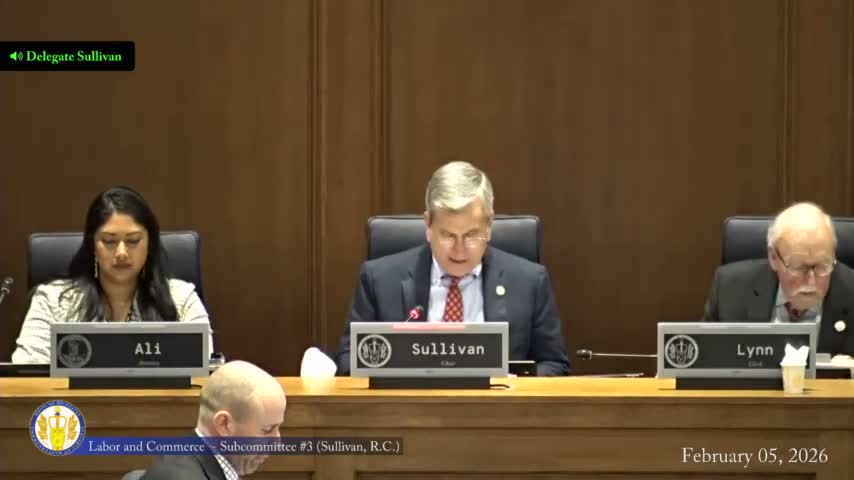
Delegate Raquel Maldonado, the bill patron, told the House Subcommittee 3 that HB 672 would act only as a state-level backstop if federal appliance efficiency standards are rolled back. "The bill does not create new efficiency standards, rather it preserves existing federal benchmarks," Maldonado said, adding that the measure would adopt federal requirements "with a product compliance date that's on or before 12/31/2025."
Supporters said the bill simply maintains the status quo for consumers. Lena Lewis of The Nature Conservancy said federal minimum standards save energy and reduce peak load, and she cited an Appliance Standards Awareness Project finding that Virginia would have consumed 14% more electricity last year without federal minimum standards. Kim Suttarth, policy director at Virginia Interfaith Power and Light, told the committee those standards can save families up to 15% on utility bills—"That's over $5,000 over 10 years," she said—and said HB 672 would step in only if federal protections disappear.
Utilities and industry participants described negotiations with the patron. Morgan Whalen of Virginia Natural Gas and representatives of gas utilities thanked the delegate for working through concerns; Broadstreet Group's Matt Mansell, testifying for Coalition of Power America, also praised stakeholder engagement. Opponents urged caution: one industry representative, speaking neutrally, warned this would be the first time in his 25 years the Commonwealth prospectively adopts a national manufacturing standard in anticipation of a federal change and asked for more time for manufacturers (represented by the Association of Home Appliance Manufacturers) to review complex code language.
Maldonado said the substitute keeps testing and enforcement with the Department of Energy's established procedures and leverages existing third-party databases, such as the modernized appliance efficiency database system, to confirm compliance. "This bill changes nothing," she told the committee, emphasizing the narrow trigger: it would apply only if federal standards are withdrawn or eliminated.
After testimony and brief questioning, the subcommittee voted to report HB 672 and refer it to Appropriations by a vote of 8–0. The committee record shows the motion to report was made and seconded and the substitute was adopted before referral.
What happens next: HB 672 will move to the Appropriations Committee for further consideration. If enacted in later stages, the measure would become effective only under the condition that the stated federal standards are removed.
Supporters said the bill simply maintains the status quo for consumers. Lena Lewis of The Nature Conservancy said federal minimum standards save energy and reduce peak load, and she cited an Appliance Standards Awareness Project finding that Virginia would have consumed 14% more electricity last year without federal minimum standards. Kim Suttarth, policy director at Virginia Interfaith Power and Light, told the committee those standards can save families up to 15% on utility bills—"That's over $5,000 over 10 years," she said—and said HB 672 would step in only if federal protections disappear.
Utilities and industry participants described negotiations with the patron. Morgan Whalen of Virginia Natural Gas and representatives of gas utilities thanked the delegate for working through concerns; Broadstreet Group's Matt Mansell, testifying for Coalition of Power America, also praised stakeholder engagement. Opponents urged caution: one industry representative, speaking neutrally, warned this would be the first time in his 25 years the Commonwealth prospectively adopts a national manufacturing standard in anticipation of a federal change and asked for more time for manufacturers (represented by the Association of Home Appliance Manufacturers) to review complex code language.
Maldonado said the substitute keeps testing and enforcement with the Department of Energy's established procedures and leverages existing third-party databases, such as the modernized appliance efficiency database system, to confirm compliance. "This bill changes nothing," she told the committee, emphasizing the narrow trigger: it would apply only if federal standards are withdrawn or eliminated.
After testimony and brief questioning, the subcommittee voted to report HB 672 and refer it to Appropriations by a vote of 8–0. The committee record shows the motion to report was made and seconded and the substitute was adopted before referral.
What happens next: HB 672 will move to the Appropriations Committee for further consideration. If enacted in later stages, the measure would become effective only under the condition that the stated federal standards are removed.
Don't Miss a Word: See the Full Meeting!
Go beyond summaries. Unlock every video, transcript, and key insight with a Founder Membership.
✓
Get instant access to full meeting videos
✓
Search and clip any phrase from complete transcripts
✓
Receive AI-powered summaries & custom alerts
✓
Enjoy lifetime, unrestricted access to government data
30-day money-back guarantee
