Public-safety subcommittee advances dozens of bills: risk-order training, trafficking fee, civilian oversight access and more
February 06, 2026 | 2026 Legislature VA, Virginia
This article was created by AI summarizing key points discussed. AI makes mistakes, so for full details and context, please refer to the video of the full meeting. Please report any errors so we can fix them. Report an error »
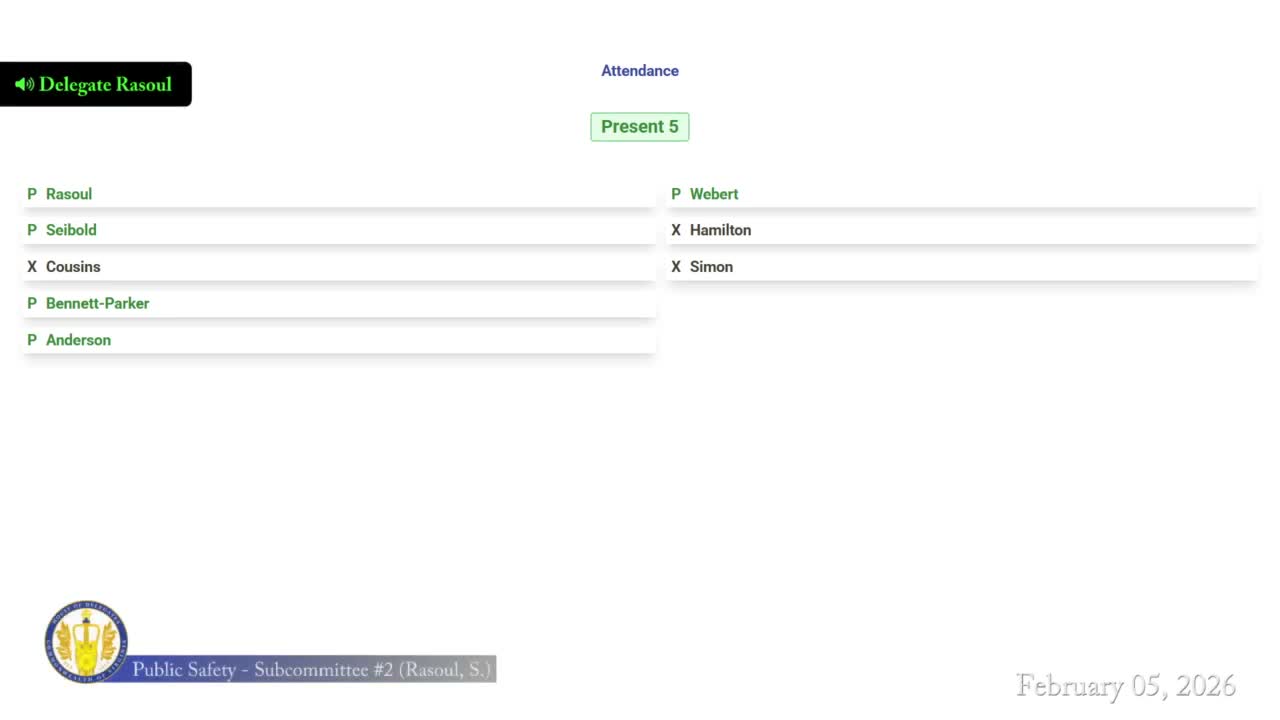
The House public-safety subcommittee moved a set of disparate public-safety proposals through its docket on a single session day, advancing bills that address training, victims' funding, civilian oversight, courthouse procedures and guidelines for confidential informants.
House Bill 896 (Delegate Sullivan) would direct the Department of Criminal Justice Services to establish training standards and an SRO/risk-order training program with outreach to law enforcement, mental-health professionals and school staff. Sponsor Sullivan and witnesses including Joe Vu (UVA law student) and Lori Haas (Johns Hopkins) said uneven use of risk orders across localities justifies proactive DCJS outreach. The subcommittee reported HB 896 as amended and referred it to Appropriations 5-2.
House Bill 12 33, presented by Delegate Delaney with a substitute, creates a court fee of $1,000 on convicted traffickers, solicitors and related offenders to fund the Virginia sexual and domestic violence victim fund and explicitly add human-trafficking victims. The administration signaled support; opponents including the Legal Aid Justice Center and the Fines and Fees Justice Center warned that criminal fees are unreliable and regressive revenue sources. The subcommittee reported the substitute to Appropriations 7-0.
House Bill 14 76 (Delegate Schmidt) would allow civilian review boards and independent police auditors access to juvenile and sexual-assault case records necessary for oversight while requiring closed-session review and preserving victim privacy. Local officials from Arlington and civilian-oversight directors testified in favor; the subcommittee reported the substitute 4-2.
House Bill 11 40 ("Troy bill," Delegate Cherry) directs DCJS to develop enforceable guidelines limiting the use of confidential informants in situations such as recent probationary drug users; a mother whose son died while acting as an informant urged passage. The subcommittee reported HB 11 40 as amended to Appropriations 7-0.
Other bills advanced included HB 11 14 (paid military leave for law enforcement) reported unanimously and HB 13 92 to standardize attorney-client confidential access in local facilities (reported 5-2 with amendments). Several bills were stricken from the docket at patrons' requests and one bill was gently laid on the table pending the patron's presence.
The committee used standard motions to report substitutes and refer multiple measures to Appropriations for fiscal review. Where vote tallies were recorded in the transcript, they are noted above.
House Bill 896 (Delegate Sullivan) would direct the Department of Criminal Justice Services to establish training standards and an SRO/risk-order training program with outreach to law enforcement, mental-health professionals and school staff. Sponsor Sullivan and witnesses including Joe Vu (UVA law student) and Lori Haas (Johns Hopkins) said uneven use of risk orders across localities justifies proactive DCJS outreach. The subcommittee reported HB 896 as amended and referred it to Appropriations 5-2.
House Bill 12 33, presented by Delegate Delaney with a substitute, creates a court fee of $1,000 on convicted traffickers, solicitors and related offenders to fund the Virginia sexual and domestic violence victim fund and explicitly add human-trafficking victims. The administration signaled support; opponents including the Legal Aid Justice Center and the Fines and Fees Justice Center warned that criminal fees are unreliable and regressive revenue sources. The subcommittee reported the substitute to Appropriations 7-0.
House Bill 14 76 (Delegate Schmidt) would allow civilian review boards and independent police auditors access to juvenile and sexual-assault case records necessary for oversight while requiring closed-session review and preserving victim privacy. Local officials from Arlington and civilian-oversight directors testified in favor; the subcommittee reported the substitute 4-2.
House Bill 11 40 ("Troy bill," Delegate Cherry) directs DCJS to develop enforceable guidelines limiting the use of confidential informants in situations such as recent probationary drug users; a mother whose son died while acting as an informant urged passage. The subcommittee reported HB 11 40 as amended to Appropriations 7-0.
Other bills advanced included HB 11 14 (paid military leave for law enforcement) reported unanimously and HB 13 92 to standardize attorney-client confidential access in local facilities (reported 5-2 with amendments). Several bills were stricken from the docket at patrons' requests and one bill was gently laid on the table pending the patron's presence.
The committee used standard motions to report substitutes and refer multiple measures to Appropriations for fiscal review. Where vote tallies were recorded in the transcript, they are noted above.
Don't Miss a Word: See the Full Meeting!
Go beyond summaries. Unlock every video, transcript, and key insight with a Founder Membership.
✓
Get instant access to full meeting videos
✓
Search and clip any phrase from complete transcripts
✓
Receive AI-powered summaries & custom alerts
✓
Enjoy lifetime, unrestricted access to government data
30-day money-back guarantee
