Tenants’ advocates warn shortening eviction timelines would harm renters; landlords call for speedier process
February 06, 2026 | General & Housing, HOUSE OF REPRESENTATIVES, Committees, Legislative , Vermont
This article was created by AI summarizing key points discussed. AI makes mistakes, so for full details and context, please refer to the video of the full meeting. Please report any errors so we can fix them. Report an error »
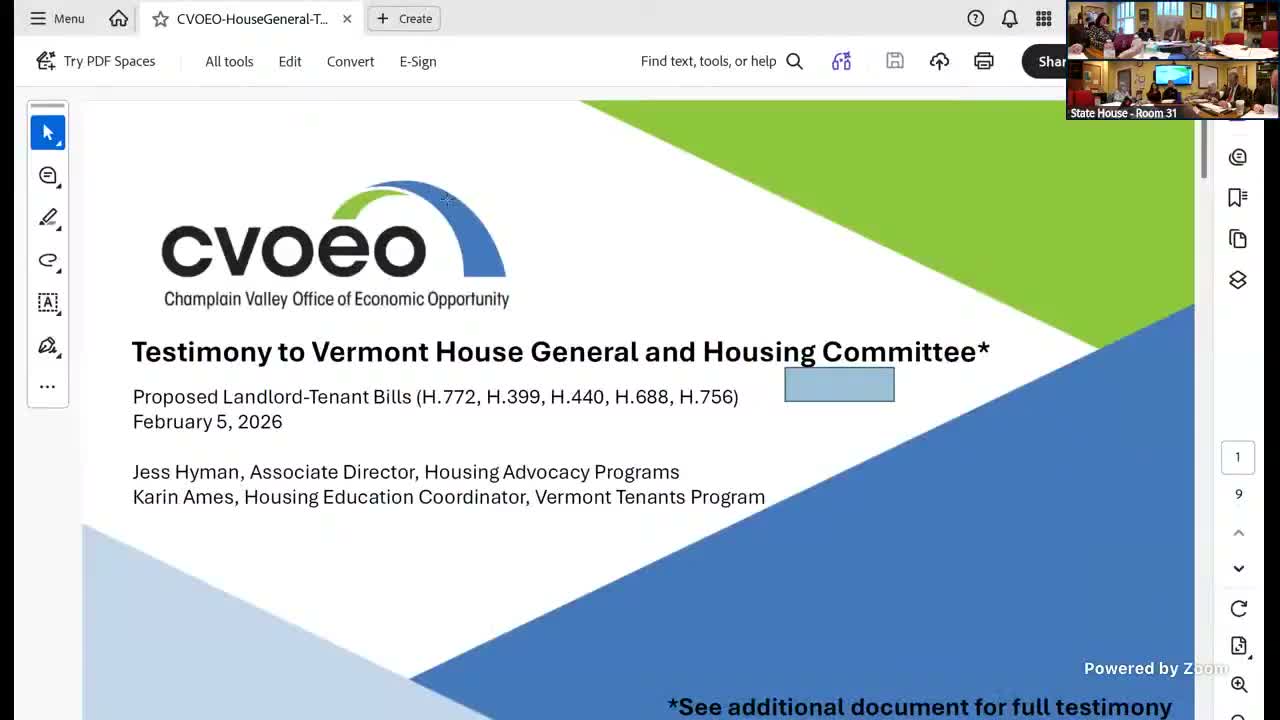
Champlain Valley Office of Economic Opportunity representatives told the House Devlin Finance committee on Feb. 5 that shortening eviction notice periods would likely increase homelessness and generate unintended defaults, particularly for low-income renters who need time to access legal aid and supports.
Jess Finan, associate director of CVOEO’s statewide housing-advocacy programs, said CVOEO opposes reducing eviction notice periods and supports rent-increase limits, just-cause eviction protections, a rental registry, tenant right to counsel and confidentiality for eviction records. She described the agency’s statewide hotline and counseling services and gave two hotline examples to illustrate the practical barriers tenants face when required to respond quickly in court: a nursing student who was seven days into a 21-day response window and a single mother in a rural area who had four days to file an answer and lacked transportation.
“Short timelines for everyday people are hard,” Finan said, describing how tenants who are unfamiliar with court forms or who cannot quickly reach legal aid risk default judgments. She also raised concerns about consumer-reporting services, identified in testimony as RealPage, which can list notices to vacate and effectively prevent tenants from obtaining housing even when cases do not result in a judgment.
Finan and CVOEO urged lawmakers to consider targeted alternatives to address dangerous or criminal behavior without broad changes to landlord–tenant law that could be misused. She recommended improving clarity in statutory language, expanding tenant education and funding landlord‑liaison and financial‑coach positions at community action agencies so tenants and landlords can use new policies effectively.
Representing housing providers, Angela Zajkowski, director of the Vermont Landlords Association and a practicing attorney, told the committee the current eviction process is often long, expensive and undermines landlords’ willingness to take on marginal tenants. Zajkowski said her review of other states shows court-processing time in Vermont averages four to six months from filing to removal; she said H.772’s proposal to streamline notice and court steps would reduce the court-phase removal timeline to roughly 40–70 days.
Zajkowski also emphasized the practical steps already taken to reduce defaults, noting that a blank answer form included in eviction packets (adopted in recent years) has reduced default rates because tenants have a ready format to respond and the packet includes court contact information. She said some landlords still support streamlining to make the market less risky and more likely to encourage landlords to rent to applicants with imperfect records.
The committee followed that testimony with additional questions about how to balance shortened timelines with mechanisms to prevent unintended defaults, how to limit harmful uses of notice data by consumer-reporting companies, and what targeted law‑enforcement or public‑safety options might address the small share of tenants who cause outsized harm to neighbors.
The hearing included multiple references to H.772 as the vehicle for proposed timeline changes; witnesses repeatedly called for pairing statutory reforms with investments in legal aid, tenant education and targeted interventions so changes do not produce avoidable homelessness.
Next steps: the committee continued the broader landlord–tenant docket with additional testimony scheduled later in the day; witnesses filed written testimony and side‑by‑side analyses for members to review.
Jess Finan, associate director of CVOEO’s statewide housing-advocacy programs, said CVOEO opposes reducing eviction notice periods and supports rent-increase limits, just-cause eviction protections, a rental registry, tenant right to counsel and confidentiality for eviction records. She described the agency’s statewide hotline and counseling services and gave two hotline examples to illustrate the practical barriers tenants face when required to respond quickly in court: a nursing student who was seven days into a 21-day response window and a single mother in a rural area who had four days to file an answer and lacked transportation.
“Short timelines for everyday people are hard,” Finan said, describing how tenants who are unfamiliar with court forms or who cannot quickly reach legal aid risk default judgments. She also raised concerns about consumer-reporting services, identified in testimony as RealPage, which can list notices to vacate and effectively prevent tenants from obtaining housing even when cases do not result in a judgment.
Finan and CVOEO urged lawmakers to consider targeted alternatives to address dangerous or criminal behavior without broad changes to landlord–tenant law that could be misused. She recommended improving clarity in statutory language, expanding tenant education and funding landlord‑liaison and financial‑coach positions at community action agencies so tenants and landlords can use new policies effectively.
Representing housing providers, Angela Zajkowski, director of the Vermont Landlords Association and a practicing attorney, told the committee the current eviction process is often long, expensive and undermines landlords’ willingness to take on marginal tenants. Zajkowski said her review of other states shows court-processing time in Vermont averages four to six months from filing to removal; she said H.772’s proposal to streamline notice and court steps would reduce the court-phase removal timeline to roughly 40–70 days.
Zajkowski also emphasized the practical steps already taken to reduce defaults, noting that a blank answer form included in eviction packets (adopted in recent years) has reduced default rates because tenants have a ready format to respond and the packet includes court contact information. She said some landlords still support streamlining to make the market less risky and more likely to encourage landlords to rent to applicants with imperfect records.
The committee followed that testimony with additional questions about how to balance shortened timelines with mechanisms to prevent unintended defaults, how to limit harmful uses of notice data by consumer-reporting companies, and what targeted law‑enforcement or public‑safety options might address the small share of tenants who cause outsized harm to neighbors.
The hearing included multiple references to H.772 as the vehicle for proposed timeline changes; witnesses repeatedly called for pairing statutory reforms with investments in legal aid, tenant education and targeted interventions so changes do not produce avoidable homelessness.
Next steps: the committee continued the broader landlord–tenant docket with additional testimony scheduled later in the day; witnesses filed written testimony and side‑by‑side analyses for members to review.
View the Full Meeting & All Its Details
This article offers just a summary. Unlock complete video, transcripts, and insights as a Founder Member.
✓
Watch full, unedited meeting videos
✓
Search every word spoken in unlimited transcripts
✓
AI summaries & real-time alerts (all government levels)
✓
Permanent access to expanding government content
30-day money-back guarantee
