Pitt rolls out public-impact portfolio and 'Pitt in 67' county outreach, cites $11 billion state economic impact
February 06, 2026 | University of Pittsburgh, Other State Agencies, Organizations, Executive, Pennsylvania
This article was created by AI summarizing key points discussed. AI makes mistakes, so for full details and context, please refer to the video of the full meeting. Please report any errors so we can fix them. Report an error »
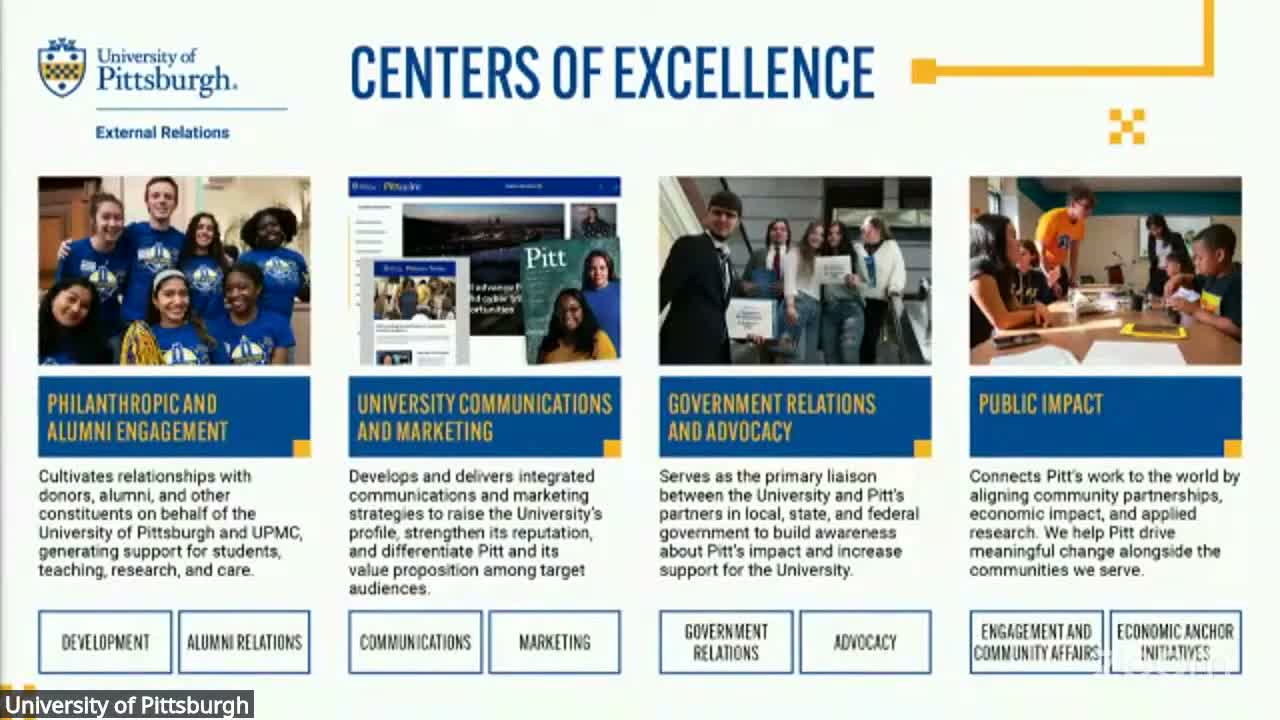
At the trustees meeting, senior vice chancellor for external relations Kevin Washoe introduced a consolidated public-impact portfolio and described a 'Pitt in 67' effort to highlight the university's work across every Pennsylvania county.
Kevin said the public-impact portfolio combines engagement, economic-impact work and university research partnerships into a single hub and that officials are building a public-impact website to aggregate outcomes and stories. "From this significant effort, we can now say that the university generates $6,600,000,000 annually for the state's economy," Washoe said, adding that when combined with $5,400,000,000 of alumni impact the total impact to the Commonwealth is about $11,000,000,000 a year.
Lina D'Austillo, who led the presentation of the portfolio's four impact areas, described Pitt as an "engaged partner in public problem solving," an economic anchor, an engine for workforce development and a "responsive and committed neighbor." She said the Plan for Pitt aims to document and share quantifiable outcomes and narratives so legislators, donors and communities can more easily locate the university's work.
Washoe highlighted county-level examples: a child-welfare resource center in Lackawanna County that trains and certifies caseworkers; Pitt Greensburg's Center for Applied Research supporting Westmoreland County health planning; and the University of Pittsburgh Small Business Development Center, which Washoe said supported more than 200 businesses in FY25 and served 39 Beaver County clients, helping them secure $2,900,000 in capital.
Trustees asked for clarification on the Carnegie Community Engagement designation; D'Austillo described the classification as an elective, exhaustive self-study that only a few hundred institutions pursue and said it is difficult to achieve and maintain.
What happens next: the university plans to publish the public-impact hub and roll out a communications campaign tied to Plan for Pitt and upcoming fundraising activities.
Kevin said the public-impact portfolio combines engagement, economic-impact work and university research partnerships into a single hub and that officials are building a public-impact website to aggregate outcomes and stories. "From this significant effort, we can now say that the university generates $6,600,000,000 annually for the state's economy," Washoe said, adding that when combined with $5,400,000,000 of alumni impact the total impact to the Commonwealth is about $11,000,000,000 a year.
Lina D'Austillo, who led the presentation of the portfolio's four impact areas, described Pitt as an "engaged partner in public problem solving," an economic anchor, an engine for workforce development and a "responsive and committed neighbor." She said the Plan for Pitt aims to document and share quantifiable outcomes and narratives so legislators, donors and communities can more easily locate the university's work.
Washoe highlighted county-level examples: a child-welfare resource center in Lackawanna County that trains and certifies caseworkers; Pitt Greensburg's Center for Applied Research supporting Westmoreland County health planning; and the University of Pittsburgh Small Business Development Center, which Washoe said supported more than 200 businesses in FY25 and served 39 Beaver County clients, helping them secure $2,900,000 in capital.
Trustees asked for clarification on the Carnegie Community Engagement designation; D'Austillo described the classification as an elective, exhaustive self-study that only a few hundred institutions pursue and said it is difficult to achieve and maintain.
What happens next: the university plans to publish the public-impact hub and roll out a communications campaign tied to Plan for Pitt and upcoming fundraising activities.
Don't Miss a Word: See the Full Meeting!
Go beyond summaries. Unlock every video, transcript, and key insight with a Founder Membership.
✓
Get instant access to full meeting videos
✓
Search and clip any phrase from complete transcripts
✓
Receive AI-powered summaries & custom alerts
✓
Enjoy lifetime, unrestricted access to government data
30-day money-back guarantee
