Montgomery County council backs 10.2% WSSC spending‑control limit after debate and failed 9.5% motion
October 30, 2024 | Montgomery County, Maryland
This article was created by AI summarizing key points discussed. AI makes mistakes, so for full details and context, please refer to the video of the full meeting. Please report any errors so we can fix them. Report an error »
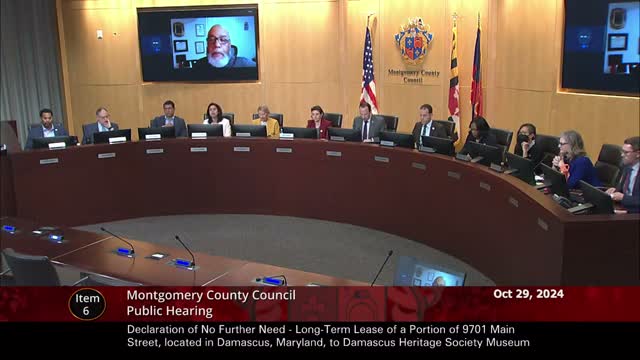
The Montgomery County Council on Oct. 29 adopted the Transportation & Environment Committee’s recommendation to set a 10.2% spending‑control limit for the Washington Suburban Sanitary Commission’s (WSSC) FY26 water rates, after a divided discussion and a failed motion to endorse a 9.5% limit.
Council members said the decision reflects a choice between paying more now to address deteriorating infrastructure or deferring costs and risking larger increases later. Committee presentations noted roughly 1,000,000 meters in the WSSC system, about 470,000 requiring manual, on‑site reads, and an average meter lifespan of about 17 years — roughly in the middle of the industry estimate of 15–20 years. Council members also cited workplace safety for meter readers, lead pipe replacement and capital needs as drivers of the proposed increases.
During debate, Council Vice President Stewart and others described WSSC’s original request as 12.2% and said the committee’s 10.2% recommendation offered predictable, stable increases that protect bond ratings and avoid larger future spikes. Council Member Fontaine Gonzalez moved to support a 9.5% limit to align more closely with Prince George’s County; the motion was seconded but failed in a raised‑hand tally (5 in favor, 6 opposed). After the failed motion, the council voted to support the 10.2% committee recommendation (10 in favor, 1 opposed).
Staff told the council that Prince George’s County met earlier in the day and acted on a 9% figure. Council members said they will continue bicounty negotiations during the next two weeks with the goal of presenting a unified number; the council plans to return in two weeks to either affirm today’s guidance or present a compromise between 9% and 10.2% for final action. Council staff said the November 1 deadline for agreeing on guidance is self‑imposed, not a statutory requirement.
The committee report and members’ remarks repeatedly framed the vote as guidance for WSSC’s rate‑setting process so the agency can develop its operating budget for public comment in January. The council did not take final legislative action on rates at the Oct. 29 meeting; it set a guidance figure and directed staff to continue bicounty discussions before a formal vote.
Council members said the decision reflects a choice between paying more now to address deteriorating infrastructure or deferring costs and risking larger increases later. Committee presentations noted roughly 1,000,000 meters in the WSSC system, about 470,000 requiring manual, on‑site reads, and an average meter lifespan of about 17 years — roughly in the middle of the industry estimate of 15–20 years. Council members also cited workplace safety for meter readers, lead pipe replacement and capital needs as drivers of the proposed increases.
During debate, Council Vice President Stewart and others described WSSC’s original request as 12.2% and said the committee’s 10.2% recommendation offered predictable, stable increases that protect bond ratings and avoid larger future spikes. Council Member Fontaine Gonzalez moved to support a 9.5% limit to align more closely with Prince George’s County; the motion was seconded but failed in a raised‑hand tally (5 in favor, 6 opposed). After the failed motion, the council voted to support the 10.2% committee recommendation (10 in favor, 1 opposed).
Staff told the council that Prince George’s County met earlier in the day and acted on a 9% figure. Council members said they will continue bicounty negotiations during the next two weeks with the goal of presenting a unified number; the council plans to return in two weeks to either affirm today’s guidance or present a compromise between 9% and 10.2% for final action. Council staff said the November 1 deadline for agreeing on guidance is self‑imposed, not a statutory requirement.
The committee report and members’ remarks repeatedly framed the vote as guidance for WSSC’s rate‑setting process so the agency can develop its operating budget for public comment in January. The council did not take final legislative action on rates at the Oct. 29 meeting; it set a guidance figure and directed staff to continue bicounty discussions before a formal vote.
View the Full Meeting & All Its Details
This article offers just a summary. Unlock complete video, transcripts, and insights as a Founder Member.
✓
Watch full, unedited meeting videos
✓
Search every word spoken in unlimited transcripts
✓
AI summaries & real-time alerts (all government levels)
✓
Permanent access to expanding government content
30-day money-back guarantee
