Hendrick Hudson board kicks off 2025–26 budget season, sets preliminary priorities and outreach plan
December 06, 2024 | HENDRICK HUDSON CENTRAL SCHOOL DISTRICT, School Districts, New York
This article was created by AI summarizing key points discussed. AI makes mistakes, so for full details and context, please refer to the video of the full meeting. Please report any errors so we can fix them. Report an error »
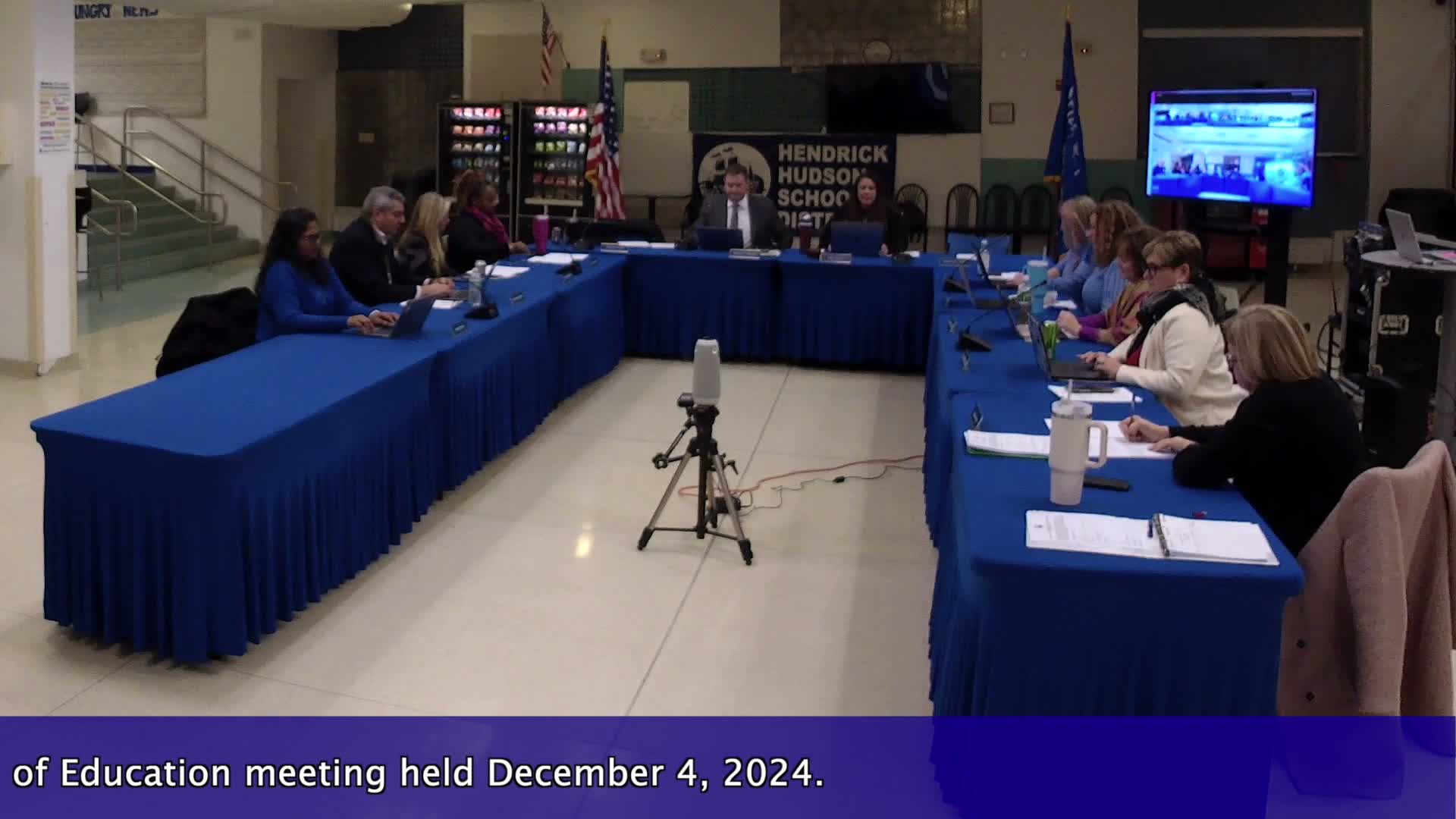
The Hendrick Hudson Central School District Board of Education on Dec. 4 launched the district’s budget development season for 2025–26, outlining early parameters and public‑engagement steps that administrators said will shape the superintendent’s proposed budget.
Superintendent Mr. Trombley opened the discussion by summarizing major state and local inputs: an optional New York State regionalization initiative with an opt‑in decision due by mid‑January and forthcoming state aid projections. “Regional planning is a mechanism for achieving this goal,” he said, describing the state’s guidance for districts considering collaboration. He also told the board the district will post working draft presentations as editable Google links in BoardDocs to provide more timely transparency than static PDFs.
Board members and administrators identified a set of preliminary parameters to guide budget development, which Mr. Trombley said will be refined as more information arrives. The board asked staff to plan around the district remaining within the state tax‑levy cap if feasible, while prioritizing a “responsive instructional program” that meets student needs. Trustees directed administrators to include options for contingent positions that can be activated mid‑year if enrollment or student‑need changes require additional staffing.
Facilities and transportation were singled out as recurring priorities. Trustees asked administrators to look for opportunities to increase funding for buildings and grounds maintenance and to study the feasibility of transitioning the bus fleet to electric vehicles as a longer‑term parameter. Board members acknowledged the tax‑cap and collective‑bargaining implications of such capital changes and asked staff to return cost estimates.
On communications and community input the board approved a pilot rollout of ThoughtExchange, a crowd‑sourcing tool administrators said will allow residents to submit and rate priorities during the budget season. Mr. Trombley noted ThoughtExchange will be shared via the district website and in presentations with QR codes and short links so people watching remotely can participate.
Trustees also debated a mailed newsletter strategy to increase outreach to residents who do not receive digital notices. Staff provided cost estimates: a single budget‑postcard mailing the district used previously cost about $2,217 for printing and postage; a one‑page quarterly mailed newsletter was estimated at roughly $7,000 per year, while a two‑page full‑color option would be materially higher. To limit recurring mailing costs, the board agreed to send a low‑cost postcard inviting residents to opt in for future printed newsletters or to receive digital delivery via ParentSquare or ThoughtExchange.
Administrators flagged several time‑sensitive items that could affect the budget timeline. Mr. Trombley described work the district is doing on Indian Point‑related environmental monitoring and advocacy (see separate item) and reported that the state’s Rockefeller Institute recently released a 314‑page study of the foundation‑aid formula; he said the governor had indicated she did not plan to remove the current hold‑harmless provision in her executive budget. The board was reminded that formal state aid runs and the tax‑cap calculation are expected in January and that a March 15 line‑by‑line budget review will precede a final April 2 adoption meeting and a May 20 public budget vote.
What’s next: administrators will present more detailed departmental budget proposals beginning in January, refine contingent‑staffing scenarios, prepare cost estimates for facilities and transportation options and run the ThoughtExchange prompt to collect resident preferences. The board asked staff to return with a plan for how many mailed newsletters would be needed if the opt‑in test indicates strong demand.
Superintendent Mr. Trombley opened the discussion by summarizing major state and local inputs: an optional New York State regionalization initiative with an opt‑in decision due by mid‑January and forthcoming state aid projections. “Regional planning is a mechanism for achieving this goal,” he said, describing the state’s guidance for districts considering collaboration. He also told the board the district will post working draft presentations as editable Google links in BoardDocs to provide more timely transparency than static PDFs.
Board members and administrators identified a set of preliminary parameters to guide budget development, which Mr. Trombley said will be refined as more information arrives. The board asked staff to plan around the district remaining within the state tax‑levy cap if feasible, while prioritizing a “responsive instructional program” that meets student needs. Trustees directed administrators to include options for contingent positions that can be activated mid‑year if enrollment or student‑need changes require additional staffing.
Facilities and transportation were singled out as recurring priorities. Trustees asked administrators to look for opportunities to increase funding for buildings and grounds maintenance and to study the feasibility of transitioning the bus fleet to electric vehicles as a longer‑term parameter. Board members acknowledged the tax‑cap and collective‑bargaining implications of such capital changes and asked staff to return cost estimates.
On communications and community input the board approved a pilot rollout of ThoughtExchange, a crowd‑sourcing tool administrators said will allow residents to submit and rate priorities during the budget season. Mr. Trombley noted ThoughtExchange will be shared via the district website and in presentations with QR codes and short links so people watching remotely can participate.
Trustees also debated a mailed newsletter strategy to increase outreach to residents who do not receive digital notices. Staff provided cost estimates: a single budget‑postcard mailing the district used previously cost about $2,217 for printing and postage; a one‑page quarterly mailed newsletter was estimated at roughly $7,000 per year, while a two‑page full‑color option would be materially higher. To limit recurring mailing costs, the board agreed to send a low‑cost postcard inviting residents to opt in for future printed newsletters or to receive digital delivery via ParentSquare or ThoughtExchange.
Administrators flagged several time‑sensitive items that could affect the budget timeline. Mr. Trombley described work the district is doing on Indian Point‑related environmental monitoring and advocacy (see separate item) and reported that the state’s Rockefeller Institute recently released a 314‑page study of the foundation‑aid formula; he said the governor had indicated she did not plan to remove the current hold‑harmless provision in her executive budget. The board was reminded that formal state aid runs and the tax‑cap calculation are expected in January and that a March 15 line‑by‑line budget review will precede a final April 2 adoption meeting and a May 20 public budget vote.
What’s next: administrators will present more detailed departmental budget proposals beginning in January, refine contingent‑staffing scenarios, prepare cost estimates for facilities and transportation options and run the ThoughtExchange prompt to collect resident preferences. The board asked staff to return with a plan for how many mailed newsletters would be needed if the opt‑in test indicates strong demand.
View the Full Meeting & All Its Details
This article offers just a summary. Unlock complete video, transcripts, and insights as a Founder Member.
✓
Watch full, unedited meeting videos
✓
Search every word spoken in unlimited transcripts
✓
AI summaries & real-time alerts (all government levels)
✓
Permanent access to expanding government content
30-day money-back guarantee
